
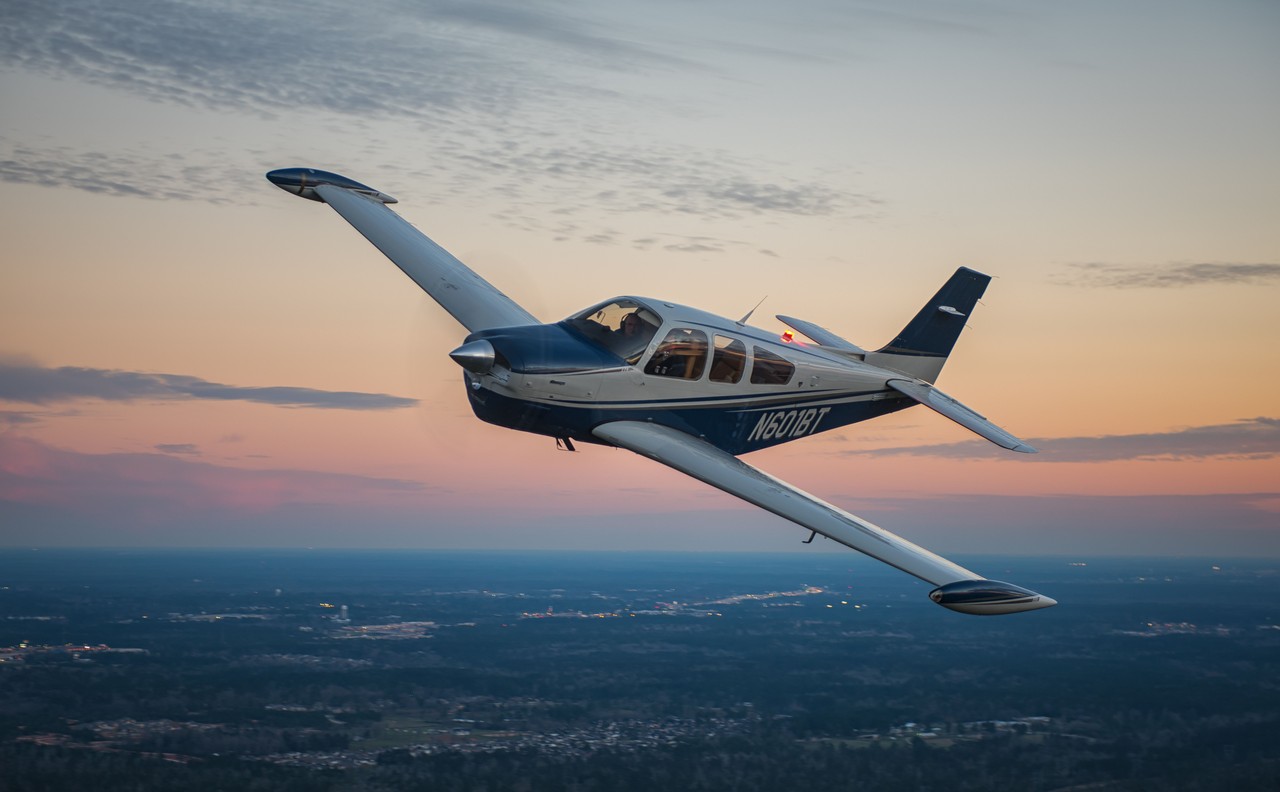
Market Domination and Service History
Despite its aggressive initial pricing of $19,965 in 1960, the Debonair faced stiff competition in its first year, with only 233 units sold compared to over 800 Piper Comanche 250s. However, the aircraft's superior build quality and performance characteristics gradually won over buyers. By 1968, Beechcraft acknowledged what the market already knew—the Debonair was essentially a Bonanza with a conventional tail—and officially renamed the line to Bonanza.
The F33A variant, introduced in 1970, became the most successful iteration with nearly 1,800 aircraft built over 25 years. Starting at just under $50,000 in 1970, prices had climbed to over $325,000 by the mid-1990s, reflecting both inflation and continuous improvements. The aircraft served primarily business executives and affluent private pilots who demanded the performance of a Bonanza without the V-tail's maintenance concerns.
The Manufacturer
Beech Aircraft Corporation, founded by Walter and Olive Ann Beech in 1932, had established itself as the premium manufacturer in general aviation by the time the 33 series launched. The company's reputation for building robust, high-performance aircraft made the Bonanza name synonymous with quality. Beechcraft underwent several ownership changes during the 33's production run, including acquisition by Raytheon in 1980, but maintained its engineering excellence throughout.
The Wichita, Kansas facility where the 33 series was built had been producing aircraft for over 50 years by the program's end. Today, the company continues operations under Textron Aviation, still manufacturing aircraft including the modern Bonanza G36.
Engine and Technical Innovation
The 33 series utilized Continental's proven IO-470 and IO-520 inline piston engines throughout its production run. The original 33 Debonair featured the 225-horsepower Continental IO-470-J, while later variants like the C33A and F33A stepped up to the 285-horsepower IO-520-B. The G33, produced only in 1972-1973, used the unique 260-horsepower IO-470-N engine in just 49 aircraft.
Continental Motors' inline engines provided excellent power-to-weight ratios and smooth operation. The IO-520-B became particularly popular among pilots for its reliability and performance characteristics. These fuel-injected engines eliminated the carburetor icing concerns of earlier designs while providing consistent power delivery across varying altitudes and temperatures.
The aircraft's gross weight progressively increased from 2,900 pounds in the original 33 to 3,300 pounds in later models, reflecting structural improvements and market demands for greater payload capacity.
Pilot Perspective and Performance
Pilots praised the 33 series for combining Bonanza performance with conventional tail reliability. The straight tail eliminated the V-tail Bonanza's reputation for in-flight breakups, while maintaining excellent handling characteristics and speed. The aircraft's low-wing design provided inherent stability and efficient cruise performance.
The Continental engines delivered cruise speeds competitive with other high-performance singles, while the robust Beechcraft construction inspired confidence in weather flying. The progressive improvement in cabin comfort, from the spartan early Debonairs to the well-appointed later Bonanzas, reflected evolving customer expectations in the personal aircraft market.
Production Evolution and Variants
The 33's production history reveals Beechcraft's methodical approach to product development. Each annual model incorporated incremental improvements: the A33 added extra windows and increased gross weight, the B33 introduced a new instrument panel, and the C33 featured enlarged rear windows and further weight increases.
The transition from Debonair to Bonanza branding in 1968 eliminated market confusion and leveraged the established Bonanza reputation. The E33 and E33A models bridged this transition, with only 201 total examples built across both variants. The F33A's 25-year production run from 1970 to 1995 demonstrated the design's maturity and market acceptance.
Specialty variants included the aerobatic F33C, with 23 examples built including 21 for the Mexican Air Force. This longer-fuselage variant proved the airframe's versatility beyond standard general aviation roles.
Legacy and Current Status
With 3,350 aircraft produced over 36 years, the 33 series ranks among general aviation's most successful designs. The aircraft's longevity stemmed from Beechcraft's commitment to continuous improvement rather than radical redesign. Many examples remain active in private hands today, testament to their durable construction and enduring appeal.
The 33 series proved that conventional design could compete with innovative configurations like the V-tail, prioritizing practicality over novelty. This philosophy influenced subsequent Beechcraft designs and demonstrated the importance of pilot confidence in aircraft certification and operation.