
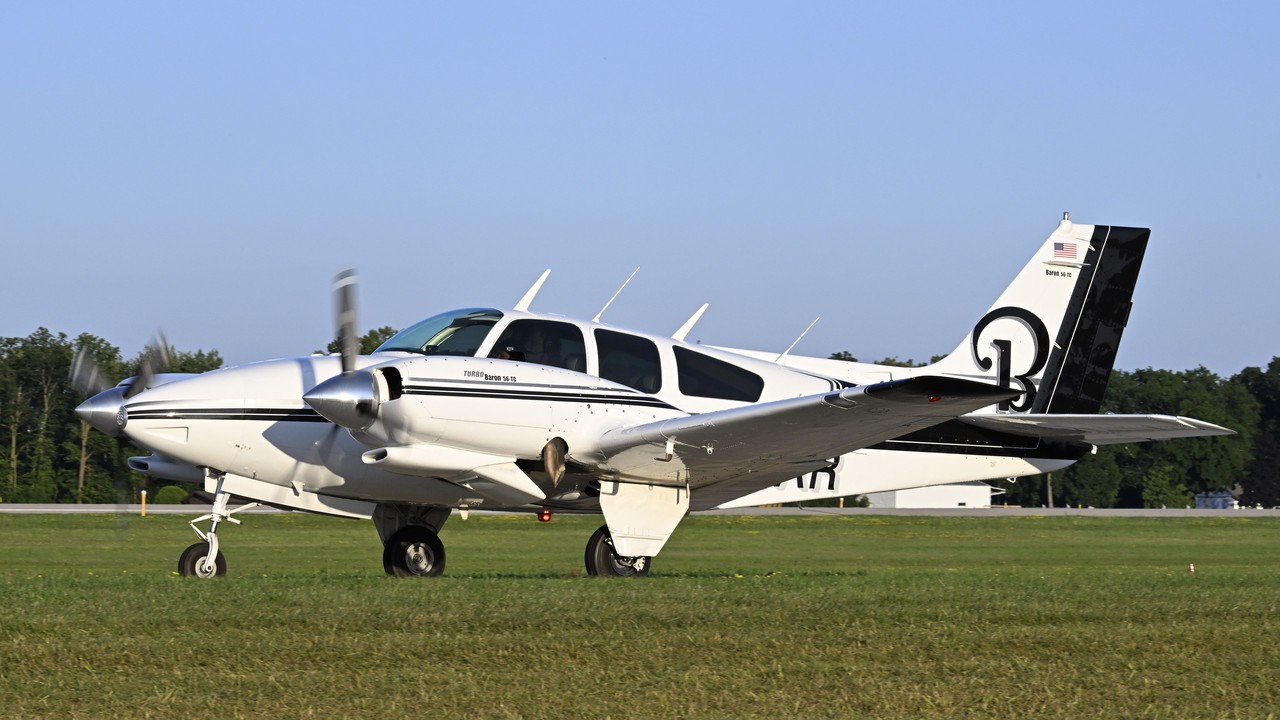
A Short-Lived Performance Pioneer
The Beech 56 Turbo Baron emerged during aviation's transitional period of the late 1960s, when manufacturers sought to extract maximum performance from piston engines before turboprops dominated the high-end twin market. With only 82 to 94 aircraft produced across its brief four-year production run, the 56TC became one of aviation's rarest production twins, yet its technological contributions far exceeded its limited numbers.
Development and Design Innovation
Beechcraft's engineering team built the 56TC upon the proven Model 55 Baron airframe, transforming it into a high-altitude performer through aggressive turbocharging technology. The prototype, bearing construction number TG-1, took to the skies on May 25, 1966, with company test pilot Bob Hagan at the controls. The aircraft's design objectives centered on bridging the performance gap between conventional light twins and the emerging King Air turboprops, achieving speeds and altitudes previously reserved for much larger aircraft.
The 56TC incorporated several advanced systems that would later appear on the Model 60 Duke, including comprehensive de-icing equipment for wings, empennage, and propellers. This technology transfer made the brief Turbo Baron program a valuable testbed for Beechcraft's future pressurized aircraft development.
Powerplant Performance
At the heart of the 56TC's impressive performance lay two Lycoming TIO-541-E1B4 engines, each producing 380 horsepower at 2,900 RPM and 41.5 inches of manifold pressure. These turbocharged, fuel-injected, six-cylinder powerplants represented the pinnacle of piston engine technology, enabling the aircraft to achieve cruise speeds of 247 knots indicated airspeed while maintaining single-engine service ceilings between 18,600 and 23,000 feet.
The engines' 1,600-hour overhaul intervals and substantial fuel consumption of 41.2 gallons per hour reflected the performance-first philosophy that defined the aircraft. Lycoming's TIO-541 series, manufactured by what is now part of Textron Aviation, powered only the most exclusive high-performance aircraft of its era, including select Baron variants and the Duke.
The Manufacturer's Vision
Beech Aircraft Corporation, founded by Walter H. Beech in 1932, had established itself as the premier manufacturer of high-performance general aviation aircraft through models like the Bonanza and standard Baron series. The company's post-World War II expansion into twin-engine aircraft positioned it in direct competition with Cessna and Piper for the growing business aviation market.
The 56TC represented Beechcraft's attempt to own the absolute top tier of the piston twin market, offering performance that approached light turboprops at a fraction of the acquisition cost. However, the aircraft's complexity and fuel consumption challenged even experienced pilots, limiting its appeal to a narrow market segment.
Production Reality
Manufacturing at Beechcraft's Wichita, Kansas facility began in 1967 with approximately 50 aircraft delivered, representing the program's peak production year. Subsequent deliveries declined sharply: 20 in 1968, 12 in 1969, nine improved A56TC models in 1970, and just two final aircraft in 1971. This production pattern reflected both the aircraft's specialized nature and the market's growing preference for turbine power.
The 56TC's brief production run coincided with the February 1968 certification of the Model 60 Duke, which offered pressurization and greater cabin volume using similar engine technology. The Duke's eventual production of over 500 units through 1982 validated the turbo-piston concept while highlighting the 56TC's role as a developmental stepping stone.
Operational Characteristics
Pilots found the 56TC demanding but rewarding, with its 247-knot cruise speed placing it among the fastest piston twins ever certified. The aircraft's 737-nautical-mile range and 5,990-pound maximum gross weight enabled serious cross-country travel, while its compact dimensions—37 feet 8 inches wingspan and 28 feet length—allowed operation from shorter runways than competing aircraft.
The turbo Baron's single-engine performance capabilities, with service ceilings reaching 23,000 feet on one engine, provided safety margins unavailable in naturally aspirated twins. However, the aircraft's complexity required pilot proficiency in turbocharged engine management and high-altitude operations.
Legacy and Current Status
The 56 Turbo Baron's significance extends far beyond its modest production numbers, serving as a crucial technology demonstrator that informed Beechcraft's subsequent pressurized aircraft development. Its innovations in turbocharging, de-icing systems, and high-altitude fuel management directly influenced the successful Duke program and established engineering principles that guided the company's future designs.
Today, the surviving 56TC aircraft represent some of aviation's rarest production twins, prized by collectors and enthusiasts for their historical significance and exceptional performance capabilities. While exact airworthiness numbers remain unknown, the type's rarity and technological importance ensure its place in aviation history as the ultimate expression of piston twin performance.
Beechcraft itself evolved through multiple ownership changes, becoming part of Raytheon in 1980, then Hawker Beechcraft in 2006, and finally Textron Aviation in 2014, where the brand continues today. The brief but influential 56 Turbo Baron program exemplifies the innovation and risk-taking that established Beechcraft's reputation for producing aviation's most capable and sophisticated aircraft.