
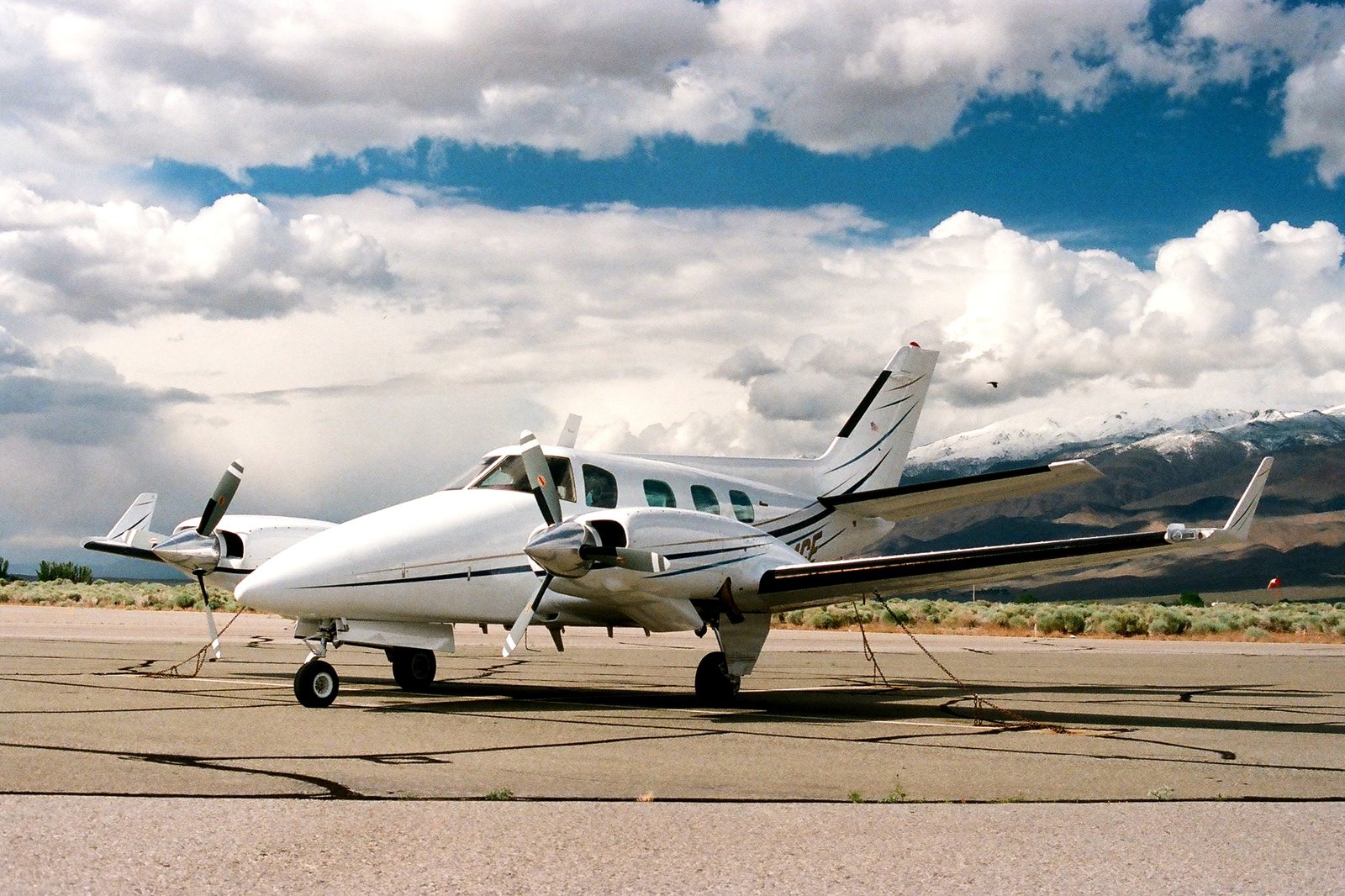
The Executive's High-Performance Twin
The Duke emerged during the golden age of general aviation when businesses demanded sophisticated aircraft capable of flying above weather while maintaining reasonable operating costs. Beechcraft positioned the Duke to fill a crucial gap between unpressurized twins like the Baron and larger turboprop aircraft like the King Air, creating what the company marketed as the lowest-priced IFR-equipped pressurized twin on the market.
Receiving FAA certification in February 1968, the first customer delivery occurred in August of that year. The Duke competed directly with Cessna's 414 and 421 series and Piper's pressurized Navajo variants, but distinguished itself through superior performance and build quality that reflected Beechcraft's reputation for precision manufacturing.
Evolution Through Three Models
Production spanned three distinct variants over 15 years. The original Model 60, produced from 1968 to 1969, established the baseline with twin 380-horsepower Lycoming TIO-541-E1A4 engines and a 202-gallon fuel capacity. Approximately 126 of these initial aircraft were delivered before improvements necessitated the A60 variant.
The A60, introduced in March 1970 beginning with serial number P-127, incorporated significant enhancements including an increased gross weight from 6,725 to 6,775 pounds, lighter turbochargers for improved performance, upgraded pressurization systems, and refined interior appointments. About 120 A60 models were produced through 1973, bringing total early production to approximately 246 aircraft.
The final and most numerous variant, the B60, debuted in October 1973 at serial number P-247. This model featured the most comprehensive improvements, including more efficient turbochargers, adjusted cabin dimensions for enhanced comfort, and upgraded TIO-541-E1C4 engines. In 1976, fuel capacity increased to 232 gallons and engine time between overhauls extended to 1,600 hours. The B60 accounted for approximately 350 units, making it the most common Duke variant encountered today.
Beechcraft's Manufacturing Excellence
Beech Aircraft Corporation, founded in 1932 by Walter H. Beech and Olive Ann Beech, applied innovative manufacturing techniques to Duke construction. The aircraft incorporated advanced processes including skin bonding, honeycomb panels, chemical milling, and magnesium empennage components. These techniques, cutting-edge for general aviation in the late 1960s, contributed to the Duke's structural integrity and relatively light weight despite its pressurization requirements.
The company operated independently until Raytheon's acquisition in 1980, subsequently becoming Raytheon Aircraft. Following later ownership changes through Hawker Beechcraft in 2006, the Beechcraft name continues today under Textron Aviation's umbrella, though Duke production ceased permanently in 1983.
Power and Performance
The Duke's twin Lycoming TIO-541 engines provided exceptional performance for their era. These six-cylinder, fuel-injected, turbocharged powerplants delivered 380 horsepower each, enabling cruise speeds superior to competing aircraft. The engines' complexity, however, proved to be both the Duke's greatest asset and its primary weakness. While they provided impressive performance and the ability to maintain power at altitude, they required meticulous maintenance and carried higher operating costs than simpler naturally aspirated engines.
Continuous improvements addressed reliability concerns. The A60 introduced lighter turbochargers, while the B60 featured more efficient exhaust ducting beginning with aircraft P-144. In 1975, longer exhaust stacks were implemented to combat corrosion issues. The 1976 extension of time between overhauls to 1,600 hours represented significant progress in engine reliability.
Pilot Perspective and Handling
Pilots appreciated the Duke's sophisticated systems and impressive performance capabilities, though the aircraft demanded respect and proper training. The pressurized cabin allowed comfortable flight at altitudes where weather and turbulence were minimal, while the turbocharged engines maintained power output well above the service ceiling of naturally aspirated competitors.
The Duke's Baron-derived landing gear and control systems provided familiar handling characteristics for pilots transitioning from other Beechcraft aircraft. However, the complexity of managing pressurization systems and turbocharged engines required additional training compared to simpler twins.
Legacy and Current Status
With only 596 aircraft produced across all variants, the Duke remains relatively rare in today's general aviation fleet. Dozens continue flying, prized by owners who value their performance despite higher maintenance costs compared to simpler aircraft. The Duke's exclusivity, combined with its sophisticated systems and impressive capabilities, maintains strong appeal among pilots seeking high-performance pressurized twins.
The Duke's significance extends beyond its production numbers. It represented Beechcraft's successful attempt to democratize pressurized flight, bringing high-altitude capabilities to a broader segment of business aviation. While its complexity ultimately limited mass adoption, the Duke established important precedents for integrating advanced systems into general aviation aircraft and demonstrated the viability of sophisticated piston twins in the business market.