
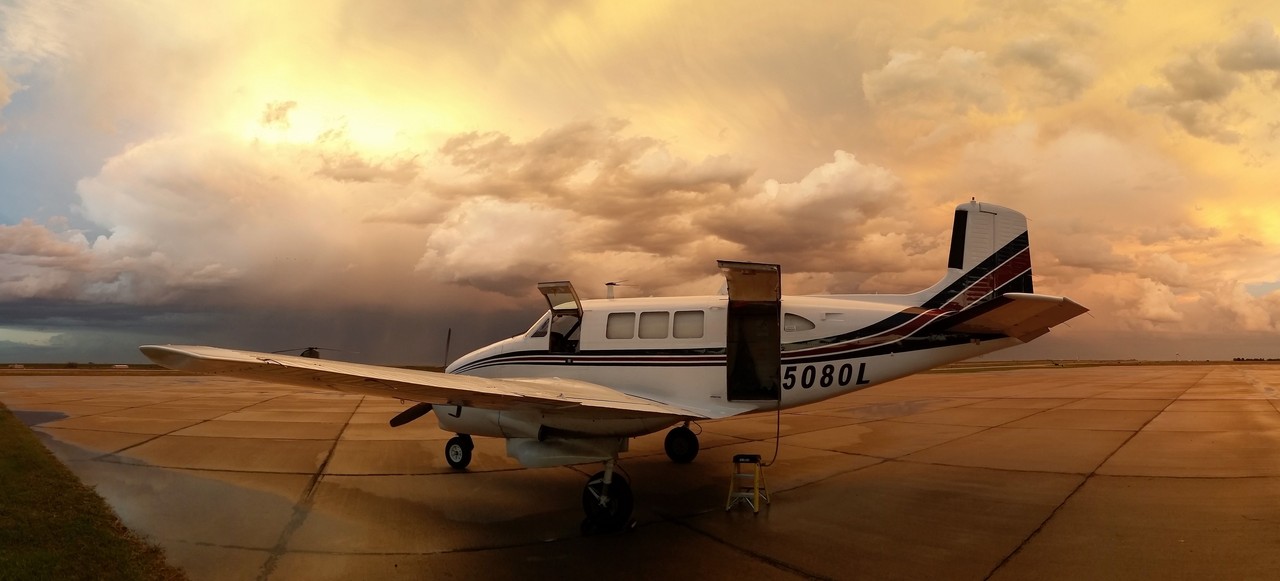
Service History
The Queen Air found its niche in corporate aviation, small commuter airlines, and utility operations where its spacious cabin and reliable performance made it invaluable. With seating for seven to nine occupants, the aircraft provided significantly more passenger capacity than earlier twin-engine aircraft while maintaining excellent short-field performance capabilities. Airlines like Indonesia's SAATAS-Eastindo PT operated Queen Airs on regional routes, where the aircraft's ability to carry substantial payloads from shorter airstrips proved economical for smaller operators.
The aircraft's versatility extended beyond passenger service, with many operators utilizing its generous cargo capacity and useful loads exceeding 3,000 pounds for freight and utility missions. Private owners appreciated the Queen Air's combination of performance and comfort, making it a popular choice for corporate transportation during the 1960s and 1970s.
Military Service
While primarily designed for civilian use, the Queen Air saw limited military adoption. The U.S. Army ordered 68 aircraft designated L-23F in 1958, utilizing them for utility transport missions. These military variants, derived from the earlier Twin Bonanza L-23 Seminole program, served alongside later U-8 variants during the Vietnam era for reconnaissance and utility operations.
The military Queen Airs performed essential support roles rather than combat missions, providing reliable transportation and liaison services. Their ability to operate from rough airstrips made them valuable assets for military commanders requiring dependable twin-engine aircraft for personnel and light cargo transport.
The Manufacturer
Beech Aircraft Corporation, founded in 1932 by Walter H. Beech and Olive Ann Beech, had established itself as a premier manufacturer of light aircraft by the time the Queen Air entered development. The company's innovative designs, including the Model 17 Staggerwing in 1934 and the revolutionary Bonanza in 1947, had earned Beechcraft a reputation for building high-quality, all-metal aircraft that set industry standards.
Operating independently until 1980, Beechcraft helped establish Wichita as the "Aviation Capital of the World." The company merged with Raytheon Company in 1980, which later sold the aviation division to Goldman Sachs in 2007. Textron acquired the company in 2014, continuing operations under the Textron Aviation banner while maintaining the respected Beechcraft brand.
Engine and Technical Innovation
The Queen Air's early models utilized two Lycoming IGSO-480 engines, each producing 340 horsepower from supercharged, geared, six-cylinder horizontally opposed configurations. These powerplants, manufactured by Lycoming's Williamsport, Pennsylvania facility, provided the reliability and performance necessary for the aircraft's intended roles. Later B80 variants upgraded to more powerful Lycoming IGSO-540 engines producing between 360 and 380 horsepower.
Beechcraft's engineering team designed the Queen Air by adapting the proven wings, engines, and tail surfaces from the successful Twin Bonanza while incorporating a significantly larger fuselage. The aircraft featured retractable tricycle landing gear and a low-wing cantilever design that optimized both performance and cabin space. Notable innovations included the swept tail design introduced on the A65 variant in 1967 and extended wings on the Model 70 and B80 versions.
Performance and Records
The Queen Air demonstrated impressive high-altitude capabilities, setting an altitude record of 34,862 feet on February 8, 1960. This achievement showcased the effectiveness of the supercharged Lycoming engines and the aircraft's aerodynamic design. With gross weights ranging from 8,200 pounds on early models to 8,800 pounds on the B80, the Queen Air provided substantial payload capacity while maintaining reasonable operating costs.
Fuel capacity reached 264 U.S. gallons on later variants, providing excellent range for its class. The aircraft's performance characteristics made it particularly suitable for operations requiring reliable twin-engine capability with single-pilot operation, though many operators chose to fly with two crew members for enhanced safety and workload distribution.
Production Legacy
Beechcraft manufactured 1,005 Queen Airs between 1960 and 1978 across multiple variants. Production included 411 Model 65/A65 aircraft (including military versions), 35 Model 70s, 511 Models 80/A80/B80s, one experimental Model 85D, and 47 pressurized Model 88s. The Model 88, introduced in 1965, featured cabin pressurization and directly led to the development of the King Air turboprop series.
The Queen Air's most significant legacy lies in its role as the foundation for Beechcraft's King Air family. The first turboprop conversion flew in 1963, with deliveries beginning in 1964. This evolution proved so successful that King Air production continued well beyond the Queen Air's 1978 production end, with the line remaining active today as one of the most successful business aircraft families ever created.
Dozens of Queen Airs remain airworthy today, testament to their robust construction and enduring utility. The National Air and Space Museum recognizes the aircraft's historical significance by displaying a Beechcraft King Air 65-90, a direct descendant of the Queen Air program, highlighting the aircraft's role in advancing executive aviation technology.