
Market Innovation and Development
When the Travel Air prototype took to the skies in January 1953, aviation observers noted that "there was nothing else like it in the skies." Beechcraft had identified a lucrative market niche between their successful single-engine Model 35 Bonanza and the much larger D-50 Twin Bonanza. The company's engineering team spent three years refining the design before production began, achieving CAA certification in March 1954, just three months after the competing Piper Apache received its approval.
Production Success and Challenges
Beechcraft launched Travel Air production in 1958 with remarkable initial success, delivering 173 aircraft in the first year alone. The following year saw 128 additional deliveries, establishing the Travel Air as a serious contender in the light twin market. However, competition intensified quickly with the Cessna 310's introduction in April 1954, forcing Beechcraft to continuously innovate throughout the Travel Air's decade-long production run.
Total production reached 720 aircraft across five distinct variants before ending in 1968. The breakdown revealed the market's evolution: 301 original Model 95s (1958-1959), 150 Model B95s (1960), 81 Model B95As (1961-1962), 174 Model D95As (1963-1967), and just 14 final Model E95s in 1968.
Technical Evolution
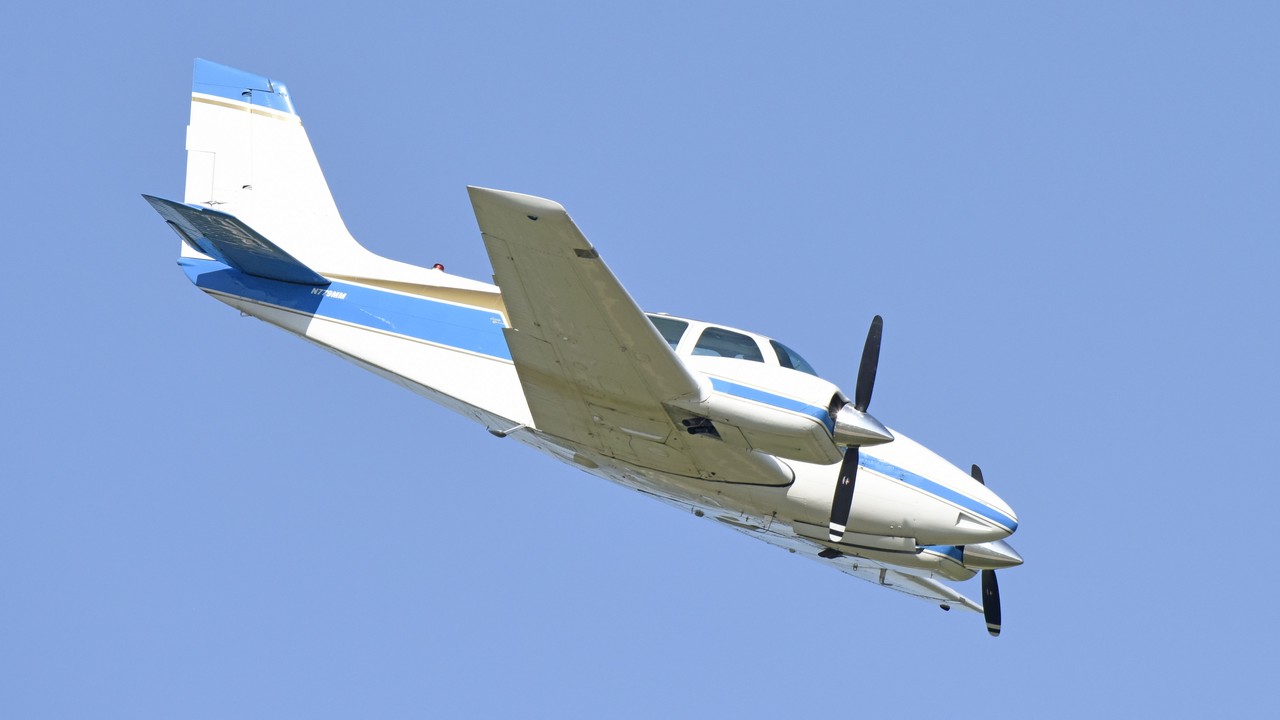
The Travel Air underwent substantial refinement throughout its production life. The original Model 95 featured two carbureted Lycoming O-360-A1A engines producing 180 horsepower each, driving two-blade constant-speed propellers. The cabin, sharing large windows with the G35 Bonanza, initially accommodated four passengers in a space measuring 6 feet 11 inches in length.
Significant improvements arrived with the 1960 Model B95, which added 100 pounds to the maximum takeoff weight, bringing it to 4,100 pounds, and offered an optional fifth seat. The cabin was stretched 19 inches, dramatically improving passenger comfort and baggage capacity.
The 1961 Model B95A introduced fuel-injected Lycoming IO-360-B1A engines, boosting maximum speed to 210 mph while improving fuel efficiency. This variant accommodated up to six passengers and featured another 100-pound gross weight increase, along with a larger rear window for improved visibility.
Design Refinements
Beechcraft's commitment to continuous improvement showed clearly in the 1963 Model D95A, which incorporated the larger curved third cabin window design borrowed from the Bonanza line. Engineers enlarged the forward baggage compartment to 19 cubic feet and redesigned the nose section with more aerodynamic tapering. Perhaps most significantly, this variant featured improved engines with larger half-inch valves that extended Time Between Overhauls from 1,200 to 2,000 hours, substantially reducing operating costs.
The 1966 D95A models introduced a one-piece windshield, while the final 1968 Model E95 featured a completely redesigned "speed-slope" windshield, fully updated interior appointments, and a more pointed spinner design that enhanced the aircraft's already sleek appearance.
Performance Characteristics
Pilots appreciated the Travel Air's combination of twin-engine safety with relatively economical operation. The aircraft delivered a useful load of 1,465 pounds in the B95 configuration, making it practical for both business travel and family transportation. With fuel-injected engines, the Travel Air achieved its maximum speed of 210 mph, offering performance competitive with larger, more expensive twins.
The twin Lycoming powerplants provided redundancy crucial for instrument flying and overwater operations, while the constant-speed, full-feathering propellers allowed safe single-engine operation when necessary. This capability made the Travel Air particularly attractive to pilots transitioning from high-performance singles who wanted twin-engine security without the complexity of larger aircraft.
Market Position and Legacy
Despite its technical merits, the Travel Air faced increasing pressure from Beechcraft's own product line. The company's introduction of the larger, faster Model 55 Baron, which evolved directly from Travel Air engineering, began cannibalizing sales by the mid-1960s. The Baron offered superior performance and more spacious accommodations, making the Travel Air's market position increasingly difficult to defend.
By 1968, Baron sales had decisively overtaken the Travel Air, leading Beechcraft to terminate production after building the final aircraft, serial number TD-721. The Travel Air had successfully served its purpose, providing Beechcraft with valuable light twin experience while generating steady profits for a full decade.
Beech Aircraft Corporation
Beech Aircraft Corporation, founded by Walter and Olive Ann Beech, established itself as a premium manufacturer in the general aviation market. The company's reputation for quality construction and innovative design made the Beechcraft name synonymous with excellence among pilots and aircraft owners. Originally designating the Model 95 as the "Badger," the company wisely dropped this name to avoid confusion with the Soviet Tupolev TU-16 bomber of the same nickname.
The Travel Air represented Beechcraft's successful entry into the competitive light twin market, demonstrating the company's ability to identify market opportunities and deliver aircraft that met specific operational requirements. While production numbers remained modest compared to competitors like the Cessna 310, the Travel Air established engineering principles and manufacturing expertise that directly contributed to the Baron's later success.