
Service History
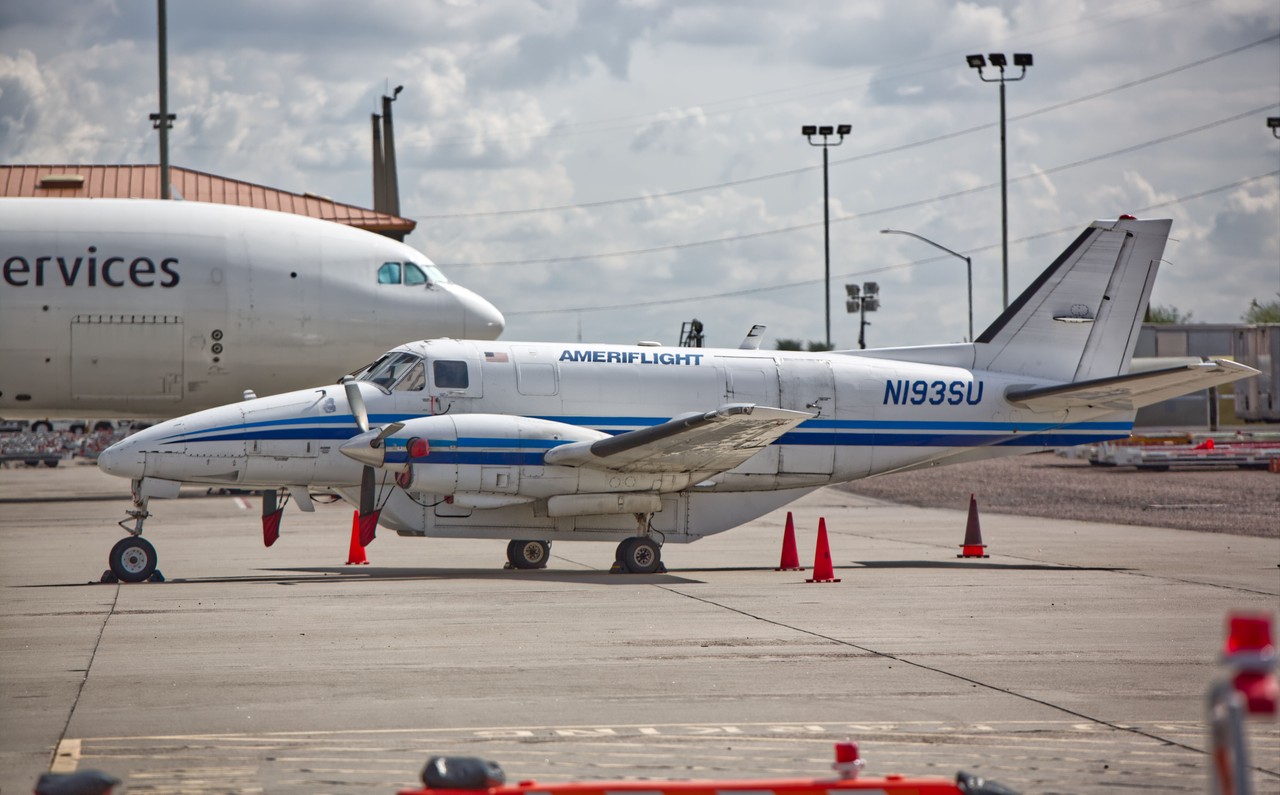
The Beech 99 dominated the emerging commuter airline market during the 1970s and 1980s, filling a critical gap between small aircraft and larger regional jets. Fleet operations peaked at 147 aircraft in service simultaneously in both 1984 and 1986, representing a substantial portion of the turboprop commuter market. By the mid-1980s, the aircraft had proven so reliable that nearly half of all operating Beech 99s transitioned from passenger service to cargo operations, with Ameriflight of Dallas and Wiggins Airways of Manchester, New Hampshire, becoming the largest operators of freighter conversions.
The Manufacturer
Beech Aircraft Corporation, founded by Walter and Olive Ann Beech in 1932, developed the Model 99 as part of their expansion into commercial aviation markets. The company had established itself through successful general aviation aircraft like the Bonanza and twin-engine designs including the Model 18. Beech operated independently until acquired by Raytheon in 1980, later becoming part of Hawker Beechcraft, and ultimately joining Textron Aviation in 2014. The manufacturer's Wichita facility produced all 239 Model 99 aircraft at Beech Factory Airport between 1968 and early 1987.
Design Development
Engineers at Beech created the Model 99 by combining proven components from existing aircraft in their lineup during the mid-1960s. The design utilized wings from the Queen Air, engines and nacelles from the King Air, and subsystems from both aircraft, paired with a newly designed nose section optimized for airline operations. This approach allowed Beech to achieve type certification on May 2, 1968, delivering 62 aircraft by year's end. The aircraft replaced the aging piston-powered Model 18 in Beech's commercial lineup, offering modern turboprop reliability and performance.
Engine & Technical Specifications
Pratt & Whitney Canada PT6A turboprops powered all Model 99 variants, with engine ratings increasing throughout the production run. The original 99 Airliner featured PT6A-20 engines rated at 550 shaft horsepower each, while the 99A introduced PT6A-27 engines maintaining the same power rating. The B99 Airliner received PT6A-27/28 engines producing 680 horsepower each, and the final C99 Commuter variant utilized PT6A-36 engines flat-rated at 715 horsepower. All engines drove four-bladed Hartzell constant-speed feathering and reversible propellers, providing excellent ground handling characteristics.
Performance Characteristics
Pilots appreciated the Model 99's straightforward handling and reliable performance across varied operating conditions. The aircraft achieved a maximum cruise speed of 286 knots at altitude, with a service ceiling of 26,313 feet and initial climb rate of 2,090 feet per minute. Short-field performance proved exceptional for commuter operations, requiring only 2,480 feet for takeoff over a 50-foot obstacle and 1,810 feet for landing distance. With a range of 1,035 miles, the aircraft could serve most regional route structures without refueling stops.
Production Variants
Beech manufactured the Model 99 in six distinct configurations across two production periods. The original series included the 99 Airliner, 99 Executive, and 99A Airliner, with 164 aircraft completed through 1975. Production resumed in 1981 with the B99 Airliner, B99 Executive, and C99 Commuter variants, adding 75 aircraft through 1986. Each successive variant incorporated improvements in engine power, avionics, and interior configurations, with maximum takeoff weights ranging from 10,400 to 11,300 pounds depending on the specific model.
Legacy and Current Operations
The Beech 99's significance extends beyond its passenger service contributions to include its role in establishing overnight cargo networks across North America. Alaska-based operators continue utilizing substantial fleets for freight operations in challenging weather conditions, demonstrating the aircraft's durability and reliability. The Model 99's success directly influenced development of the pressurized Beechcraft 1900, introduced in 1984 as its 19-passenger successor. As of recent surveys, 114 Model 99 aircraft remained active in United States operations, with many examples accumulating over 30,000 flight hours while maintaining their structural integrity and operational reliability.