
Service History
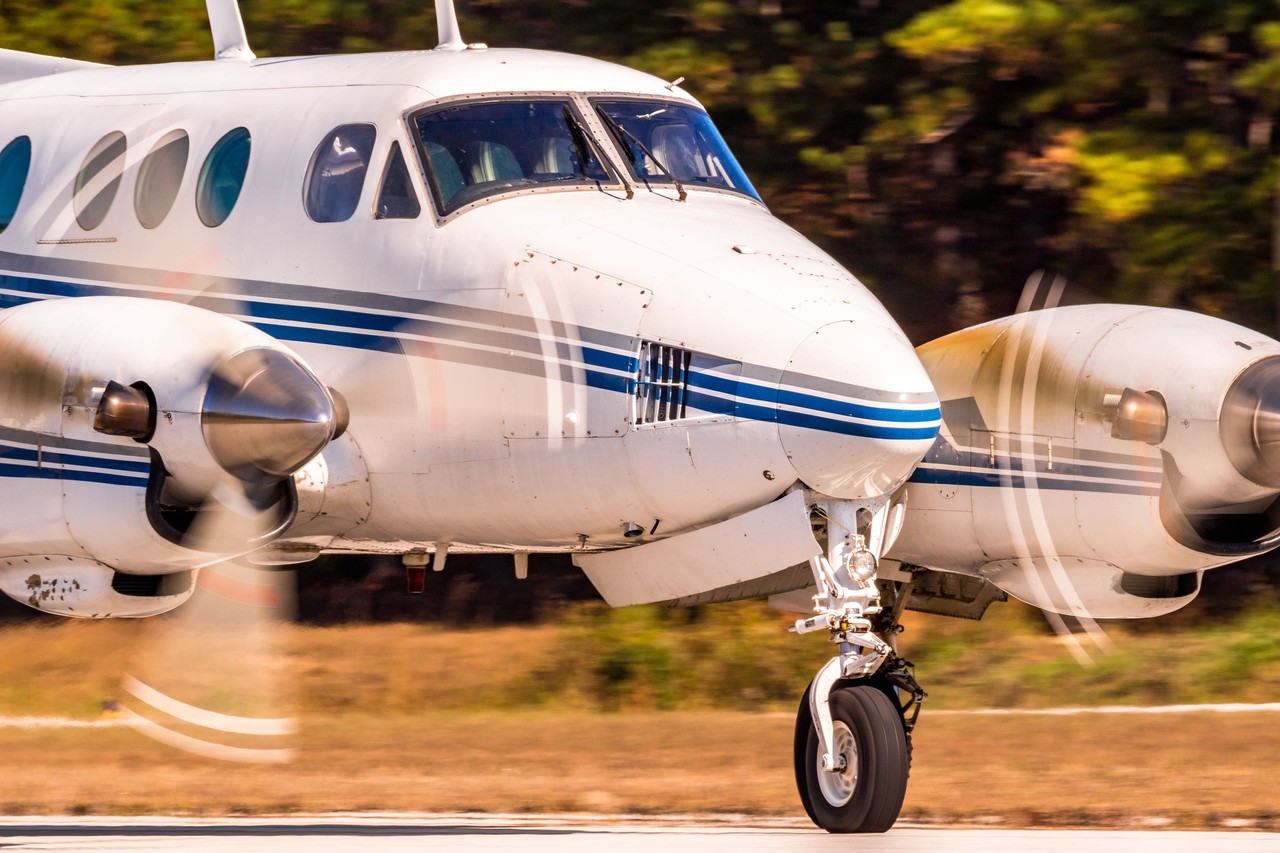
The King Air 90 series dominated corporate aviation from its introduction, with Beechcraft receiving 152 orders worth $10.8 million within just 90 days of its July 14, 1964 announcement. By 1968, the company had delivered 400 aircraft, and the type quickly outsold all competing twin-turboprops combined. The aircraft's ability to cruise above weather at 31,000 feet while operating from short airfields made it indispensable for business travelers who needed jet-like performance without jet-sized runways.
Military Service
While primarily designed for civilian use, the King Air 90 found its way into military service under various designations. The U.S. Army adopted the type as the U-21, using it for utility transport, reconnaissance, and training missions. The prototype Model 87, which served as the proof-of-concept aircraft beginning test flights on May 15, 1963, was delivered to the U.S. Army in 1964 as the NU-8F. However, the aircraft saw no direct combat roles in major conflicts, serving instead in peacetime utility functions.
The Manufacturer
Beech Aircraft Corporation was founded in 1932 by Walter H. Beech and Olive Ann Beech, establishing itself as a premier builder of high-quality general aviation aircraft. The company operated independently until 1980, when Raytheon acquired it, taking over King Air production. Raytheon merged the operations in 1984, and after a bankruptcy period, the Beechcraft name was revived under Hawker Beechcraft in 2007. Textron Aviation acquired the company in 2014 and continues King Air production today, maintaining the legacy that began over 90 years ago.
Engine & Technical Innovation
The King Air 90's success stemmed from its marriage of Pratt & Whitney Canada's revolutionary PT6A turboprop engines to a modified Queen Air airframe. Initial models used the PT6A-6 producing 500 shaft horsepower, later upgraded to the PT6A-20 and PT6A-20A generating 550 horsepower in the A90 and C90 variants. The PT6A engine, which began production in 1963 and continues today with more than 55,000 units produced, offered exceptional reliability with time between overhauls reaching 3,600 hours. Its free-turbine design provided smooth operation and reverse thrust capability, while flat-rating maintained power output at high altitudes.
Pilot Perspective
Pilots praised the King Air 90 for its forgiving flight characteristics and impressive performance envelope. The aircraft could climb at 2,500 feet per minute and cruise at 270 mph while maintaining cabin pressurization equivalent to 8,000 feet when flying at its 31,000-foot service ceiling. Its short-field performance allowed operations from 3,000-foot runways, opening destinations unavailable to larger aircraft. The cockpit accommodated one or two crew members, with many owner-operators choosing to fly single-pilot after appropriate training and certification.
Production Evolution
Beechcraft produced the King Air 90 series in multiple variants over four decades, with production numbers reflecting its market success. The initial Model 65-90 saw 112 aircraft built between 1964-1966, followed by 206 Model 65-A90s (1966-1968), 184 Model B90s (1968-1970), and 507 Model C90s (1971-1982). The military-focused Model E90 reached 347 units by 1982, while specialized variants included 203 Model F90s (1979-1983) and 235 Model C90As through 1992. The final production run of C90B and C90SE models totaled 456 aircraft from 1992 to 2005, bringing the 90-series total to more than 2,300 aircraft.
Legacy and Current Status
The King Air 90 established the template for modern turboprop business aircraft and launched what became the best-selling turboprop family in aviation history. Hundreds of 90-series aircraft remain in active service today, with some airframes accumulating more than 7,000 flight hours while maintaining their structural integrity and performance capabilities. The National Air and Space Museum in Washington, D.C., preserves a Beechcraft King Air 65-90 (registration LJ-34) as a testament to the type's historical significance. The aircraft's combination of reliability, versatility, and performance characteristics established Beechcraft's dominance in the turboprop market and influenced business aircraft design for generations to come.