
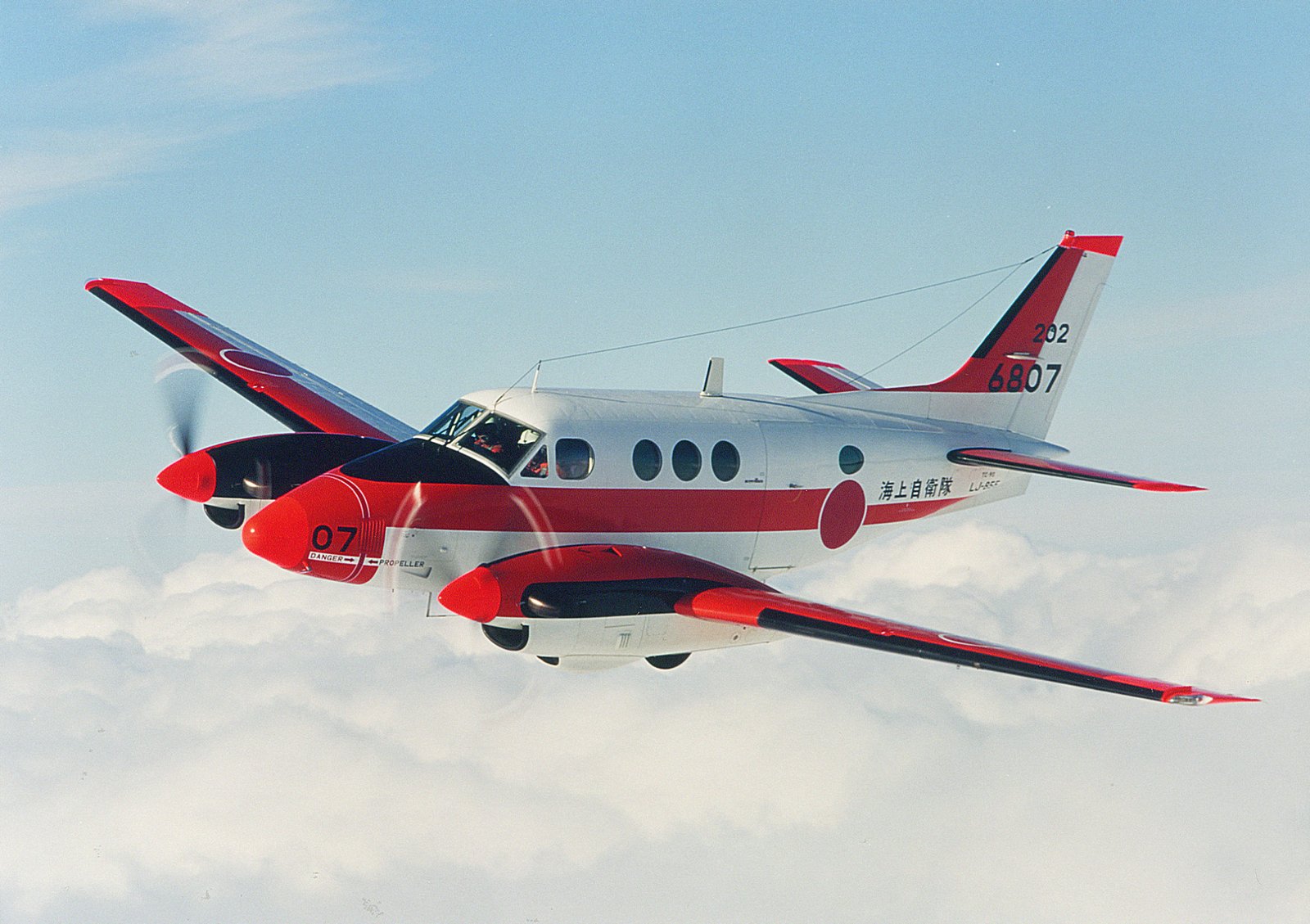
The Corporate Speed King
The F90 emerged during the golden age of corporate aviation when business executives demanded aircraft that could bridge the gap between piston-powered twins and larger jets. Unlike its predecessors in the King Air 90 series, the F90 incorporated advanced pressurization technology that maintained sea-level cabin conditions up to 11,000 feet altitude, a significant improvement achieved through its 5 psi cabin differential pressure system.
Engineering Excellence
Beech Aircraft's engineering teams created the F90 by marrying proven components in an innovative configuration. The aircraft utilized the fuselage and wing structure from the established E90 model but incorporated the striking T-tail empennage from the larger Super King Air 200 series. This design decision not only improved aerodynamic efficiency but also provided better propeller clearance and reduced cabin noise.
The powerplant selection proved crucial to the F90's performance advantage. Each Pratt & Whitney Canada PT6A-135 turboprop engine delivered 750 shaft horsepower in flat-rated configuration, though capable of producing up to 885 horsepower for takeoff. These engines, part of the legendary PT6 family that began production in 1963, drove four-bladed propellers that enabled the F90 to achieve cruise speeds of 270-300 mph at altitudes up to 29,000 feet.
The Manufacturer's Legacy
Beech Aircraft Corporation, founded by aviation pioneer Walter H. Beech in 1932, had established itself as the premier manufacturer of twin-engine business aircraft long before the F90's development. The company's roots in high-performance twins traced back to the Model 18 of the 1930s, which eventually evolved into the King Air lineage starting in 1964. During the 1970s boom years, Beech was producing more than 30 King Air aircraft monthly from its Wichita facilities.
The corporate landscape shifted dramatically during the F90's production run when Raytheon acquired Beech Aircraft in 1980. This acquisition occurred just as the general aviation industry entered a severe downturn that would last throughout the 1980s. Subsequent ownership changes saw the company become Raytheon Aircraft, then Hawker Beechcraft in 2007, and finally Beechcraft under Textron Aviation beginning in 2014.
Limited Production Run
Production of the F90 remained deliberately limited, with exactly 203 original F90s manufactured between 1979 and 1983, followed by the improved F90-1 variant that brought total production to 236 aircraft. This exclusivity was partly intentional, as Beech positioned the F90 to avoid direct competition with their larger Super King Air 200, which offered similar performance in a bigger package.
The short production run occurred during a challenging period for general aviation manufacturers. The luxury tax implications and economic recession of the early 1980s significantly reduced demand for high-end corporate aircraft. Additionally, the F90's premium pricing and specialized mission profile limited its market appeal compared to the more versatile King Air models.
Operational Excellence
Pilots consistently praised the F90's combination of speed, altitude capability, and short-field performance. The aircraft could operate from runways as short as 2,500 feet while maintaining the ability to cruise in the flight levels typically reserved for jets. This operational flexibility made it ideal for corporate missions requiring access to smaller airports while maintaining airline-like scheduling reliability.
The cockpit accommodated one or two pilots, with many operators choosing single-pilot operations for shorter flights. The cabin typically configured for six to eight passengers in a club seating arrangement, providing comfort levels that rivaled much larger aircraft. The pressurization system proved particularly valuable for passenger comfort during flights above 10,000 feet.
Surviving Legacy
Today, approximately 137 F90 and F90-1 aircraft remain on the FAA registry, representing nearly 58 percent of total production. This high survival rate reflects both the aircraft's robust construction and the care typically lavished on corporate aircraft. Many examples continue flying regular missions, with some receiving modern avionics upgrades that enhance their utility in contemporary airspace.
Notable restoration projects have brought several F90s to like-new condition. In 2019, aviation enthusiasts Shawn and David Edgington completed a comprehensive restoration of a 1982 F90, demonstrating the continuing appeal of these rare aircraft among discerning owners.
The F90's influence extended beyond its limited production numbers. Its successful integration of the T-tail configuration into the King Air family established design principles that continue in modern King Air variants. The aircraft proved that pressurized turboprops could deliver jet-like performance while maintaining the operational flexibility that made the King Air series legendary in corporate aviation.
Among King Air enthusiasts, the F90 remains the most coveted variant, earning recognition as the "hot rod" of the 90 series. Its combination of rarity, performance, and distinctive appearance ensures its place in aviation history as one of the finest examples of 1970s turboprop design excellence.