
Service History
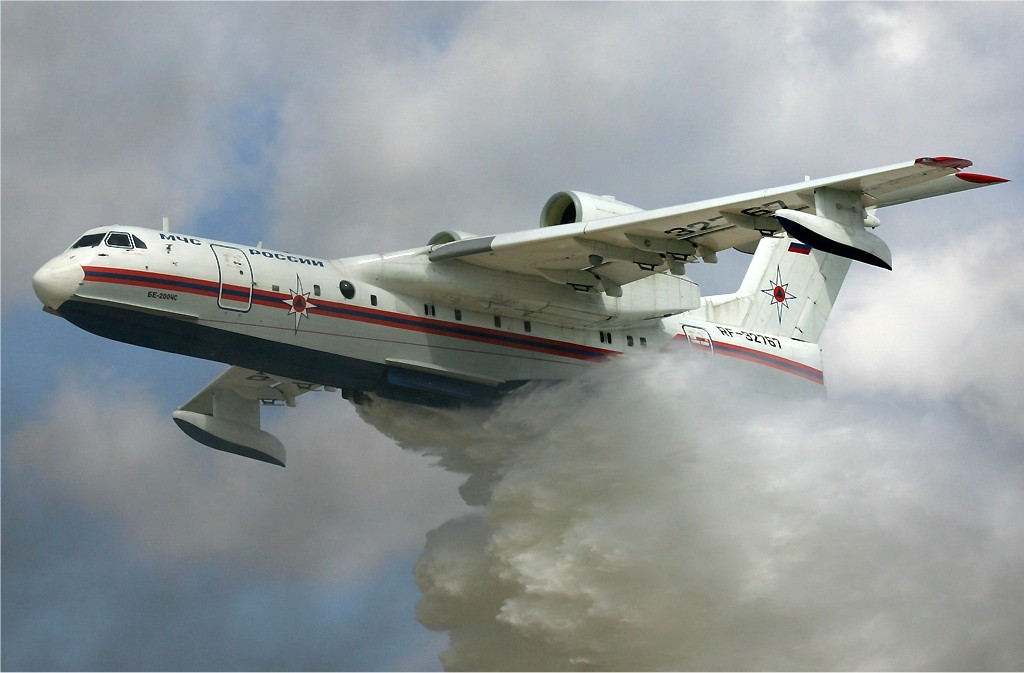
The Be-200 entered operational service in July 2003 when Russia's Ministry of Emergency Situations (EMERCOM) took delivery of the first production aircraft. Since then, the type has carved out a specialized niche in emergency services, with EMERCOM operating seven aircraft for firefighting and search-and-rescue missions across Russia's vast territory. Azerbaijan's Ministry of Emergencies operates one aircraft delivered in 2008, while international orders have come from Chile's Asesorias SVR (two contracted in September 2018 with three options), and potential operators in Kazakhstan, Thailand, and Vietnam.
Despite its innovative design, production has remained extremely limited, with only 14 aircraft built including prototypes as of recent records. The aircraft's unique ability to scoop water while flying at 90-95% of takeoff speed revolutionized amphibious firefighting operations, allowing rapid deployment to remote areas without runway infrastructure.
The Manufacturer
The Beriev Aircraft Company traces its origins to 1934 when it was founded as the Beriev Design Bureau under Georgy Beriev. Based in Taganrog, the company specialized in flying boats and amphibious aircraft, gaining prominence during World War II with designs like the MBR-2 reconnaissance flying boat. During the Soviet era, the company operated as the Taganrog Machine-Building Design Bureau (TANTK) before reverting to the Beriev name following the USSR's collapse in 1991.
Production of the Be-200 was handled jointly with the Irkutsk Aircraft Production Association (Irkut), established in 1932 as an aircraft manufacturing plant. Irkut, known for producing Sukhoi fighters including the Su-30 series, was integrated into the United Aircraft Corporation (UAC) between 2006-2012. Today, Beriev operates as Joint Stock Company Beriev Aircraft Company under UAC's umbrella, continuing its focus on specialized amphibious aircraft.
Design and Development
The Be-200 program officially began on December 8, 1990, under the leadership of chief designer Aleksandr Yavkin. The design derived from the ambitious Soviet-era Beriev A-40 Albatros antisubmarine warfare project, which was suspended following the Soviet Union's collapse. Yavkin's team adapted the large flying boat concept into a smaller, more versatile aircraft suitable for civilian emergency services and commercial applications.
Test pilot Konstantin V. lifted the prototype off the water for its maiden flight on September 24, 1998, marking the achievement of the world's first jet-powered flying boat to reach operational status. The aircraft incorporated several innovative features, including high-mounted engines positioned above the fuselage to avoid water spray ingestion, and a composite-aluminum hull optimized for water operations while maintaining structural integrity for pressurized flight.
Engine and Technical Specifications
Powering the Be-200 are two Progress D-436TP turbofan engines, each producing 16,535 pounds of thrust. These high-bypass engines, manufactured by Ukraine's Ivchenko-Progress with final assembly by Motor Sich, entered production in the late 1980s following certification in 1987. The D-436 series has proven reliable across various applications, with over 1,000 units built for aircraft including the Yakovlev Yak-42 and Antonov An-72.
The engines feature corrosion-resistant components specifically designed for maritime operations, though production faced significant disruption following Russia's 2022 invasion of Ukraine and subsequent sanctions. A proposed upgrade to French-Russian SaM146 turbofans was suspended in April 2019 due to NATO supplier concerns over dual-use technology.
The aircraft requires a crew of two to three, depending on mission configuration. In passenger mode, it can accommodate up to 72 travelers, while firefighting configuration allows for 12 tons of water or fire retardant. Performance figures include a maximum speed of 435 mph, service ceiling of 26,247 feet, and range of 1,305 miles.
Pilot Perspective and Performance
The Be-200's unique operational envelope presents pilots with challenges unlike any other aircraft. Water operations require precise speed and attitude control during takeoff and landing sequences, while the ability to scoop water at near-takeoff speeds demands exceptional skill and timing. The aircraft's climb rate of 3,350 feet per minute provides rapid altitude gain crucial for firefighting missions in mountainous terrain.
Its high-wing configuration and elevated engine placement protect critical components from water damage while providing excellent visibility for water operations. The pressurized cabin allows operations at altitudes up to 26,247 feet, enabling efficient transit between widely separated firefighting zones.
Production and Legacy
With total production limited to 14 aircraft over two decades, the Be-200 represents one of aviation's most exclusive operational types. Post-2022 sanctions have effectively halted future production due to Ukrainian engine supply disruptions, casting uncertainty over the program's continuation.
The aircraft gained international recognition at the 1999 Paris Air Show, where it demonstrated water scooping capabilities that highlighted Russian amphibious aviation expertise. Several prototypes remain active with Beriev for demonstration and firefighting support roles.
The Be-200's significance extends beyond its modest production numbers. As the world's sole operational jet amphibian, it proved that modern turbofan technology could be successfully adapted to flying boat operations, opening possibilities for future amphibious designs. While geopolitical tensions have clouded its commercial prospects, the Be-200 Altair stands as a remarkable engineering achievement in specialized aviation applications.