
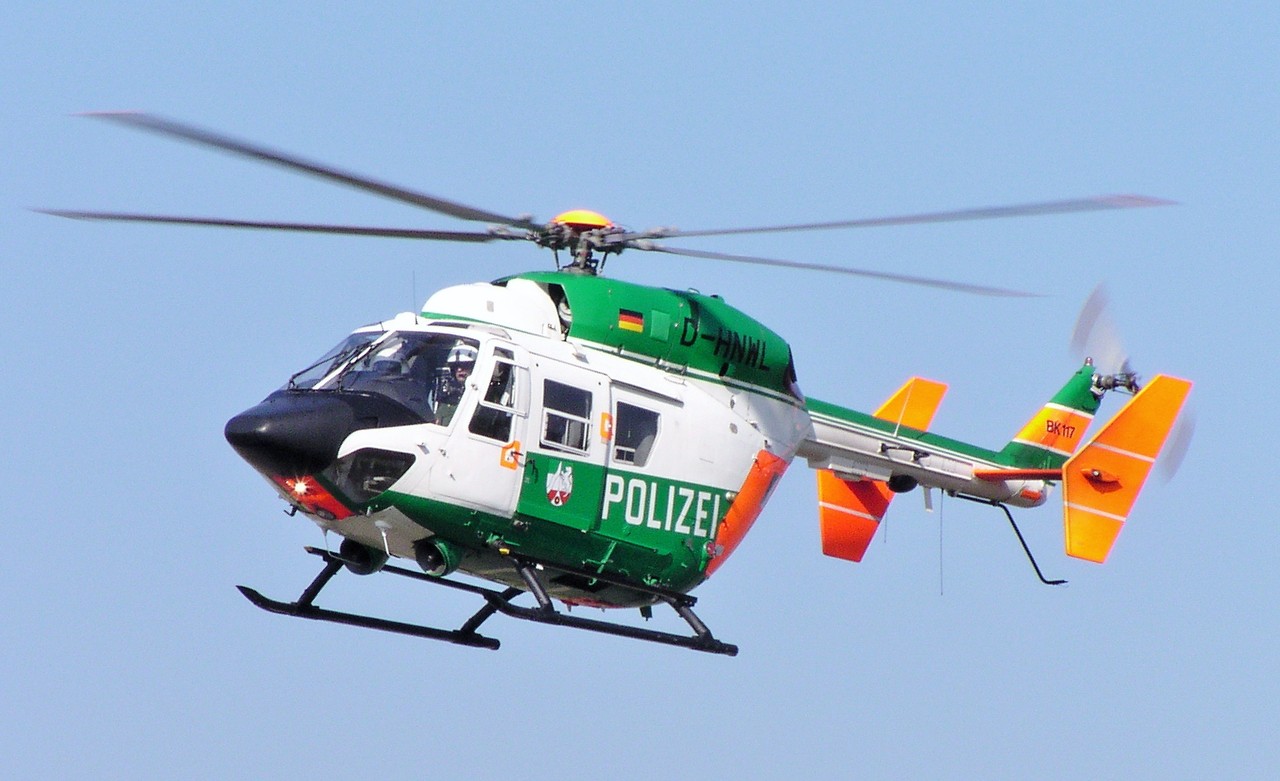
International Partnership Success
The BK-117 emerged from an ambitious cross-Pacific partnership when MBB and Kawasaki signed their cooperation agreement on February 25, 1977. This merger combined two separate national projects: MBB's Bo 107 and Kawasaki's KH-7, creating a development program that would split costs equally between the partners. MBB contributed their proven rigid rotor system from the Bo 105, along with flight controls and hydraulic systems, while Kawasaki developed the airframe, landing gear, and main transmission. The division of labor leveraged each company's engineering strengths while sharing the substantial financial risks of helicopter development.
Development and Certification
Development proceeded with parallel prototype construction in both countries. MBB's flying prototype conducted its maiden flight on June 13, 1979, at Ottobrunn, Bavaria, piloted by company test crews. Kawasaki's prototype followed two months later on August 10, 1979, at their Gifu facility in Japan's Chūbu region. However, manpower shortages at MBB delayed the certification timeline significantly beyond original projections.
German airworthiness certification finally arrived on December 9, 1982, with Japanese approval following eight days later on December 17, 1982. The critical U.S. Federal Aviation Administration certification was secured on March 29, 1983, opening the crucial North American market to the new helicopter.
The Manufacturer Legacy
Messerschmitt-Bölkow-Blohm represented the consolidation of Germany's helicopter expertise, bringing decades of rotorcraft experience to the partnership. The company underwent significant corporate evolution during the BK-117's production life, eventually being acquired by Daimler-Benz before becoming part of Eurocopter. Today, the German heritage continues under Airbus Helicopters, which maintains production facilities and support for the BK-117 family.
Kawasaki Heavy Industries contributed their precision manufacturing capabilities and access to Asian markets. The Japanese company had established helicopter credentials through licensed production of foreign designs and indigenous development programs. Their partnership with MBB represented Japan's emergence as a major helicopter manufacturer rather than merely a licensee.
Technical Innovation and Design
The BK-117 featured several innovative design elements that contributed to its market success. Engineers incorporated a distinctive "slant nose" configuration where the nose and windshield shared the same inclination angle, optimizing pilot visibility and aerodynamic efficiency. The wide cabin with double doors facilitated rapid passenger loading and cargo operations, particularly valuable for emergency medical services.
Power came from two Textron Lycoming LTS 101 turboshaft engines, initially the 650B-1 variant producing 592 shaft horsepower each. Later variants upgraded to the more powerful LTS 101-750B-1 engines, each delivering 593 horsepower for improved hot-and-high performance. The twin-engine configuration provided crucial safety redundancy for operations over populated areas and challenging terrain.
The rigid rotor system, adapted from MBB's successful Bo 105, eliminated the need for flapping hinges while providing excellent maneuverability and structural simplicity. This system contributed to the helicopter's reputation for precise handling characteristics and reduced maintenance requirements compared to conventional articulated rotor systems.
Operational Excellence and Market Penetration
The BK-117 achieved remarkable commercial success, capturing a 40 percent market share of Japanese emergency medical services operations. This dominance reflected the helicopter's combination of cabin space, twin-engine reliability, and operating economics that made it ideal for hospital transport missions. Emergency medical services worldwide adopted the type for its ability to accommodate medical crews and patient stretchers while maintaining instrument flight capability.
Utility operators appreciated the helicopter's 3,350-kilogram maximum takeoff weight and 697-liter internal fuel capacity, providing substantial payload flexibility. The aircraft could carry up to 10 passengers in high-density configuration or equivalent cargo loads, making it versatile for corporate transport, offshore operations, and government services.
Production Achievement and Variants
Total production reached 1,304 helicopters between 1982 and 2016, representing one of the most successful international helicopter collaborations in aviation history. MBB produced 329 aircraft plus two prototypes at their Donauworth facility, while Kawasaki manufactured 111 aircraft plus one prototype in Japan. An additional 175 units underwent final assembly at Kawasaki facilities, demonstrating the flexible production arrangements.
Continuous development produced numerous variants addressing market demands. The BK 117 A-3 introduced increased maximum takeoff weight and an enlarged tail rotor with twisted airfoils for improved performance. The A-4 variant featured the uprated LTS 101-750B-1 engines and increased fuel capacity. Later C-series aircraft replaced the Lycoming engines with Turbomeca Arriel powerplants, while the final D-2 variant introduced a distinctive Fenestron shrouded tail rotor and advanced Helionix avionics.
Military Service and Special Programs
While primarily a civil helicopter, the BK-117 received limited military evaluation. The Canadian Forces Air Command leased a single BK 117 A-3 for testing, designating it CH-143. After program completion, the aircraft returned to MBB Canada, and no production orders followed.
Museum Preservation and Legacy
The original Kawasaki prototype, designated BK 117 P-3/P-5 and registered JQ0003, is now preserved at the Kakamigahara Aerospace Museum in Gifu, Japan. This aircraft represents the successful culmination of international cooperation that created one of the helicopter industry's most enduring designs, demonstrating that cross-border partnerships could produce world-class aircraft competing effectively in global markets.