
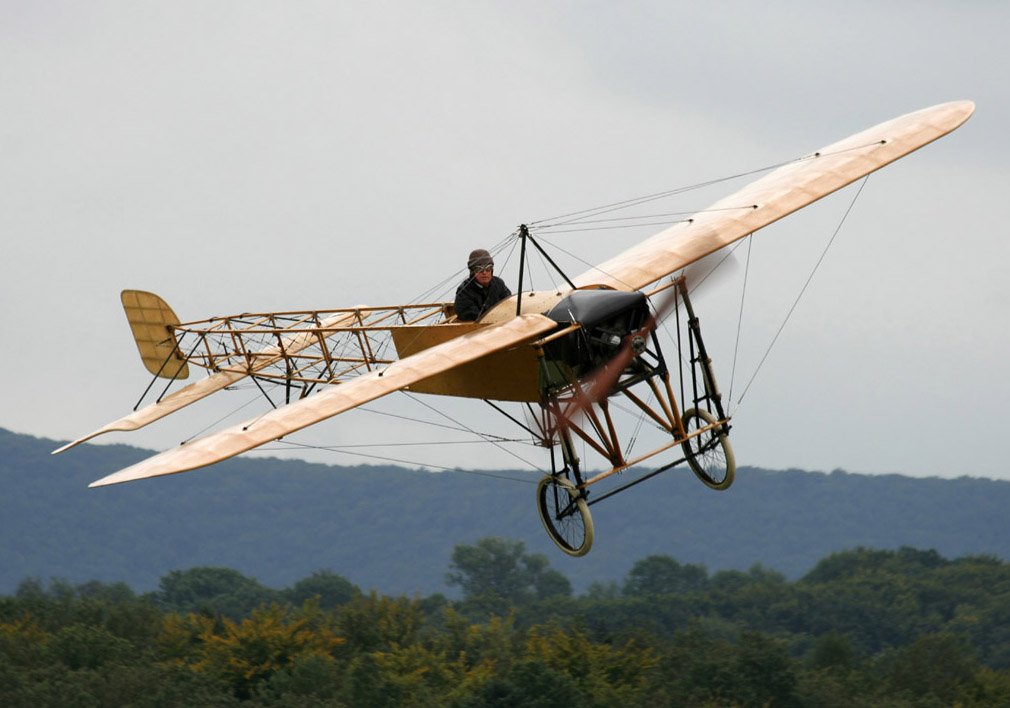
The Blériot XI is a landmark of aviation history, designed by Louis Blériot in collaboration with Raymond Saulnier. The aircraft first flew on January 23, 1909, at Issy-les-Moulineaux, France. It is most renowned for the flight conducted by Louis Blériot on July 25, 1909, when he flew from Calais to Dover, achieving the first heavier-than-air crossing of the English Channel and winning a £1,000 prize from the Daily Mail.
Technically, the Blériot XI was notable for its tractor-configuration monoplane design, featuring a wooden fuselage constructed from ash longerons and a wire-braced wing that used warping for lateral control. This layout was more efficient than many contemporary pusher or biplane designs. The aircraft was produced in various versions between 1909 and the start of World War I in 1914. While production totals vary between sources, estimates suggest between 103 and 132 aircraft were built by Blériot Aéronautique in France, with many others license-built abroad.
Powerplants varied by model. Early versions, including the Channel-crossing aircraft, utilized a 25 hp Anzani 3-cylinder air-cooled radial engine. Later variants and military models often employed 50 hp Gnôme rotary engines. A typical single-seat model featured a wingspan of 25 feet 9 inches, a length of 23 feet, and a gross weight of approximately 660 lb, capable of reaching speeds over 45 mph with a service ceiling of 5,000 feet.
In military service, the Blériot XI was an early pioneer of operational air power. It was adopted by the French and Italian militaries in 1910. During the Italo-Turkish War (1911–1912), Italian forces used the aircraft in Libya for bombing and reconnaissance. By the outbreak of World War I in 1914, the French air force operated eight squadrons of Blériot aircraft, and the British Royal Flying Corps utilized them for observation and training. Other operators included Russia, Japan, Mexico, Sweden, and New Zealand, where the "Britannia" (a Blériot XI-2) served as the nation's first military aircraft from 1913 to 1914.
Beyond military use, the aircraft was a staple of early aviation schools and air racing, winning numerous European contests between 1909 and 1912. Its legacy persists today; two restored examples in the United Kingdom and the United States are considered the oldest airworthy aircraft in the world. Additionally, the Smithsonian National Air and Space Museum preserves a 1914 model previously flown by stunt pilot John Domenjoz.