
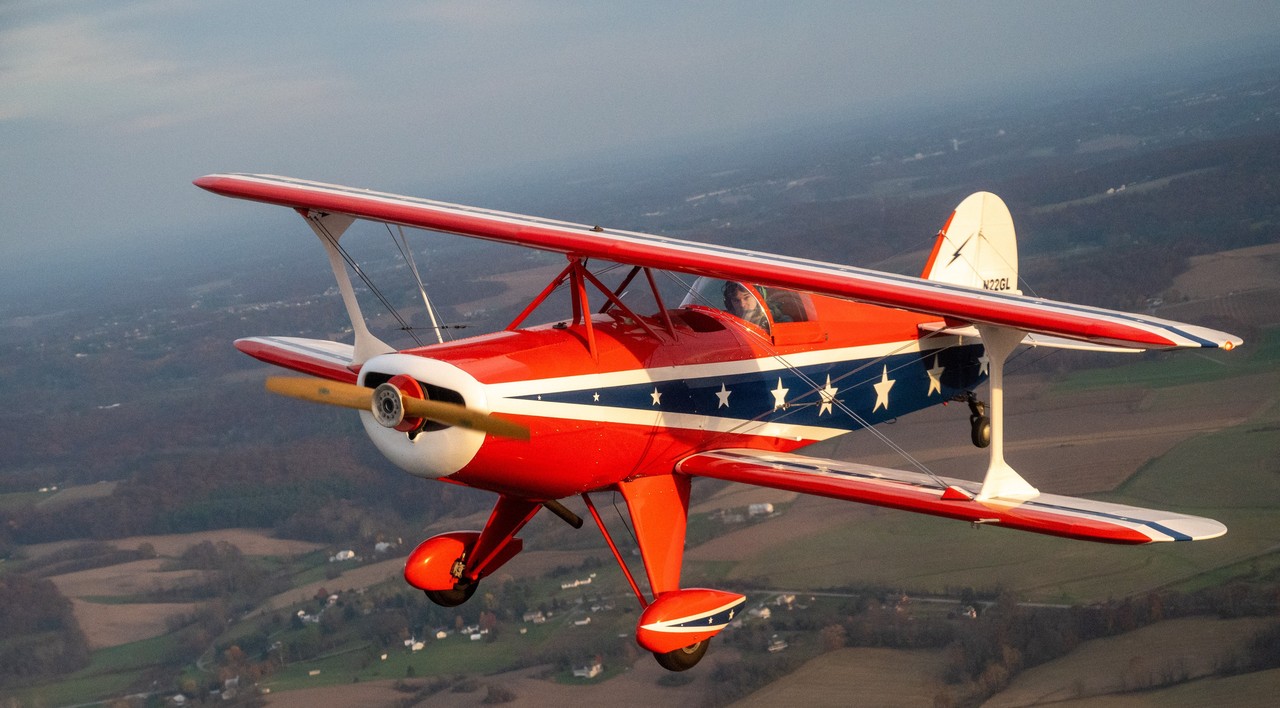
Origins and Development
The Skybolt's remarkable story began in 1968 as a high school project at Denver's Manual High School. Lamar Steen, a shop teacher who was also an accomplished aircraft designer, conceived the project to teach his students wood and fabric construction techniques while creating an aerobatic aircraft capable of accommodating larger pilots—a significant limitation of existing designs like the Pitts Special. Construction of the prototype began on August 19, 1969, and the aircraft made its maiden flight in October 1970 after just one year of student labor costing approximately $5,000.
The prototype immediately demonstrated exceptional performance, easily performing loops at 5,600 feet MSL with its 180-horsepower Lycoming HO-360-B1B engine. The aircraft achieved a cruise speed of 130 mph, stalled at 55 mph, and could climb at 2,500 feet per minute. These impressive capabilities, combined with its roomy cockpit design, quickly made the Skybolt a sensation on the airshow circuit.
Design Philosophy and Performance
Steen engineered the Skybolt to withstand extreme aerobatic loads, stressing the airframe to +12G and -10G. The design features a traditional biplane configuration with fabric-covered wooden wings using two spruce spars, married to a welded steel tube fuselage. At 19 feet in length with a 24-foot wingspan, the aircraft weighs 1,080 pounds empty and has a maximum takeoff weight of 1,650 pounds.
The Skybolt's versatility in powerplant selection has contributed significantly to its popularity. While the prototype used a 180-horsepower Lycoming, builders have successfully installed engines ranging from 150 to 350 horsepower. Modified examples include Monty Barrett's installation of a 325-horsepower IO-540 with cold-air induction, and variants equipped with Vedeneyev M14P radial engines producing 360 horsepower.
Manufacturing Evolution
After the prototype's success, Lamar Steen founded Steen Aero Lab to market plans and components. By the late 1970s, the company had achieved remarkable success, with the Skybolt becoming the most-constructed two-place experimental aircraft globally. The design's popularity stemmed from its combination of outstanding performance and relative ease of construction for homebuilders.
In the early 1990s, model aircraft expert Hale Wallace acquired Steen Aero Lab and the Skybolt rights from Lamar Steen, relocating operations to Rock Hill, North Carolina. Wallace expanded the company's portfolio to include rights to the Pitts S1-C and S1-SS, as well as the Knight Twister. Following Wallace's death from cancer in the late 1990s, ownership transitioned to Paul Goetsch and Jere Larson, who moved operations to Palm Bay, Florida.
Modern Production and Variants
Under current ownership, Steen Aero Lab has modernized production using CNC machining and CAD-CAM technology to improve kit quality and reduce construction time. The company now offers several variants, including the Skybolt Delta featuring a three-section wing design with hydraulic landing gear, and the Skybolt Radial specifically designed for the M14P engine installation.
Curtis Pitts, the legendary designer of the Pitts Special series, has contributed design enhancements to modern Skybolt variants. The company also holds manufacturing rights to other classic designs including the Great Lakes biplane and maintains the Firebolt variant for builders seeking different performance characteristics.
Recognition and Legacy
The Skybolt's impact on experimental aviation has been recognized through numerous awards. The prototype won the EAA "Best School Project" award in 1970, and a Skybolt earned the 1979 Reserve Grand Champion Custom Built award at EAA AirVenture Oshkosh. These accolades reflected the design's significance in democratizing aerobatic flying for amateur builders worldwide.
Current Status
With over 400 completed aircraft flying in 29 countries, the Skybolt continues to represent one of experimental aviation's greatest success stories. Notable examples include aircraft registered in the United Kingdom (16 as of January 2009), Canada (such as C-GDJM), and highly modified versions like the Yellowbird N3HW featuring a 325-horsepower engine, four-blade MT propeller, and titanium components for weight reduction.
The Skybolt's enduring popularity stems from its unique combination of spacious accommodations, exceptional aerobatic capability, and builder-friendly construction. As Steen Aero Lab continues operations from Palm Bay, Florida, new builders still discover the satisfaction of constructing and flying this remarkable aircraft that began as a high school shop project more than five decades ago.