
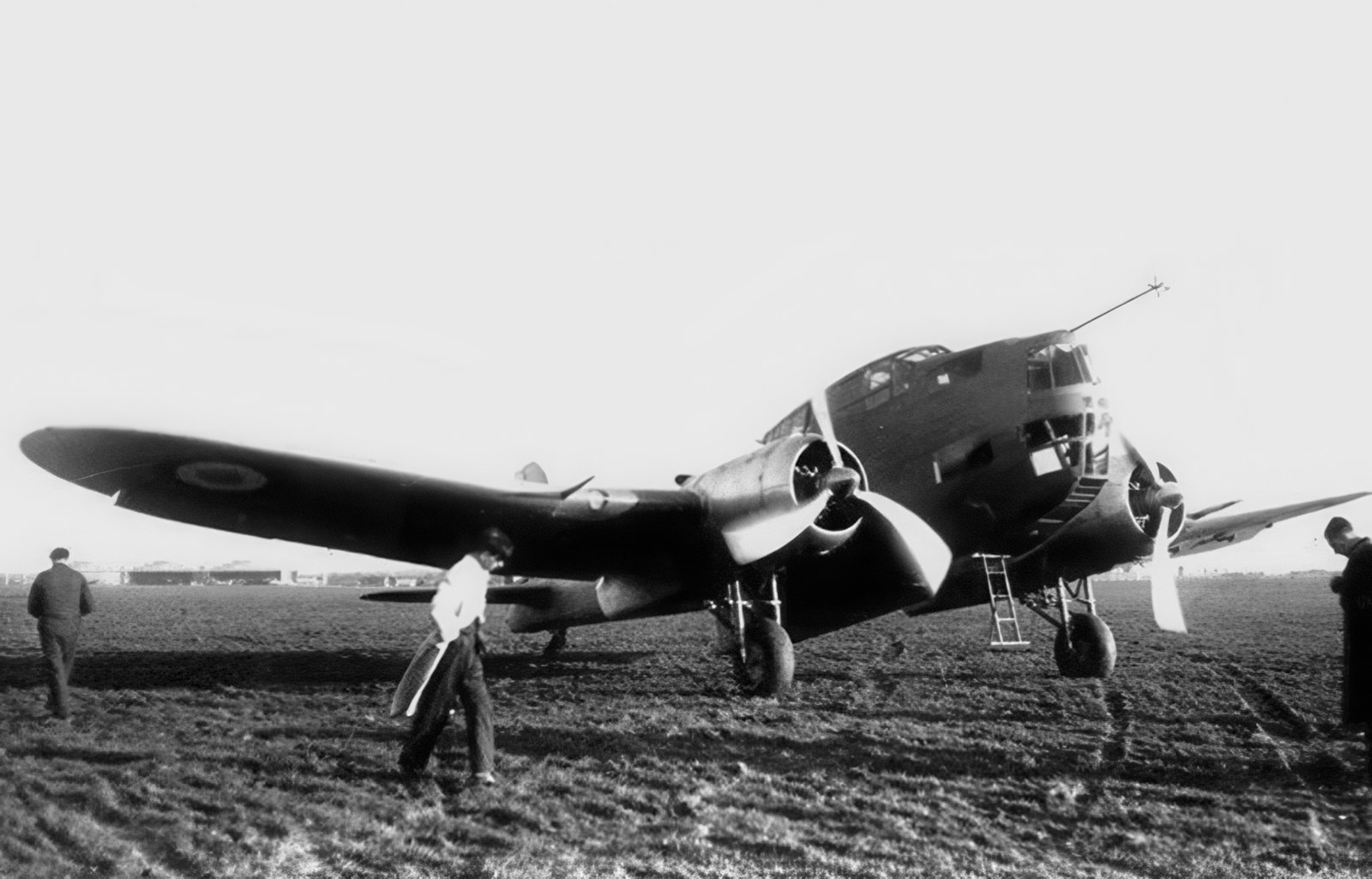
The Breguet 460 Vultur was developed in the early 1930s by Société Anonyme des Ateliers d’Aviation Louis Bréguet to meet a French military requirement for a "fast bomber" capable of speeds reaching 400 km/h. This project served as a critical evolutionary step, moving away from the unsatisfactory multi-role biplane configurations of the earlier Bréguet 410 BCR. The resulting design was a modern, all-metal, low-wing monoplane featuring a retractable undercarriage, a twin-tail assembly, and a fully enclosed crew compartment for five members.
The prototype first flew in January 1935. It was powered by two Gnome-Rhône 14Kdrs 14-cylinder, air-cooled radial piston engines, each producing 825 hp. Despite its advanced layout, the aircraft failed to meet the French Air Force's strict performance criteria; during testing, it reached a maximum speed of approximately 385 km/h, falling short of the 400 km/h target by about 15 km/h. This performance gap prevented the aircraft from securing a series production contract, leaving it as a prototype program. While a refined derivative, the Breguet 462 Vultur, eventually exceeded the required speed, the French Air Force had already committed to other bomber types.
Production was extremely limited, with some sources stating only one prototype was built, though others suggest a small number of development airframes existed. These aircraft were manufactured in France by Bréguet. While the aircraft never entered operational service with the Armée de l’Air, some Br.460s reportedly reached the Spanish Republican Air Force during the Spanish Civil War (1936–1939). Documentation regarding this service is vague, though one specific aircraft stationed in Celrà is known to have crashed in the ocean, resulting in the death of the entire crew.
Technically, the Br.460 featured a service ceiling of 10,000 m and a climb rate to 4,000 m in 8 minutes and 15 seconds. Its armament consisted of three 7.5 mm Darne machine guns located in the nose turret, dorsal position, and a ventral gondola. The internal bomb bay could accommodate up to 1,000 kg of ordnance. No examples of the Br.460 survive today, and the three Br.462 derivatives were scrapped in 1942.