
Military Dominance in Colonial Conflicts
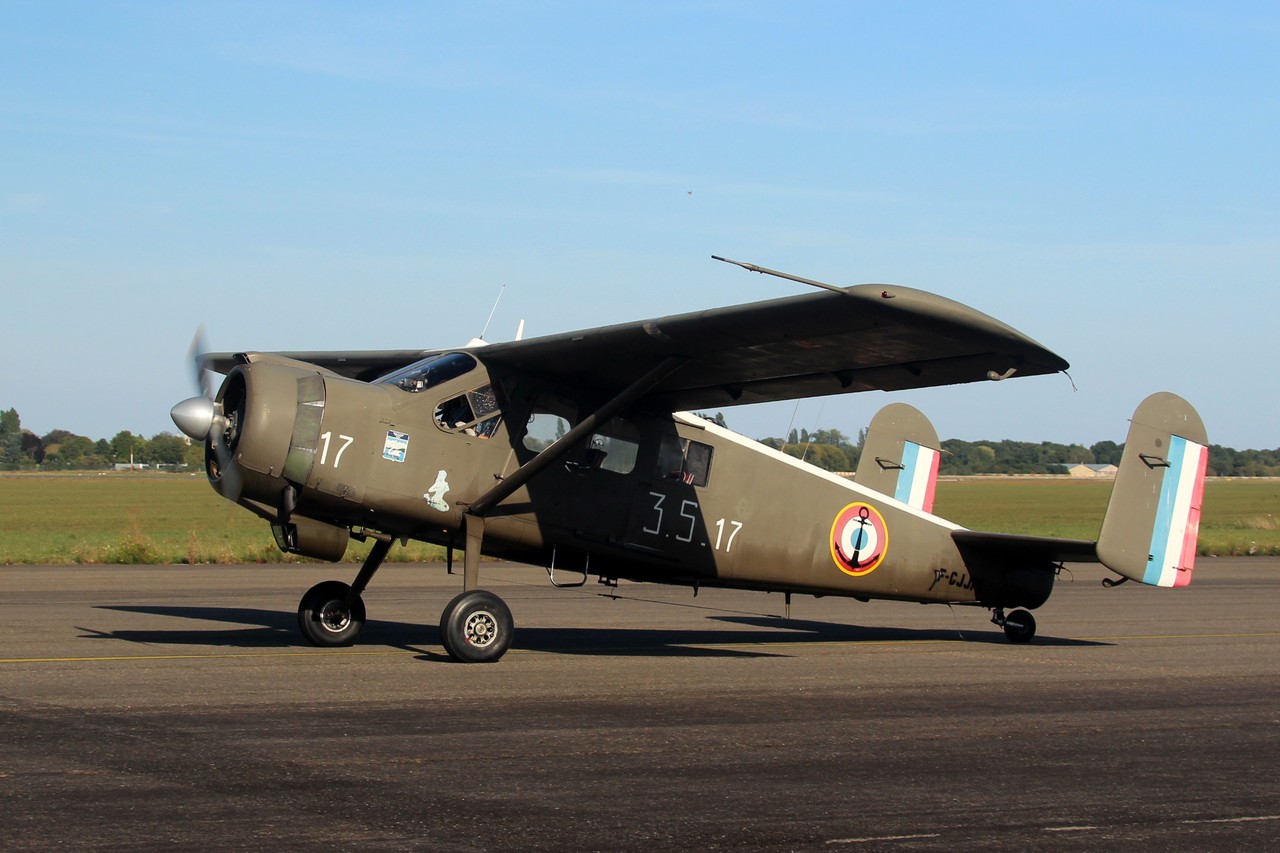
The Broussard's military service defined its legacy, with over 150 aircraft deployed during the Algerian War of Independence from 1954 to 1962. French Army units valued the MH-1521M military variant for artillery spotting, medical evacuation, supply missions, and liaison duties in the challenging North African terrain. The aircraft's ability to operate from unprepared strips and resist ground fire made it indispensable, though its noisy radial engine often alerted guerrilla forces to its presence.
The Portuguese Air Force also operated the type during the independence war in Portuguese Guinea throughout the 1960s, using it primarily for observation, supply, and ambulance missions before retiring it in favor of the Dornier Do 27. French military service continued much longer, with the last Broussards retiring from French Army service in 1992, nearly four decades after the type's introduction.
The Manufacturer's Brief Success
Société des Avions Max Holste was founded by aeronautical engineer Max Holste after World War II, with the company initially producing small numbers of the MH.52 trainer before developing the Broussard. The success of the MH-1521 represented the pinnacle of the company's achievements, but Max Holste's independent existence was short-lived. Potez acquired the company in the late 1960s, with production responsibilities eventually shifting to Sud-Aviation, which later became Aérospatiale. The original Max Holste company ceased independent operations, making the Broussard its lasting contribution to aviation history.
Engine and Design Innovation
Max Holste's design team evolved the Broussard from the earlier MH.152 prototype, which had flown on June 12, 1951, powered by a 220-horsepower Salmson engine. The production MH-1521 nearly doubled the power with its Pratt & Whitney R-985-AN-1 Wasp Junior, a nine-cylinder air-cooled radial producing 451 horsepower. This supercharged engine, paired with a Hamilton Standard 2.D.30 constant-speed propeller, provided the reliability needed for operations in dusty, austere conditions.
The aircraft's distinctive design featured a braced high-wing configuration with twin vertical tails and fixed tailwheel landing gear. Its slab-sided fuselage accommodated up to seven occupants, while the engine's air intake positioned atop the cowling helped prevent dust ingestion during ground operations. World War II ace Pierre Clostermann supported the development program and later flew with Escadrille ELO 3/45 in Algeria, experiences that inspired his novel "Leo 25 Airborne."
Operational Characteristics
Pilots appreciated the Broussard's forgiving handling characteristics and exceptional short-field performance, with takeoff runs of less than 900 feet even when fully loaded. The aircraft could carry up to 2,580 pounds including fuel and had a range of 1,200 kilometers. Its robust construction and stall-resistant design, enhanced by slats and flaps on later variants, made it ideal for bush operations and military missions in challenging environments.
The R-985 engine, while noisy, proved remarkably reliable in service. Pratt & Whitney had produced over 39,000 engines in the Wasp series, making the R-985 a proven powerplant with extensive parts availability and maintenance expertise worldwide.
Production Variants and Civil Service
Of the 363 total aircraft produced, the military MH-1521M variant accounted for 319 units, with 19 pre-production military examples also built. Civil variants included 36 MH-1521C aircraft and the agricultural MH-1521A variant. Civil operators used the type for passenger service, ambulance duties, and specialty missions such as providing aerial coverage for the Tour de France by Europe 1 radio station.
Flying clubs and private enthusiasts continued operating Broussards well into the 1980s, appreciating the type's combination of utility and character. The aircraft's ability to access remote airstrips while carrying substantial loads made it valuable for commercial bush operations throughout its service life.
Surviving Legacy
Today, approximately 25 Broussards remain airworthy worldwide, with 14 based in the United States and others maintained by enthusiasts in France and elsewhere. Notable museum examples include Portuguese Air Force serial number 3304 at the Portuguese National Aviation Museum's Sintra branch, and serial number 139 displayed at Ailes Anciennes Toulouse in Europe 1 radio station colors, recovered in 1982.
The Broussard's significance extends beyond its modest production numbers, representing France's successful entry into the specialized STOL utility aircraft market during the post-war colonial period. Its nickname "French Beaver" acknowledges its achievement in matching the performance standards set by de Havilland's Canadian design, while serving as a bridge between military necessity and civilian bush flying operations.