
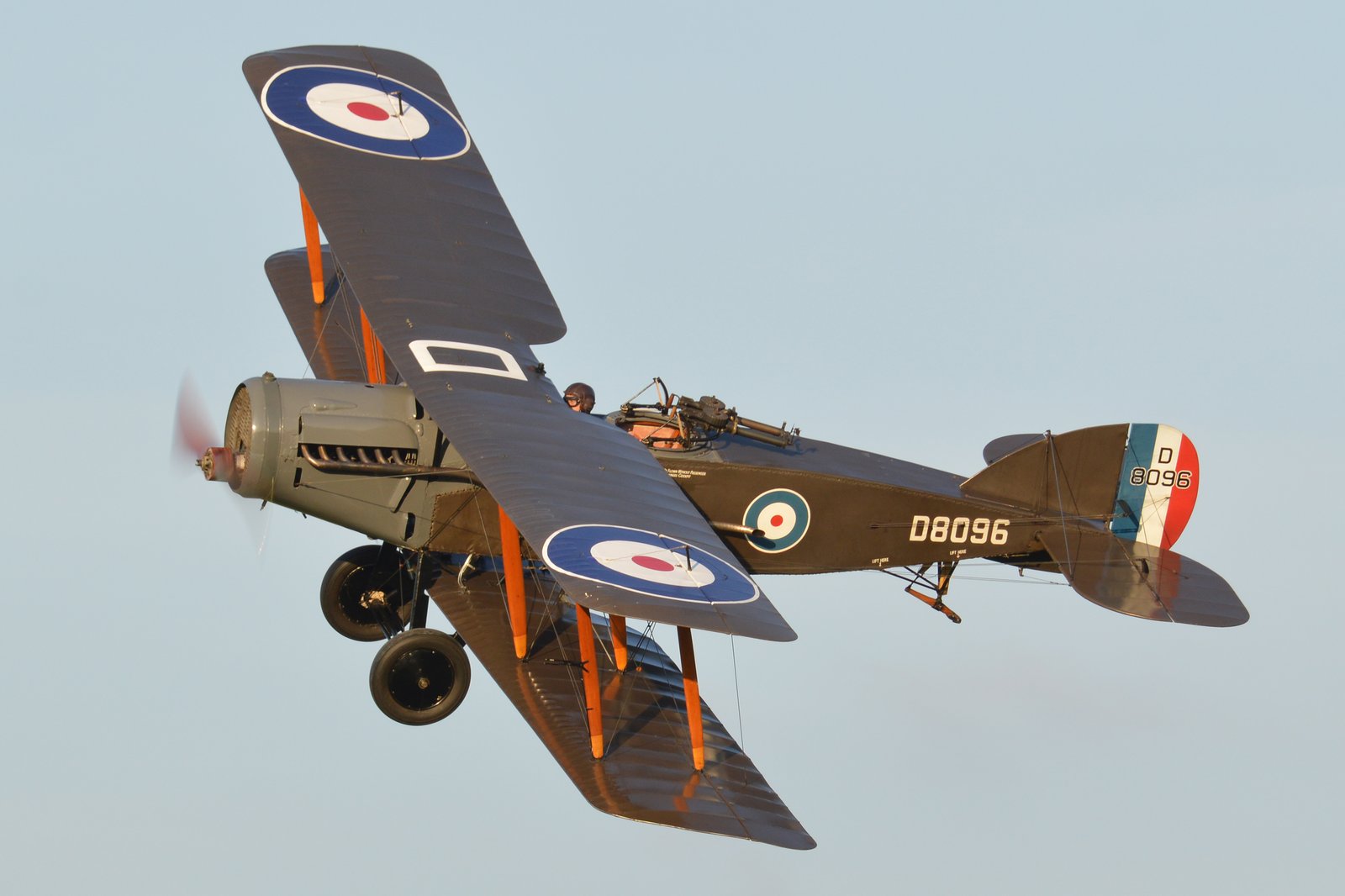
Designed by a team led by Captain Frank Sowter Barnwell, a former RFC pilot, the Bristol F.2 Fighter evolved from initial reconnaissance concepts into a potent fighter-reconnaissance aircraft. The first prototype, the F.2A, flew on September 9, 1916, powered by a 190 hp Rolls-Royce Falcon I engine. While approximately 52 F.2A units were produced, the definitive Type 14 F.2B featured a revised fuselage with downward-angled longerons to improve the pilot's forward visibility. Deliveries of the F.2B began around April 1917.
Production was primarily handled by the British and Colonial Aeroplane Company (which became the Bristol Aeroplane Company in 1920) at their Filton and Brislington works. Due to wartime demand, several subcontractors were employed, including Standard Motors, Armstrong Whitworth, and the Cunard Steamship Company. Total production is estimated at 5,329 aircraft between 1916 and 1927. In Argentina, the Argentine Army Aviation Service imported 28 aircraft between 1920 and 1924; subsequently, the Fábrica Militar de Aviones (predecessor to FAdeA) produced 10 additional aircraft under license or as rebuilds between 1930 and 1931.
The aircraft was primarily powered by the 275 hp Rolls-Royce Falcon III V-12 liquid-cooled piston engine, though other powerplants like the Sunbeam Arab and Hispano-Suiza were used in smaller numbers. The F.2B reached a maximum speed of 123 mph at 5,000 feet and had a service ceiling of 18,000 feet. Its armament consisted of a synchronized .303 in Vickers machine gun for the pilot and one or two .303 in Lewis guns on a Scarff ring for the observer, with the capacity to carry up to 240 lb of bombs.
Operational service began with No. 48 Squadron of the Royal Flying Corps in March 1917. Despite an initially difficult debut during the Arras offensive, the aircraft became "supreme in its class" once pilots adopted aggressive, single-seater-style tactics. It served in diverse roles, including night interception of Gotha bombers and ground attack. Post-war, the RAF utilized the type for imperial policing in India and the Middle East until 1932. Other global operators included the Polish Air Force, which used the type during the Polish-Soviet War, as well as air forces in Belgium, New Zealand, and Greece.
Today, the Bristol F.2 Fighter is preserved in several museums, including the RAF Museum in London and the Imperial War Museum Duxford. Airworthy originals are rare, with the Shuttleworth Collection in the UK and Peter Jackson in New Zealand maintaining flying examples.