
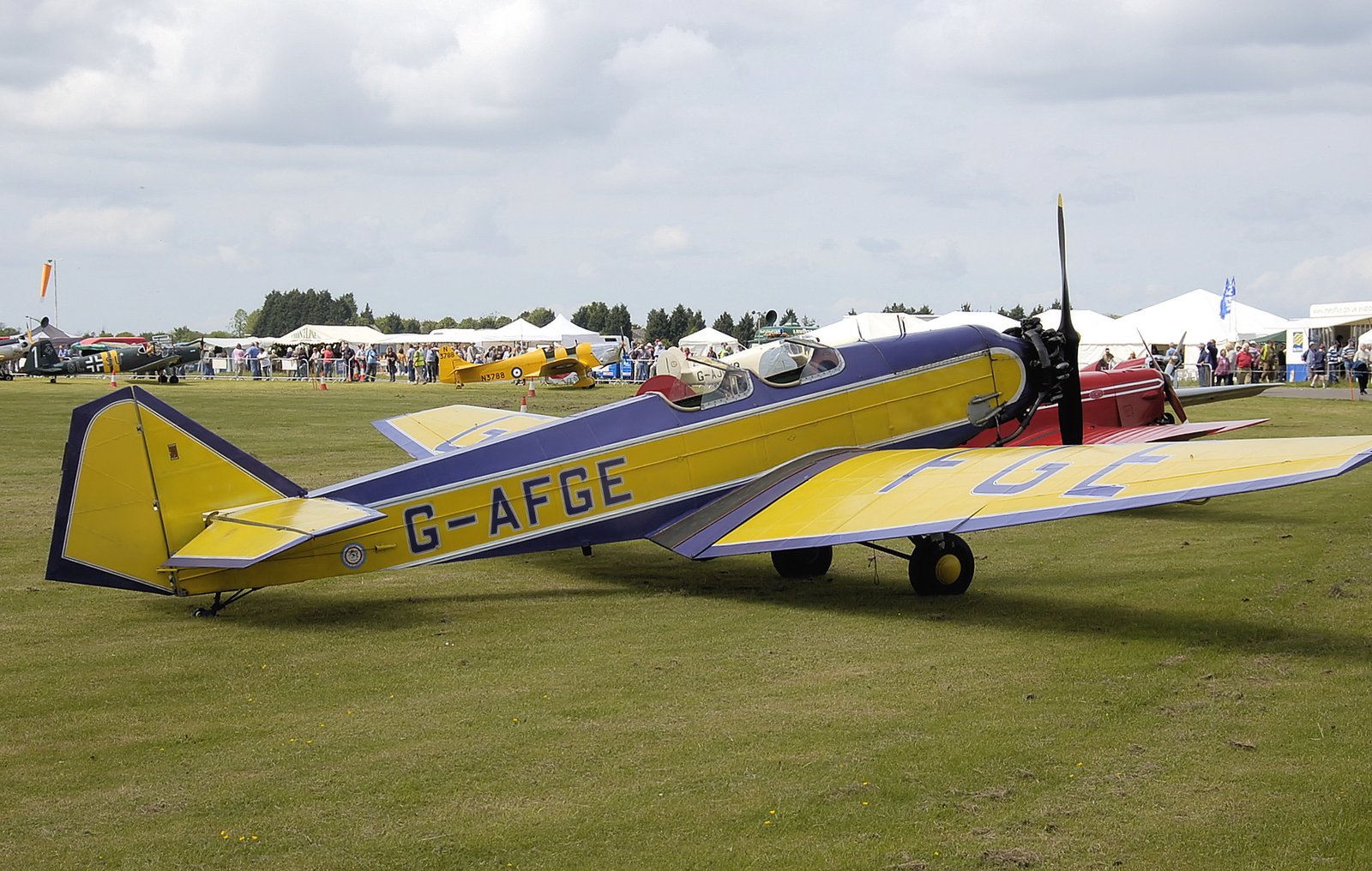
The British Aircraft Swallow was developed in 1935 as a British derivative of the German Klemm L25 two-seat monoplane. The aircraft was designed to serve the growing demand for economical light touring and training aircraft in the mid-1930s. Production began at Hanworth in Greater London, initially under the British Klemm Aeroplane Co. Ltd. Following a corporate reorganization and name change, the manufacturer became the British Aircraft Manufacturing Co. Ltd, which continued production at the same site.
Two primary versions of the aircraft were produced during the mid-1930s. The initial model, known as the BK Swallow, saw approximately 28 examples built. This was followed by a redesigned version, the BA Swallow II (or Swallow 2), which incorporated several aerodynamic and manufacturing improvements, including a straight rudder and tailplane, curved wingtips, and flat-sided top decking on the fuselage. A total of 105 BA Swallow II aircraft were manufactured, bringing the total documented production of the Swallow family to approximately 133 aircraft.
While based on the Klemm L25 layout, the Swallow was structurally strengthened to comply with British airworthiness requirements. The aircraft was powered by a variety of small piston engines. Early models utilized radial engines, such as the 56 kW (75 hp) British Salmson AD-9, the 63 kW (85 hp) Pobjoy Cataract II, or the Pobjoy Niagara. Later, a four-cylinder in-line air-cooled Blackburn Cirrus Minor I engine providing 67 kW (90 hp) was offered as an alternative.
In terms of performance, the Cirrus-powered BA Swallow achieved a maximum speed of 180 km/h (112 mph) and a cruising speed of 158 km/h (98 mph). It featured a service ceiling of 5,182 m (17,000 ft), a range of 676 km (420 miles), and an initial rate of climb of 244 m/min (800 ft/min). The aircraft had an empty weight of 449 kg (990 lb) and a maximum loaded weight of 680 kg (1,500 lb).
Primarily used for civil general aviation by private owners and flying clubs, the Swallow also saw very limited military service. One example, imported to New Zealand in 1937, was impressed into the Royal New Zealand Air Force (RNZAF) during World War II as aircraft NZ583. Today, the type is remembered as an example of Anglo-German aviation collaboration, with some Swallow II airframes still documented in existence.