
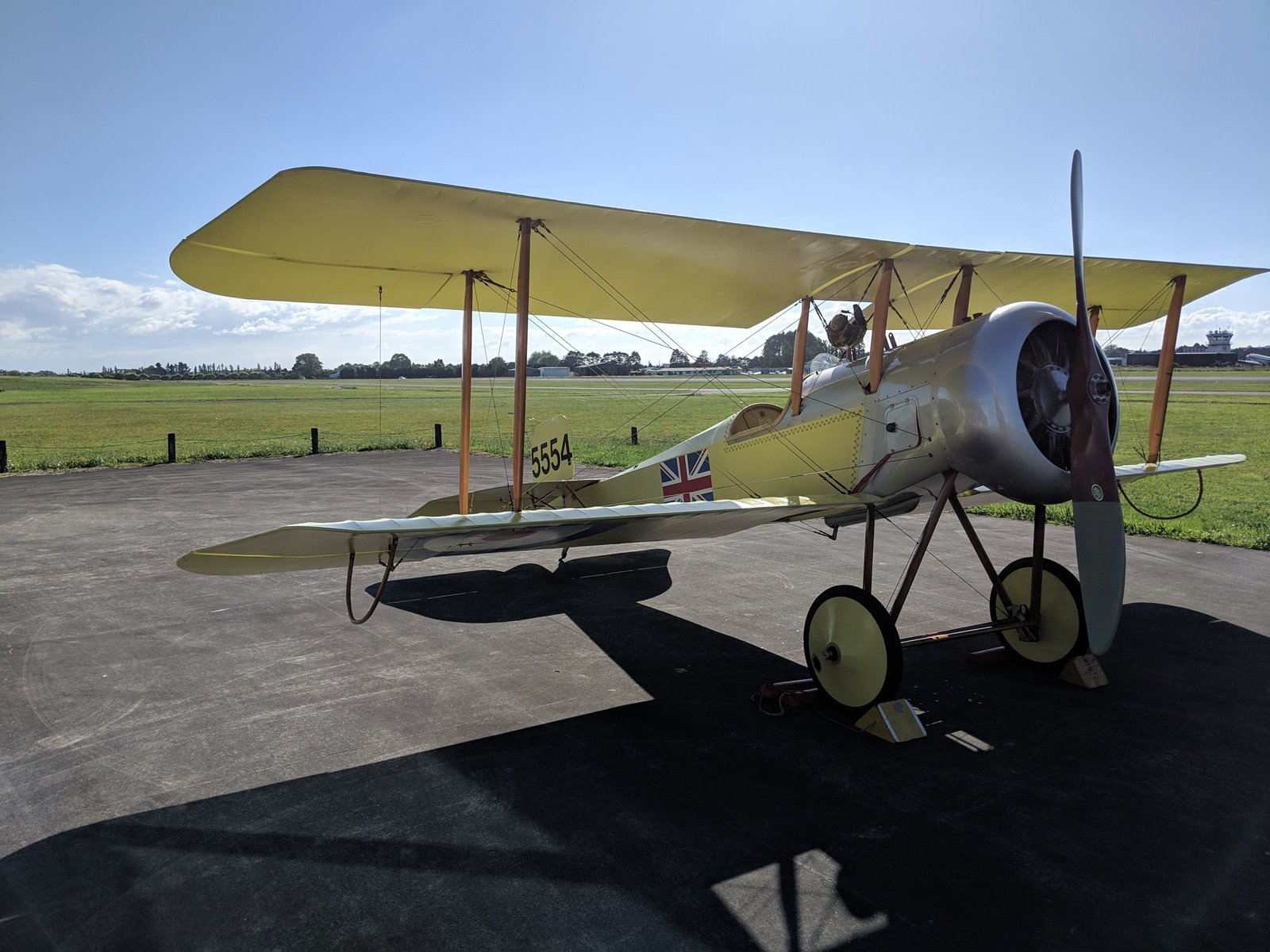
Design and Development
The Bristol Scout was designed in 1913 by Frank Barnwell, the chief designer at Bristol, in collaboration with the company's chief pilot, Harry Busteed. While it eventually became a military asset, the aircraft was originally conceived to compete in air racing. Its inherent agility and speed made it an attractive candidate for military adoption, leading the Royal Naval Air Service (RNAS) and the Royal Flying Corps (RFC) to utilize the type for reconnaissance and as one of the earliest single-seat fighters in British service.
Production and Manufacturer
The aircraft was produced by the British and Colonial Aeroplane Company, Ltd., which later became the Bristol Aeroplane Company. The company had been founded on February 19, 1910, in Bristol, Somerset, by Sir George White and his family members, Stanley and Samuel. Production of the Scout occurred in several variants (A, B, C, and D) between 1914 and approximately 1916, with a total of 374 aircraft built. Specifically, the Scout C variant was manufactured at a facility in Brislington, southeast of Bristol, England.
Technical Specifications
The Bristol Scout C was powered by a French-made Le Rhône 9C nine-cylinder air-cooled rotary engine. This powerplant provided between 80 and 83 horsepower and had a displacement of 10.91 liters. The aircraft featured a biplane configuration with a wingspan of 24 feet 7 inches and a length of 20 feet 8 inches. It had a maximum gross weight of 1,195 lb and could reach a top speed of 92.7 mph at sea level. Its service ceiling was 15,500 feet, and it possessed an endurance of 2.5 hours.
Military Service
During the First World War, the Scout operated in home defense and battlefield support roles. Because the British lacked a reliable gun synchronizer until late 1916, pilots had to improvise armament. Captain Lanoe George Hawker of No. 6 Squadron, RFC, famously equipped his Scout C with a Lewis machine gun fixed to fire at a 45-degree angle to the left to avoid hitting the propeller. On July 25, 1915, near Passchendaele, Belgium, Hawker used this configuration to shoot down three enemy aircraft, an action for which he was awarded the Victoria Cross. Additionally, the RNAS deployed the Scout in the East Mediterranean during the Gallipoli campaign for bombing raids and reconnaissance patrols along the Greek-Bulgarian border.
Legacy
Although the Scout was rendered obsolete by late 1916 due to the lack of synchronized weaponry, it established a lineage of successful Bristol fighters that included the Bristol Fighter, Bulldog, and Beaufighter. While no original airworthy examples remain, a notable Type C replica (registration G-FDHB) was built by David and Rick Bremner and Theo Willford to honor Flight Sub-Lieutenant F. D. H. “Bunnie” Bremner.