
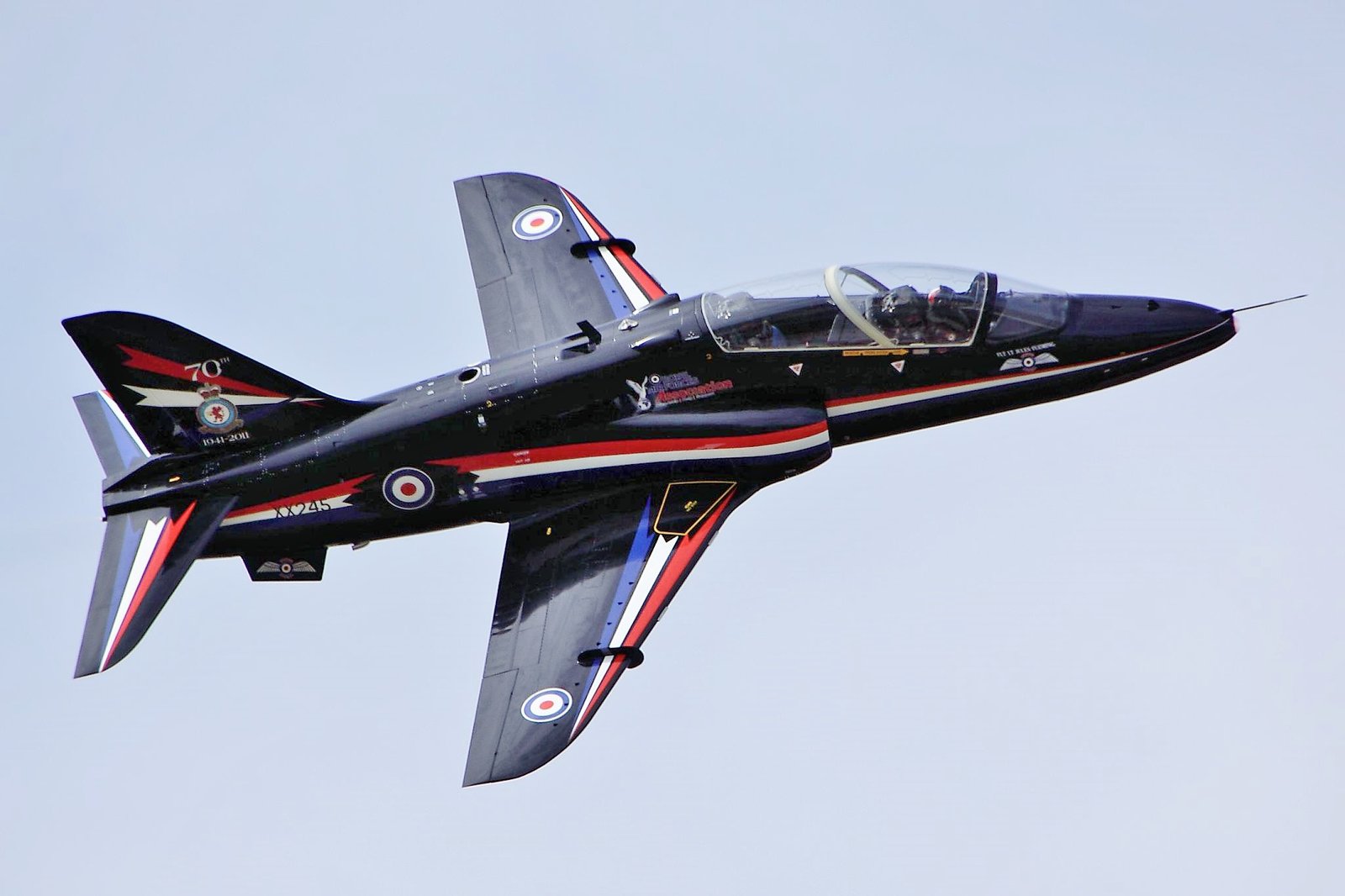
The BAE Systems Hawk is a single-engine, subsonic jet-powered aircraft designed to serve as both an advanced trainer and a light attack platform. The project originated in the late 1960s as the Hawker P.1182, with the design led by Ralph Hooper. In October 1971, the UK Ministry of Defence selected the aircraft to replace the Gnat, Hunter, and Jet Provost within the Royal Air Force (RAF). The prototype, serial XX154, first took flight on 21 August 1974 from Dunsfold Airfield in Surrey, piloted by Duncan Simpson. The Hawk T.1 subsequently entered RAF operational service in April 1976.
Production began at BAE Systems' Brough facility in East Yorkshire, continuing there until 2020, with the final new-build aircraft delivered by BAE in 2022. Beyond the UK, Hindustan Aeronautics Limited (HAL) has produced the Hawk under licence in India since 2008 and continues to do so. Other licensed assembly or production occurred via Valmet in Finland, Hunter Aerospace in Australia, and the Federal Aircraft Factory in Switzerland. Through 2023, approximately 1,074 aircraft of all variants were produced, with over 1,000 sold to at least 18 operators worldwide.
Technically, the Hawk features a two-seat tandem cockpit and an all-metal aluminium alloy fuselage. It is powered by a single turbofan engine, providing fighter-like handling for student pilots transitioning to high-performance aircraft such as the Typhoon, F-35, and Tornado. For combat and weapons training, the aircraft is equipped with a centreline gun pod, typically housing a 30 mm ADEN cannon, and up to four hardpoints across two under-wing pylons. The RAF modified 88 T.1 aircraft into the T.1A variant between 1983 and 1986, adding AIM-9L Sidewinder missiles to serve as short-range interceptors.
Operational history includes service in several global conflicts, including the Falklands War, the Gulf War (specifically by the Royal Saudi Air Force), and the Iraq War. The aircraft is also highly visible in non-combat roles; the RAF Red Arrows adopted the Hawk in 1979, while the Indian Air Force's Surya Kiran and the Saudi Hawks also utilize the type for aerobatic displays. Its legacy is further cemented by the T-45 Goshawk, a carrier-capable derivative used by the US Navy.