
Racing Success and Innovation
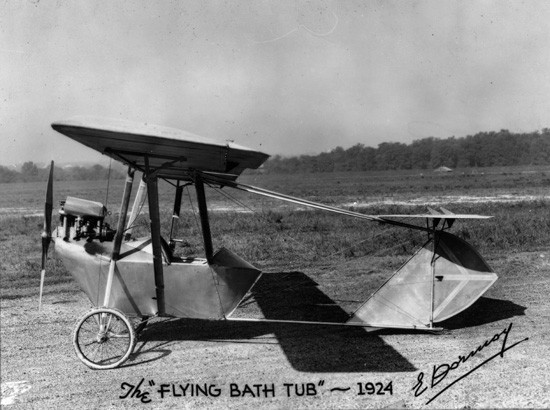
The Dormoy Bathtub proved its worth immediately upon completion, winning the prestigious Rickenbacker Trophy at the 1924 National Air Races in Dayton, Ohio. Étienne Dormoy returned the following year with a refined version featuring a covered tail section, again competing successfully at the 1925 National Air Races. These victories validated Dormoy's vision of creating an affordable racing aircraft that ordinary pilots could build and fly.
Design Philosophy and Construction
Dormoy's revolutionary approach prioritized simplicity and cost-effectiveness over raw performance. The aircraft featured a steel tube fuselage with an exposed tail section that gave it the distinctive "bathtub" appearance. The parasol wing configuration used wood spars covered in fabric, supported by steel struts, with exposed steel cables operating the ailerons. This minimalist construction philosophy kept the gross weight to just 425 pounds while maintaining structural integrity for racing competition.
The fuel system was equally spartan, carrying only 2 gallons in a tiny tank that provided sufficient range for short racing circuits. Every component was selected for minimum weight and maximum affordability, making the complete aircraft accessible to amateur builders with limited budgets.
The Designer and McCook Field
Étienne Dormoy developed the Bathtub while working as a French engineer at McCook Field, the U.S. Army's premier aviation research facility from 1917 to 1927. McCook Field served as America's primary center for aerodynamic testing and prototype development during the crucial early years of military aviation. The facility provided Dormoy with access to advanced engineering knowledge and testing capabilities that informed his ultra-light design approach.
Dormoy's influence extended beyond the Bathtub, as he later contributed to the design of the Buhl Bull Pup, incorporating lessons learned from his pioneering lightweight construction techniques. His work at McCook Field positioned him at the forefront of American aviation development during its most innovative period.
Powerplant and Performance
The Heath-Henderson B-4 engine represented a creative solution to the cost constraint, being essentially a modified Henderson motorcycle engine producing 20 horsepower. Henderson Motorcycle Company manufactured these engines from 1911 to 1924, with Heath Aircraft Company adapting them for aviation use. The $325 engine purchase price demonstrates Dormoy's commitment to affordability, though early testing revealed the limitations of such low power output.
Initial trials with a Henderson engine failed to achieve takeoff, leading to the adoption of the slightly more powerful Heath-Henderson variant. Despite the modest power output, the Bathtub achieved a respectable cruise speed of 70 mph, demonstrating the effectiveness of its lightweight design philosophy.
Production and Replicas
Only one original Dormoy Bathtub was constructed, making it a true one-off prototype rather than a production aircraft. The fate of the original remains unknown after its 1925 racing appearance, though a 1924 fuselage with Heath-Henderson engine survives on display at the Motorcycle Heritage Museum in Westerville, Ohio.
The design's influence persisted through modern replica builders, most notably Mike Kimbrel's homebuilt version from the 1980s. Kimbrel's reproduction used a 40-horsepower Volkswagen engine, providing significantly more power than the original while maintaining the basic configuration. Ed Kusmirek spent over 60 years constructing a precise 1924 replica in Renton, Washington, with his project nearing flight status by 2012.
Historical Significance
The Dormoy Bathtub occupies a crucial position in American aviation history as a pioneer of the homebuilt movement that would flourish decades later. Its emphasis on simplicity, affordability, and ease of construction established principles that influenced countless subsequent light aircraft designs. The success of mass-produced aircraft like the Aeronca C-2 can trace conceptual roots to Dormoy's innovative approach.
Jerry Turner's restoration project, utilizing over 200 original Dormoy photographs along with the designer's helmet, goggles, medals, and pilot license #5 signed by Orville Wright himself, demonstrates the enduring fascination with this pioneering design. The Bathtub represents the democratization of aviation, proving that innovative engineering could overcome financial limitations to create successful aircraft.
Today, the Dormoy Bathtub stands as a symbol of 1920s aviation innovation, when individual creativity and limited resources could still produce groundbreaking designs that influenced the entire industry. Its legacy continues through the experimental aircraft movement, where builders still pursue Dormoy's original vision of affordable, owner-built aviation.