
Design Achievement
The Bü 131 represented a remarkable engineering achievement for the newly established Bücker Flugzeugbau, founded in October 1933 by Carl Bücker at Berlin-Johannisthal. Under the leadership of designer Anders J. Andersson, the company completed the aircraft from initial design to first flight in less than six months. Test pilot Joachim von Koppen lifted the prototype D-3150 into the air on April 27, 1934, beginning what would become one of aviation's most successful trainer programs.
International Production Success
The Jungmann's immediate success led to unprecedented international demand throughout the 1930s. Between 3,000 and 4,000 aircraft were built in Germany alone, but licensed production expanded the type's reach globally. Aero of Prague manufactured over 300 during the German occupation, then resumed production from 1945 to 1949, building 260 additional aircraft as the C-4 and C-104 variants. Dornier constructed 88 of Switzerland's 94 Jungmanns, while CASA in Spain produced hundreds under license, continuing production into the early 1960s. Kyūshū in Japan manufactured 339 aircraft between 1942 and 1945 for the Imperial Navy, demonstrating the design's truly global appeal.
Wartime Dominance
During World War II, the Bü 131 became one of the conflict's most widely used trainer aircraft. The Luftwaffe selected the more powerful Bü 131B variant, introduced in 1936 with the 105-110 horsepower Hirth HM-504 engine, as its primary basic trainer. The aircraft served with nearly all German primary flying schools and equipped night harassment units including Nachtschlacht Gruppen 2, 11, and 12, which conducted low-level nocturnal bombing operations.
The Imperial Japanese forces operated more than 1,300 Jungmanns under the designations Kokusai Ki-86 for the Army and Kyūshū K9W Momoji for the Navy. The Kingdom of Yugoslavia became the largest pre-war export customer, operating as many as 400 Bü 131s before the German invasion. Hungary received 151 Bü 131Ds from 1939 onward, with most destroyed during the German retreat, though Hungarian technicians rebuilt 42 aircraft by 1947.
Technical Evolution
The Jungmann's steel tube fuselage covered in fabric and metal, combined with wood and fabric wing construction, provided exceptional durability for training operations. Early aircraft utilized the 80-horsepower Hirth HM60R engine, but the 1936 Bü 131B variant's more powerful Hirth HM-504 significantly enhanced performance. International variants adapted local powerplants: Czechoslovak-built aircraft employed the Walter Minor III producing 105 horsepower, while Argentine aircraft eventually transitioned to the indigenous ENMA "Tigre G-IVA" engine delivering 125 horsepower after the 200th aircraft.
Post-War Service and Legacy
The Jungmann's military service extended decades beyond World War II. The Spanish Air Force retained the type as its primary basic trainer until 1968, while the Czechoslovak Air Force operated post-war Aero variants from 1946 onward. This longevity reflected the aircraft's robust design and excellent handling characteristics that made it ideal for teaching fundamental flying skills.
Modern Survival
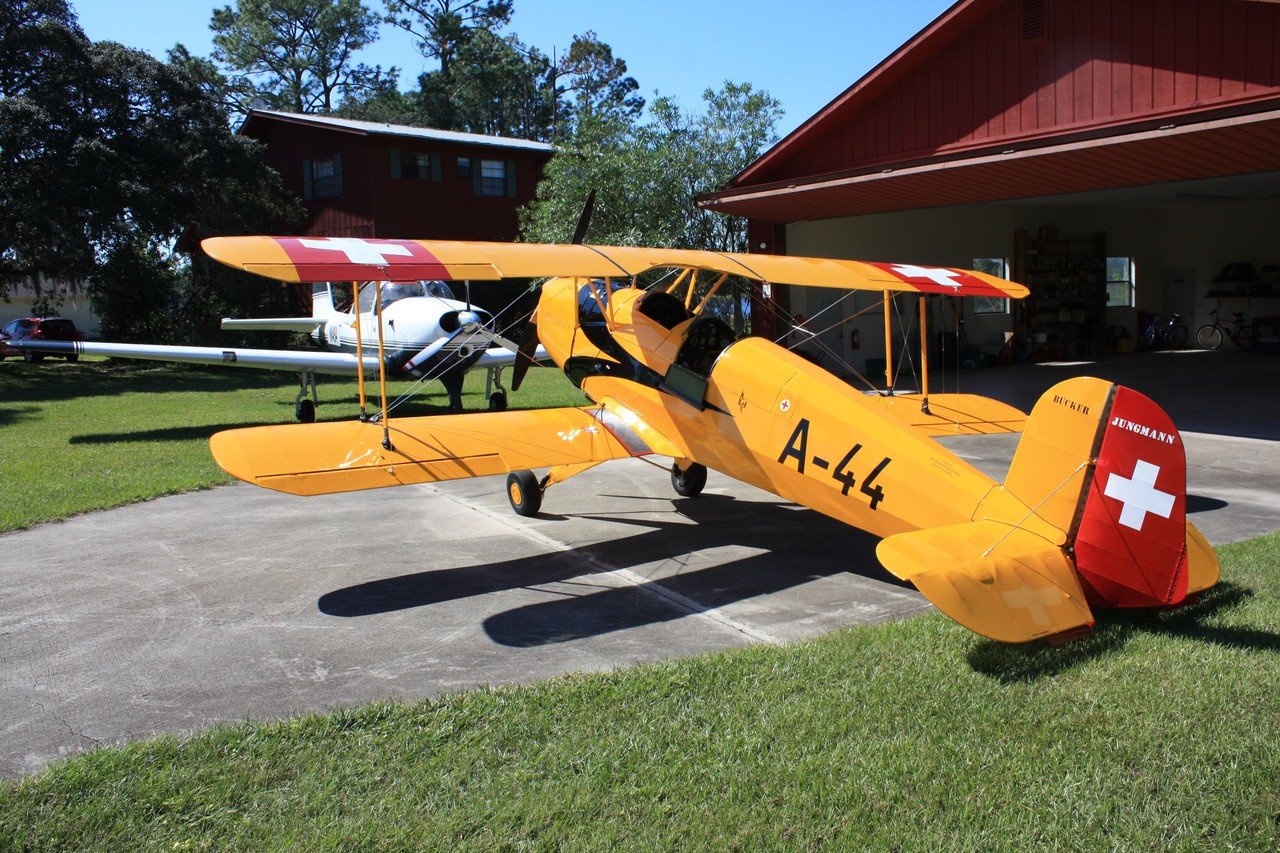
Approximately 200 Jungmanns survive today, primarily in private hands. During the 1960s and early 1970s, the Spanish, Swiss, and Czech governments sold surplus aircraft to civilian operators, with many exported to the United States. Modern owners frequently install Lycoming O-320 (150 horsepower) or O-360 (180 horsepower) engines with inverted fuel and oil systems, enhancing performance for aerobatic operations while maintaining the aircraft's classic biplane characteristics.
The Bücker Bü 131 Jungmann stands as testament to effective aircraft design, combining structural integrity, flight characteristics, and manufacturing efficiency in a package that trained thousands of pilots across multiple nations. Its influence on trainer aircraft development and continued popularity among aviation enthusiasts ensures its place in aeronautical history as one of the most successful training aircraft ever produced.