
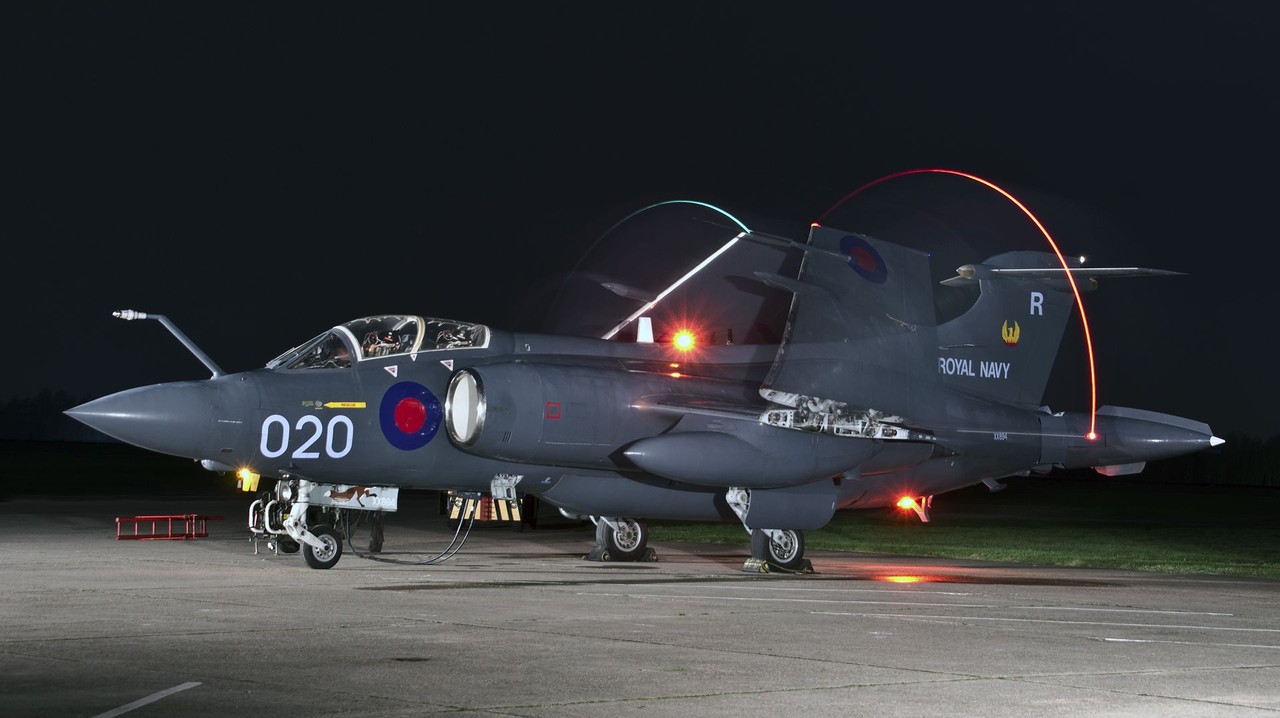
Development and Design
The Buccaneer emerged from a Royal Navy requirement for a carrier-based nuclear strike aircraft capable of high-speed, low-altitude penetration missions. Barry P. Laight led the design team at Blackburn Aircraft during the 1950s, creating an innovative aircraft designated NA.39. The design incorporated variable geometry air intakes and boundary layer control systems to achieve the demanding combination of high-speed performance and short carrier takeoffs.
Nine prototypes and 20 development batch aircraft were ordered on June 2, 1955, marking the beginning of what would become a 211-aircraft production run. The first production S.1 model flew on January 23, 1962, from Holme-on-Spalding Moor, establishing the Buccaneer's credentials as a capable strike platform.
The Manufacturer's Evolution
Blackburn Aircraft Limited originally designed and manufactured the Buccaneer at their Brough factory, building on decades of aviation experience dating to the early 20th century. During World War II, Blackburn had intensified production with aircraft like the Botha and subcontracted work on the Fairey Barracuda, while also adapting nearly 4,000 American aircraft for British service.
In 1960, the Hawker Siddeley Group acquired Blackburn, having previously purchased Folland in 1959 and de Havilland in 1960. By 1963, constituent company names were dropped, with all products rebranded as "Hawker Siddeley" or "HS." The Brough site focused specifically on Buccaneer production under this new arrangement. Hawker Siddeley later merged with British Aircraft Corporation in the 1970s to form British Aerospace, which eventually became BAE Systems in 1999 through combination with Marconi Electronic Systems.
Engine Development and Variants
The initial S.1 variant suffered from inadequate power, equipped with two de Havilland Gyron Junior 101 turbojets producing 7,100 pounds of thrust each. This powerplant proved insufficient for full-load carrier operations, limiting the aircraft's operational effectiveness and necessitating a major redesign.
The solution came with the S.2 variant, announced in January 1962, which featured two Rolls-Royce Spey turbofans. This engine change required enlarged nacelles and aerodynamic refinements to the wing design, but provided the necessary power for full operational capability. The first HS Buccaneer S.2 prototype, XK526, flew on May 17, 1963, demonstrating the improved performance that would characterize all subsequent variants.
Service History
The Royal Navy Fleet Air Arm received their first S.1 aircraft in January 1963, with all RN squadrons converting to the more capable S.2 variant by the end of 1966. The Royal Air Force adopted the Buccaneer from 1968-1969, receiving 46 new-build S.2B aircraft along with reworked Royal Navy S.2s designated as S.2As. Squadron 736 NAS utilized eight stored S.1 aircraft for RAF training purposes until December 1970.
South Africa operated 16 S.50 variants from 1965, though one aircraft was lost during delivery, leaving the South African Air Force with 15 operational examples. These aircraft served in the specialized low-level strike and reconnaissance roles for which the Buccaneer was designed.
Combat Operations
The Buccaneer's most notable combat service occurred during the 1991 Gulf War, where RAF aircraft demonstrated their precision strike capabilities. The aircraft's primary armament included nuclear and conventional bombs, plus Martel air-to-surface missiles carried in the bomb bay or on external pylons. RAF variants featured a distinctive bulged bomb-bay door that accommodated additional fuel tanks for extended range missions.
One remarkable demonstration of the aircraft's capabilities occurred when a Fleet Air Arm Buccaneer completed a non-stop transatlantic flight from Goose Bay, Canada to Lossiemouth, Scotland, covering 1,950 miles in 4 hours and 16 minutes. This flight showcased the aircraft's impressive range and reliability.
Production and Legacy
Total production reached 211 aircraft across all variants: 9 prototypes, 20 development batch aircraft, 40 S.1s (with 10 completed as S.2s), 84 S.2s by Blackburn, 74 S.2s by Hawker Siddeley, 84 additional HS variants, 16 S.50s for South Africa, and 46 S.2Bs for the RAF. Manufacturing took place primarily at Blackburn's Brough factory and later at Hawker Siddeley facilities at both Brough and Holme-on-Spalding Moor.
The RAF retired its last Buccaneers in 1994, ending nearly three decades of British military service. The aircraft had successfully filled the gap left by the cancelled TSR.2 program, providing reliable low-level nuclear and conventional strike capability throughout the Cold War and beyond. No Buccaneers remain in flying condition today, though several examples are preserved in museums as testament to this innovative British design.