
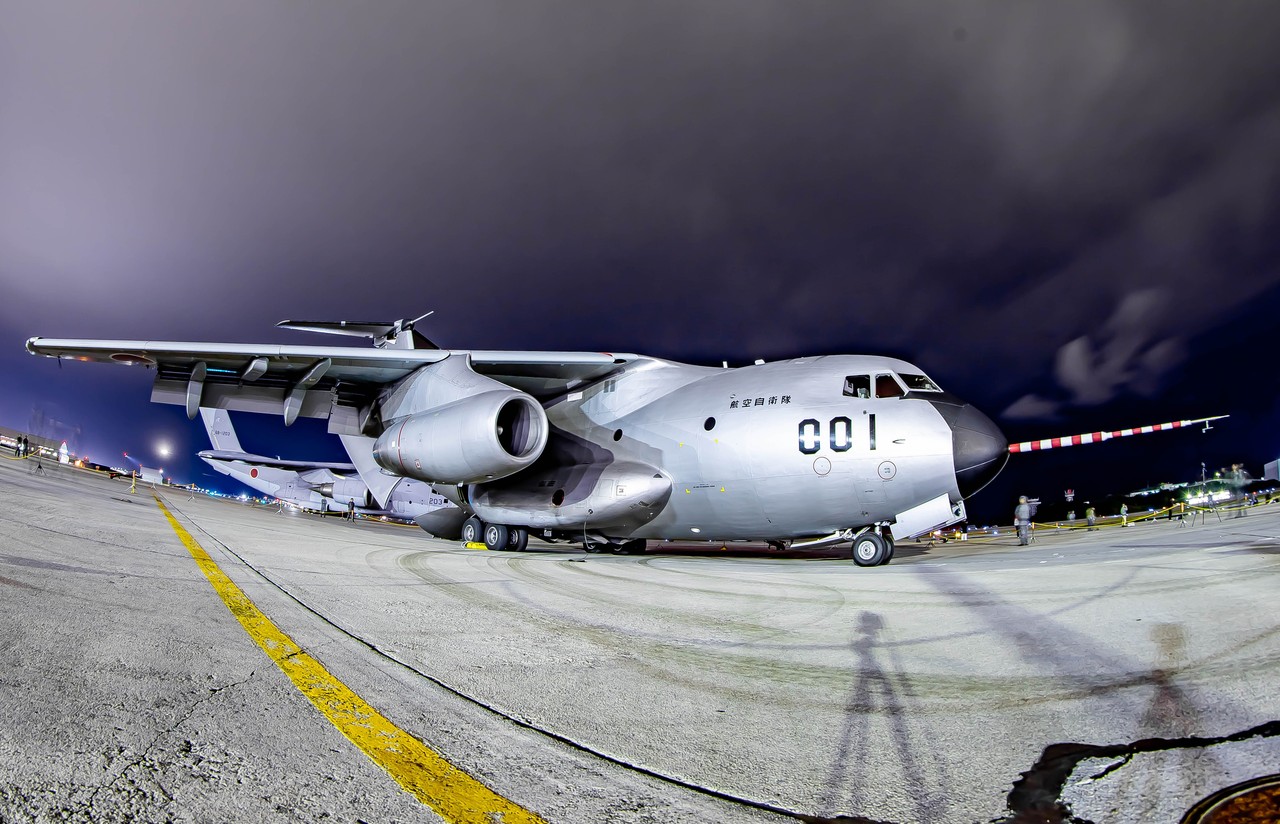
Service History
The C-1 dominated Japan's military transport operations from its December 1974 introduction until its retirement in March 2025, providing over 50 years of continuous service. All 31 aircraft built served exclusively with the Japan Air Self-Defense Force, making it one of the few modern military transports never exported to foreign operators. The type handled tactical military transport duties, cargo operations, and civilian disaster relief missions throughout Japan's mountainous terrain, where its short-field capabilities proved invaluable.
Development Origins
Development began in 1966 when the JASDF recognized the urgent need to replace its aging fleet of World War II-era Curtiss C-46 Commando transports. The Nihon Aircraft Manufacturing Corporation, a consortium of major Japanese companies, initially coordinated the design effort before transferring prime contractor responsibilities to Kawasaki Heavy Industries. The prototype XC-1 achieved its maiden flight on November 12, 1970, after four years of intensive development work.
The Manufacturer
Kawasaki Heavy Industries led the C-1 program as prime contractor while orchestrating a uniquely collaborative production arrangement among Japan's aerospace industry. Mitsubishi Heavy Industries constructed the tail section and middle fuselage portions, Fuji Heavy Industries produced the majority of wing components, Shin Meiwa built the rudder assembly, and NIPPI Corporation manufactured the flap systems. This distributed manufacturing approach demonstrated Japan's commitment to rebuilding its aviation industry following World War II restrictions.
Kawasaki Heavy Industries, founded in 1896, remains active today as a major Japanese conglomerate involved in aerospace, defense, shipbuilding, and industrial manufacturing. The company has produced numerous aircraft including the T-4 trainer and C-2 transport, establishing itself as a cornerstone of Japan's defense industrial base.
Engine & Technical Details
Two Mitsubishi-built Pratt & Whitney JT8D-M-9 low-bypass turbofan engines powered the C-1, each generating 14,500 pounds of thrust. These engines were license-produced versions of the widely successful American JT8D design that also powered commercial aircraft like the Boeing 727 and Douglas DC-9. The aircraft carried 15,200 liters of fuel distributed across four integral wing tanks, providing the range necessary for operations across Japan's island geography.
The crew consisted of two pilots and three mission specialists, with the high-wing configuration and distinctive T-tail providing excellent ground clearance for cargo operations. The rear-loading cargo compartment could accommodate various military vehicles, supplies, or up to 60 passengers depending on mission requirements.
Performance Characteristics
The C-1 achieved a maximum speed of 750 miles per hour at high altitude, though it typically cruised at more economical speeds for cargo operations. Low-altitude performance was limited to 375 miles per hour, reflecting the aircraft's design optimization for tactical transport rather than speed. Its maximum takeoff weight of 85,319 pounds allowed substantial payload capacity while maintaining the short-field performance essential for operations from Japan's smaller military airfields.
Specialized Variants
Several specialized variants emerged during the production run, including the EC-1 electronic warfare training version and the C-1FTB flight test bed converted from an XC-1 prototype. The National Aerospace Laboratory modified one airframe as the "Asuka" for Short Take-Off and Landing research, demonstrating the type's adaptability to experimental programs. The final five production aircraft incorporated additional internal fuel capacity, extending their operational range for long-distance missions.
Production & Legacy
Production extended from 1971 to 1981, with first deliveries reaching the JASDF in February 1974. The modest production run of 31 aircraft reflected Japan's specific requirements rather than export ambitions, as the nation focused on developing indigenous aerospace capabilities rather than competing in international markets. The C-1's design experience directly contributed to development of the larger, more capable Kawasaki C-2 that began replacing it in the 2000s.
The aircraft's March 15, 2025 retirement ceremony marked the end of an era for Japanese military aviation, as the last domestically designed transport of its generation left active service. Several examples are preserved in Japanese aerospace museums, commemorating the type's role in establishing Japan's modern military transport capabilities and demonstrating the nation's successful return to indigenous aircraft design and manufacturing.