
Origins and Development
The Provider's unusual genesis began with Chase Aircraft Company's ambitious 1949 design for an assault glider designated XCG-20. Chase engineer Michael Stroukoff conceived an aircraft that could operate both as a glider and powered transport, featuring an upswept rear fuselage with hydraulic loading ramp—a design innovation that would become standard on virtually all subsequent military cargo aircraft.
Chase completed the first XC-123 prototype on October 14, 1949, powered by two Pratt & Whitney R-2800 radial engines. However, financial difficulties forced Chase to abandon the project in June 1953 after building only five test aircraft. The Air Force transferred the contract to Fairchild Engine and Airplane Company, which refined the design into the production C-123B variant.
Production Challenges and Success
Fairchild's path to production proved rocky. Initially, Kaiser-Frazer won a 1953 contract to build 300 C-123B Providers, but a pricing scandal resulted in contract cancellation and the scrapping of all Kaiser-built airframes. Fairchild assumed production at their Hagerstown, Maryland facility, delivering the first operational C-123B in July 1955.
The company manufactured 302 C-123B aircraft through 1970, establishing the Provider as a workhorse for tactical airlift missions. Each aircraft featured two Pratt & Whitney R-2800-99W radial engines producing 2,300 horsepower, enabling operations from short, unprepared airstrips that challenged conventional transports.
Vietnam War Service
The Provider achieved its greatest prominence during the Vietnam conflict, where its short-field capabilities proved invaluable. C-123s delivered supplies to isolated outposts, evacuated wounded personnel, and inserted special operations teams behind enemy lines. The aircraft's ability to operate from primitive strips made it indispensable for supporting remote firebase operations throughout Southeast Asia.
Eight C-123s gained notoriety in Operation Ranch Hand, modified with spray equipment to dispense Agent Orange and other defoliants. These aircraft flew dangerous low-level missions to eliminate jungle cover protecting enemy forces, earning the motto "Only We Can Prevent Forests."
Engine Variants and Modifications
Recognizing performance limitations in hot, high-altitude conditions, the Air Force initiated several engine modification programs. Between 1966 and 1969, Fairchild converted 183 C-123Bs to C-123K configuration by adding two General Electric J85 turbojet engines mounted beneath the wings. These auxiliary jets provided crucial extra thrust for takeoffs from short strips with heavy loads.
Ten C-123Bs received conversion to C-123J standard on the production line, equipped with wingtip-mounted Fairchild J44-R-3 booster engines. In 1979, the Royal Thai government commissioned Mancro Aircraft Company to convert one C-123B to turboprop power using Allison T56-A-7 engines, creating the sole C-123T variant with "wet" wings and modern avionics.
Diverse Military Operators
Beyond Air Force service, the Provider found users throughout the military establishment. The Coast Guard acquired eight C-123Bs starting in June 1958 for logistical support of LORAN stations and isolated installations. Coast Guard Providers operated from air stations in Miami, Puerto Rico, Hawaii, Guam, Alaska, and Italy, proving the type's global versatility.
Two specially modified AC-123K gunships served briefly in Korea during 1968-1969, flying nighttime interdiction missions against North Korean infiltrators approaching by sea. The aircraft operated from Osan Air Base between August and October 1968 before returning to Southeast Asian operations.
The Air Force Thunderbirds demonstration team employed C-123s as logistics support aircraft, transporting ground crews and equipment to air shows nationwide. One Provider even carried President John F. Kennedy's limousine during his November 1963 Texas tour, demonstrating the type's utility for high-profile government missions.
Post-Military Career
Retiring from military service during the 1970s and 1980s, surplus Providers found second careers as aerial firefighters throughout the American West. Their large cargo compartments and short-field performance made them ideal for dropping fire retardant in mountainous terrain, with many aircraft serving firefighting operations into the early 1990s.
The final military C-123 unit operated UC-123s from Rickenbacker Air National Guard Base in Ohio, conducting mosquito control spraying missions until the type's complete retirement from American military service.
Legacy and Survivors
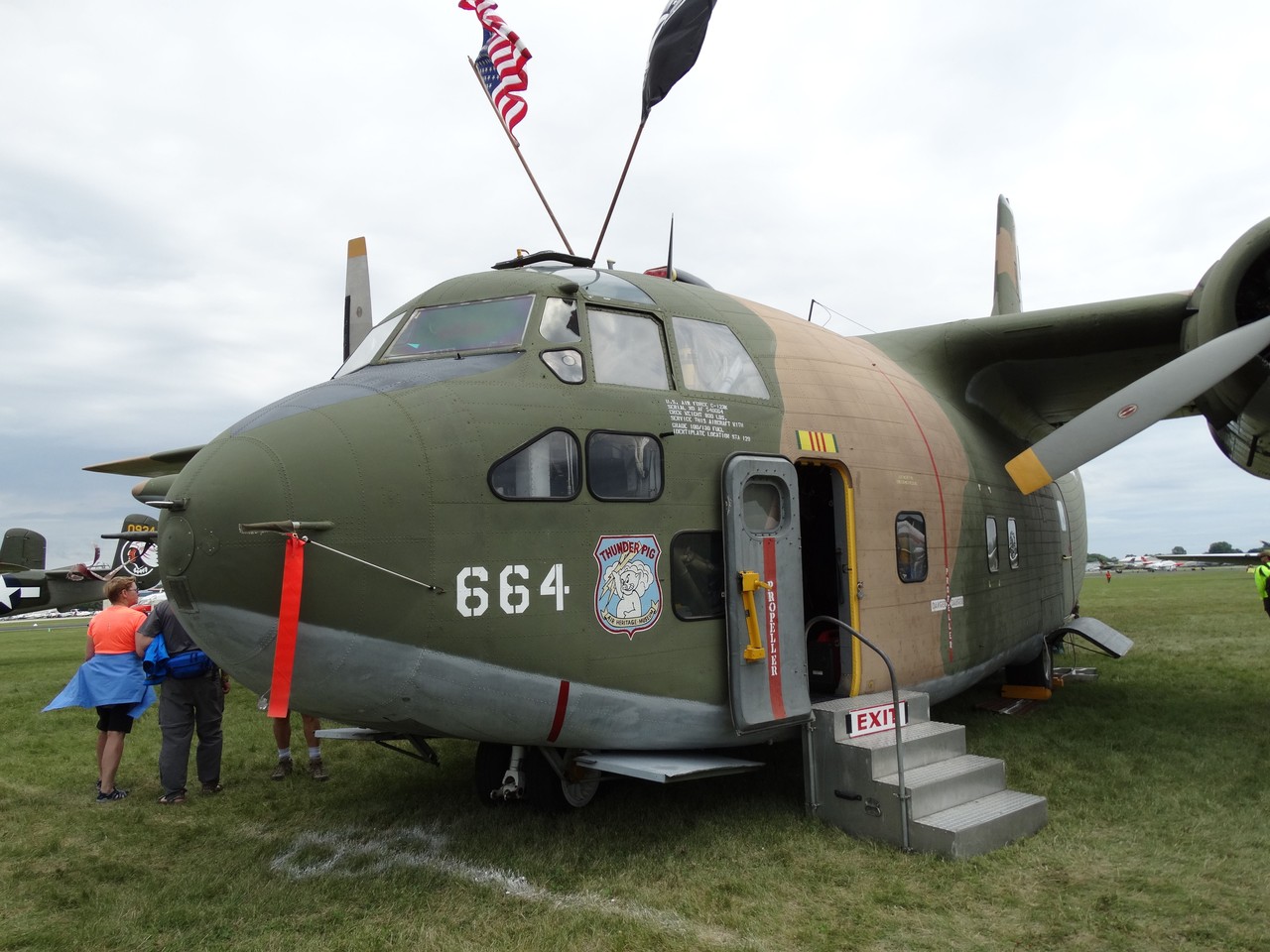
Of approximately 302 C-123 Providers manufactured, only one remains airworthy today: the "Thunder Pig" preserved at Air Heritage Aviation Museum in Chippewa, Pennsylvania. Static museum examples survive at the Pima Air & Space Museum in Arizona and the Air Mobility Command Museum in Delaware, among other locations.
The Provider's design legacy extends far beyond its modest production numbers. Its hydraulic rear loading ramp and upswept fuselage configuration established the template for virtually every subsequent military cargo aircraft, from the C-130 Hercules to modern strategic airlifters. The Royal Thai Air Force operated the type until 1995, making Thailand among the last military operators of this rugged, versatile transport that proved indispensable wherever short airstrips and heavy loads demanded an uncommon combination of strength and agility.