
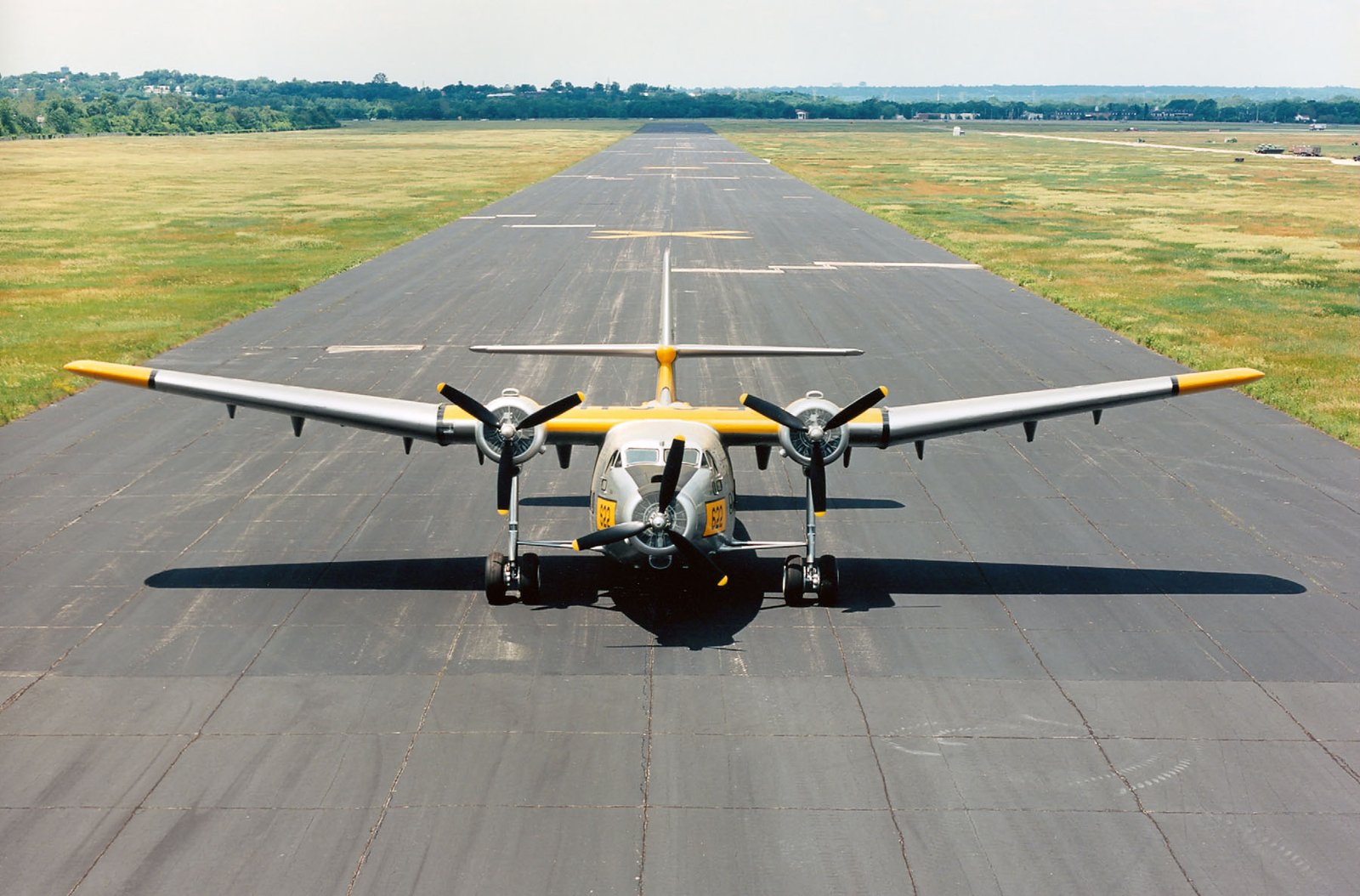
Development and Design
The C-125 Raider emerged from a March 1948 U.S. Air Force contract awarded to Northrop Aircraft for a military variant of their civilian N-23 Pioneer cargo aircraft. The Air Force designated this military adaptation as the N-32, later receiving the official designation YC-125. Northrop's design team focused on creating a tactical transport capable of operating from rough, short airfields while providing easy maintenance access and robust performance in forward deployment scenarios.
The aircraft's tri-motor configuration represented both innovation and tradition, utilizing a proven layout that would soon be rendered obsolete by advancing helicopter technology and more efficient twin-engine designs. The high-wing arrangement provided excellent ground clearance for operations from unprepared surfaces, while the substantial cargo compartment could accommodate military equipment and personnel with equal efficiency.
Production and Variants
Northrop manufactured exactly 23 C-125 Raiders between 1949 and 1950 at their Hawthorne facility. The production run comprised two distinct variants: 13 YC-125A aircraft configured for light assault transport duties, and 10 YC-125B variants specifically modified for Arctic rescue operations. This limited production reflected the Air Force's cautious approach to evaluating the design's military potential.
The YC-125B variant incorporated specialized equipment for cold-weather operations, including enhanced heating systems and survival gear storage. These aircraft underwent extensive testing at Wright-Patterson Air Force Base in Ohio during 1950, where evaluators assessed their suitability for rescue missions in harsh polar environments.
Engine and Performance
Powering the C-125 were three Wright R-1820-99 Cyclone radial engines, with one mounted in the nose and two positioned on the wings. Each nine-cylinder, air-cooled radial produced 1,200 horsepower, though this power combination proved insufficient for the aircraft's weight and mission requirements. The Wright R-1820, manufactured by Wright Aeronautical (later Curtiss-Wright), had proven its reliability in legendary aircraft including the B-17 Flying Fortress and numerous other military types.
The Raider achieved a maximum speed of approximately 170 miles per hour with a service ceiling near 20,000 feet and operational range of 1,000 miles. While these specifications met basic military transport requirements, the aircraft's performance lagged behind emerging helicopter designs that could perform similar missions with greater versatility and without requiring prepared landing areas.
Military Service
The C-125 entered Air Force service purely for evaluation and training purposes, never seeing combat operations. Initial deliveries began in 1950, with aircraft assigned to Sheppard Air Force Base in Texas under the 3750th Technical Training Wing beginning in May 1951. These aircraft primarily served as maintenance training platforms and test subjects for evaluating tactical transport concepts.
By 1955, the Air Force declared the entire C-125 fleet surplus, effectively ending the type's military career after just five years. The cancellation reflected rapid technological advancement in military aviation, as helicopters like the Sikorsky H-19 and fixed-wing transports such as the Fairchild C-123 Provider offered superior capabilities for the missions originally envisioned for the Raider.
The Manufacturer
Northrop Aircraft, Inc. was established in 1939 by visionary designer Jack Northrop, who had previously worked with Douglas Aircraft and Lockheed. The company gained recognition for innovative designs including the P-61 Black Widow night fighter and experimental flying wing bombers like the YB-49. Northrop's focus on advanced aerodynamics and unconventional configurations established the company as a significant aerospace innovator.
Following various corporate reorganizations, Northrop merged with Grumman in 1994 to form Northrop Grumman Corporation. The modern company later acquired Litton Industries in 2001 and continues operating today as a major defense contractor specializing in aerospace systems, electronics, and advanced technologies.
Civilian Operations
After military surplus declaration, most C-125 aircraft found new life in civilian cargo operations. Frank Ambrose Aviation of Miami, Florida acquired the majority of surplus Raiders, subsequently reselling them to Latin American operators. Notable civilian registrations included XB-GEY, operated by Triplay y Maderas de Durango S.A. in Mexico beginning in 1956.
Civilian operations proved challenging due to parts availability and maintenance complexity. The specialized tri-motor configuration created logistical difficulties for operators accustomed to more common twin-engine designs. Most civilian Raiders ceased operations by the mid-1960s as spare parts became increasingly scarce and operating economics favored more modern aircraft.
Legacy and Survivors
Today, only two C-125 Raiders survive in museum collections. The Pima Air & Space Museum in Tucson, Arizona displays YC-125A serial number 48-636, which previously served as civil registration N2573B and Mexican XB-GEY before museum acquisition in 1986. The National Museum of the United States Air Force in Dayton, Ohio preserves YC-125B serial number 48-626, painted to represent its 1950 Arctic testing configuration.
The C-125 Raider represents a significant milestone as the final tri-motor aircraft to serve with American military forces. While its service career proved brief and operationally limited, the type demonstrates the rapid technological evolution that characterized post-World War II aviation development, marking the transition from traditional piston-powered transports to the helicopter age.