
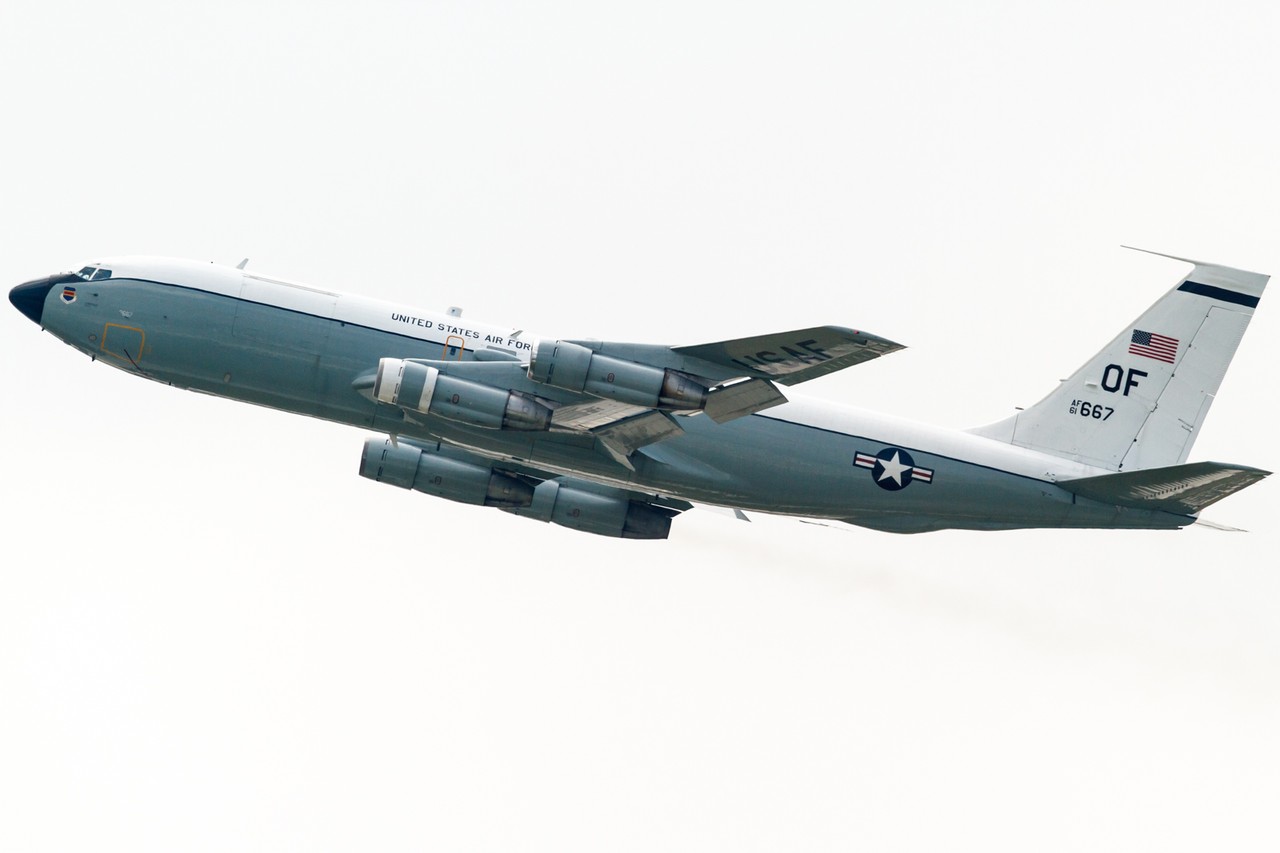
Service History
The WC-135 Constant Phoenix occupies a unique position in military aviation as the Air Force's sole dedicated atmospheric sampling platform. Since entering service in December 1965, these aircraft have provided critical intelligence gathering capabilities for nuclear treaty verification and environmental monitoring. Operating exclusively with the 55th Wing at Offutt Air Force Base, Nebraska, the WC-135 fleet has maintained continuous readiness for over six decades, flying missions that no other aircraft can perform.
Ten initial WC-135B aircraft were converted from C-135B transports and assigned to the 55th Weather Reconnaissance Squadron at McClellan Air Force Base, California, under Military Airlift Command. These aircraft replaced the aging WB-50 bombers that had previously handled atmospheric sampling duties. The specialized mission profile requires the aircraft to deliberately fly through radioactive plumes and contaminated airspace to collect samples that provide crucial data for arms control verification.
Operational Variants and Modernization
The WC-135 family encompasses four distinct variants, each representing technological advancement and operational requirements. The original WC-135B aircraft served as the foundation, with one unit redesignated as WC-135W following extensive upgrades in the 1990s. In 1998, the Air Force converted a former EC-135C Looking Glass aircraft (serial number 62-3582) into the WC-135C variant, incorporating more advanced systems.
The most recent modernization effort produced three WC-135R aircraft converted from KC-135R Stratotankers between 2022 and 2023. The first WC-135R was delivered in July 2022, followed by the second in May 2023, and the final aircraft in December 2023. These conversions ensure mission continuity well into the 21st century while incorporating modern avionics and improved reliability.
The Manufacturer
Boeing Aircraft Company, now The Boeing Company, designed and manufactured the original C-135 and KC-135 platforms from which all WC-135 variants derive. The C-135 family itself evolved from Boeing's Model 367-80 prototype, which first flew on July 15, 1954. The C-135 prototype achieved its maiden flight on August 17, 1956, establishing the foundation for one of aviation's most versatile airframe families.
Boeing has undergone significant corporate evolution since the C-135's development, including the 1961 merger with Vertol Aircraft Corporation and the pivotal 1997 acquisition of McDonnell Douglas. These changes transformed Boeing into one of the world's largest aerospace manufacturers, yet the company continues supporting the C-135 family through parts supply and technical expertise decades after initial production ended.
Engine and Technical Specifications
The WC-135 variants employ different powerplants depending on their conversion source and timeline. The WC-135B and WC-135W utilize four Pratt & Whitney TF33-P-5 turbofan engines, each producing 16,050 pounds of thrust. The WC-135C operates with TF33-P-9 engines delivering identical thrust output, while the newest WC-135R aircraft inherited General Electric F108 high-bypass turbofans from their KC-135R origins.
The TF33 engine family proved instrumental in establishing turbofan technology within military aviation during the 1960s. These high-bypass engines provided improved fuel efficiency compared to turbojet predecessors while maintaining the reliability essential for specialized reconnaissance missions. The BAC 310/311/312 airfoil at the wing root transitioning to BAC 313 at the tip optimizes performance across the aircraft's operational envelope.
Mission Profile and Capabilities
WC-135 operations require exceptional crew training and aircraft preparation due to the hazardous nature of atmospheric sampling missions. The aircraft routinely penetrates radioactive clouds, chemical plumes, and severe weather systems that would be avoided by conventional aircraft. Specialized sampling equipment installed throughout the fuselage collects air samples, particulate matter, and meteorological data during these dangerous flights.
The aircraft's maximum speed of 581 miles per hour enables rapid response to global events requiring atmospheric monitoring. With a service ceiling exceeding 40,000 feet and intercontinental range capability, the WC-135 can deploy worldwide within hours of notification. This global reach proved essential during Cold War nuclear testing monitoring and continues supporting modern arms control verification efforts.
Current Operations and Legacy
As of 2024, the active WC-135 fleet consists of five aircraft: one WC-135C, one WC-135W, and three WC-135R variants. These aircraft maintain continuous alert status from Offutt Air Force Base, ready to deploy for atmospheric sampling missions anywhere in the world. The 45th Reconnaissance Squadron operates these specialized platforms with highly trained crews qualified for hazardous material exposure and complex sampling procedures.
The WC-135 program represents one of military aviation's most enduring success stories, adapting proven airframe technology for unique national security requirements. Six decades of continuous service demonstrate both the aircraft's fundamental design excellence and the ongoing importance of atmospheric monitoring in an era of proliferating nuclear capabilities. The recent WC-135R conversions ensure this critical mission will continue for decades to come.