
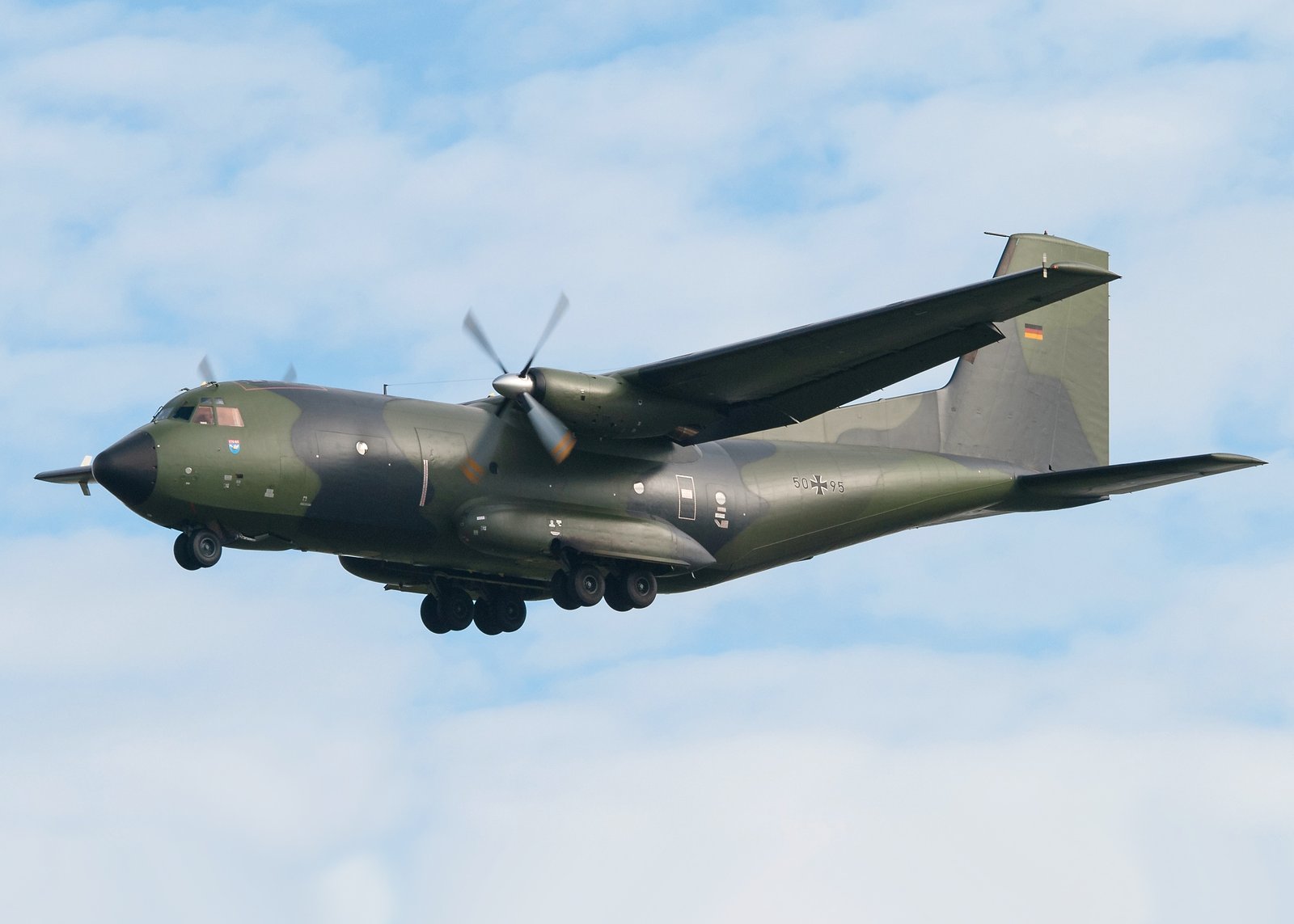
Breaking Down Barriers: The Franco-German Partnership
The Transall C-160's greatest achievement lay not merely in its technical capabilities, but in proving that complex military aircraft could emerge from international cooperation between former adversaries. The Transporter Allianz, formed in January 1959, united Aérospatiale of France with Germany's MBB and VFW-Fokker in an unprecedented partnership that would influence European aerospace collaboration for decades.
Production began with clear national divisions: France manufactured the first 25 aircraft while Germany license-built 161 examples. This arrangement demonstrated practical industrial cooperation while maintaining each nation's manufacturing capabilities. The program's success paved the way for future European projects, including the Airbus consortium and later military collaborations.
Military Service Across Four Decades
The C-160 proved its worth across multiple conflicts and operations spanning more than 40 years. During the 1991 Persian Gulf War, French C-160G Gabriel variants provided crucial signals intelligence capabilities. Later, French forces deployed at least one C-160 during operations over Libya, operating from bases in Crete.
West Germany became the largest operator with 110 C-160D aircraft, while France operated 50 C-160F examples. The aircraft's versatility showed in its capacity figures: 90 paratroopers for airborne operations or 63 casualties plus four medical attendants for evacuation missions. This flexibility made it invaluable for NATO operations throughout the Cold War.
South Africa became the first foreign operator in February 1969, receiving nine C-160Z aircraft. Turkey followed with 20 C-160T examples, originally built for West Germany but sold in 1971. Indonesia uniquely operated six civil variants, demonstrating the aircraft's potential beyond military service.
Variants and Specialized Roles
The C-160 family expanded through numerous specialized variants addressing specific operational needs. The C-160NG (Nouvelle Generation) program beginning in 1981 modernized French aircraft with updated avionics and systems. Most notably, 29 C-160G Gabriel aircraft served in signals intelligence roles, with 14 configured for aerial refueling duties.
Pre-series C-160A aircraft numbered six examples, serving both French and German air forces for evaluation. Four C-160H aircraft underwent conversion between 1981 and 1987 for specialized missions, while C-160R variants received renovated avionics packages to extend service life.
Technical Innovation and Performance
The C-160's twin-turboprop configuration provided reliable performance with a maximum speed of 319 mph and operational flexibility from unprepared airfields. Its high-wing design enhanced cargo loading capabilities while maintaining ground clearance for rough-field operations. The aircraft earned the nickname "Mumbling Bee" due to its distinctive engine sound, becoming instantly recognizable to ground personnel.
The powerplant selection proved crucial for the aircraft's success, though specific engine details demonstrate the careful engineering balance between power, fuel efficiency, and maintenance requirements. The twin-engine configuration provided redundancy essential for military operations while keeping operational costs manageable for sustained service.
Production Achievement
Total production reached 214 aircraft across two distinct series from 1967 to 1985. The first series concluded in 1972 with 178 aircraft including three prototypes and six pre-series examples. Second series production added 36 aircraft, with 29 new airframes for France and six civil variants for Indonesia.
Three prototypes validated the design through extensive testing. The first prototype flew from Melun-Villaroche airfield in France on February 25, 1963. The second prototype followed from Lemwerder, Germany on May 25, 1963, while the third flew from Hamburg-Finkenwerder on February 19, 1964. Initial production deliveries began in October 1967.
Legacy and Replacement
As of recent years, the C-160 continued active service with French, German, and Turkish air forces, testament to its enduring design. However, modernization pressures led to replacement programs. In March 2018, France announced plans to replace its C-160G Gabriel signals intelligence aircraft with modified Dassault Falcon business jets, with deliveries beginning in 2025.
The Airbus A400M emerged as the primary C-160 successor, with both Germany and France placing substantial orders despite later reductions. Turkey received its first A400M in April 2014, beginning the transition from C-160T aircraft. France invested $141 million in C-160 upgrades as a stopgap measure for delayed A400M deliveries, completing redelivery of upgraded Gabriel aircraft in 2011.
The C-160's 40-year service record established it as both reliable and effective in its defined transport role, while its international development model influenced subsequent European aerospace cooperation programs.