
Design Development
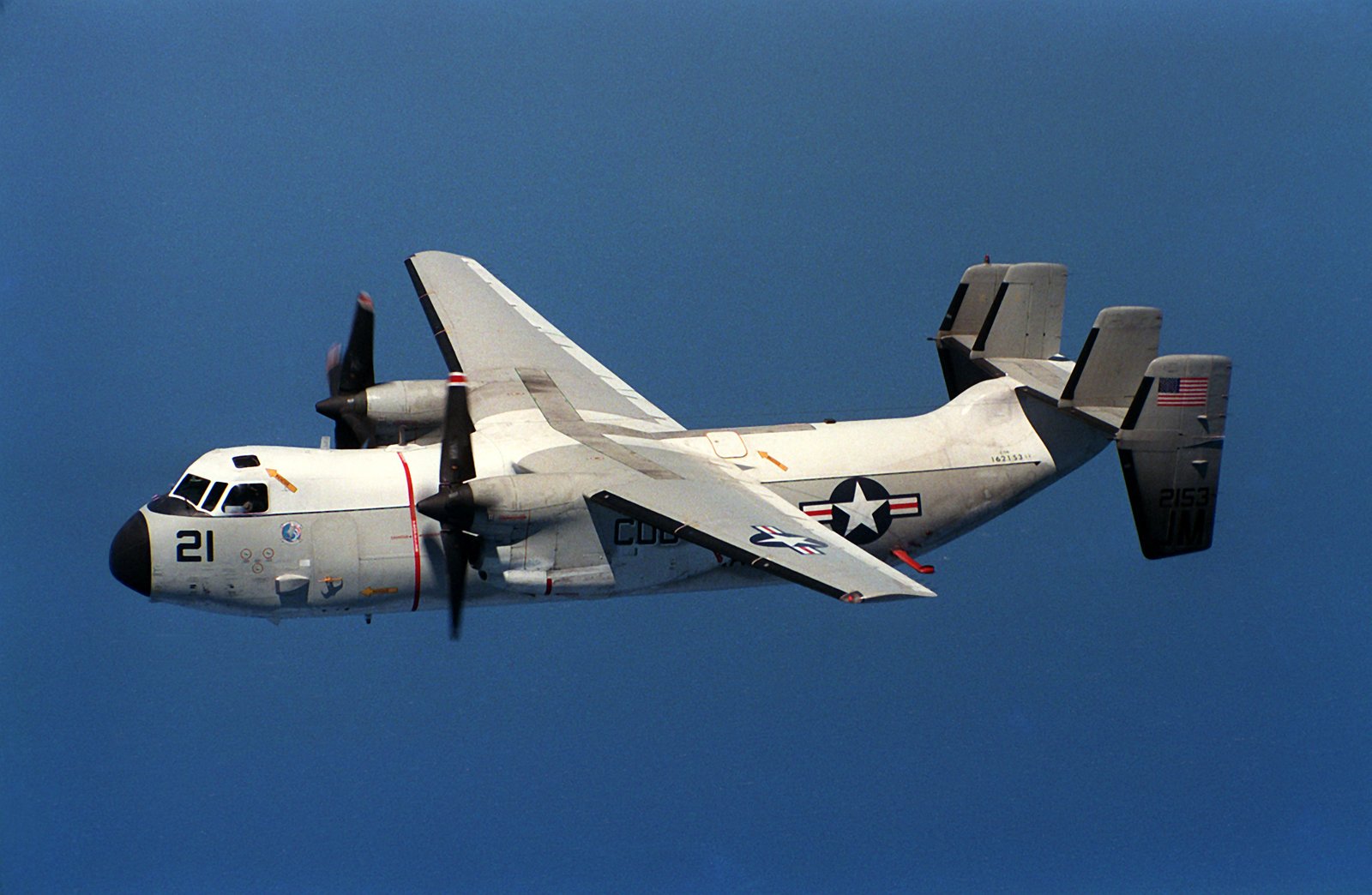
The C-2 Greyhound emerged from the U.S. Navy's urgent need to replace the aging piston-powered C-1 Trader in the carrier onboard delivery role. Grumman engineers cleverly adapted the proven E-2 Hawkeye platform, retaining the wing structure, folding "Sto-Wings," and powerplant while completely redesigning the fuselage. The new design featured a significantly widened cargo compartment with a rear loading ramp, transforming an airborne early warning aircraft into a dedicated transport.
The first prototype took flight on November 18, 1964, leading to production beginning in 1965. Two initial prototypes were actually converted from existing E-2A Hawkeyes, demonstrating the engineering efficiency of the derivative approach.
Limited Production History
Grumman's production of the C-2 occurred in two distinct phases, reflecting the Navy's changing needs and budget constraints. The initial production run from 1965 to 1968 yielded just 17 C-2A aircraft. By the early 1970s, operational attrition had reduced this small fleet to approximately a dozen airworthy examples, forcing the Navy to implement life extension programs in 1973.
Recognizing the continuing need for carrier delivery capability, the Navy authorized a second production batch beginning in 1984. This run produced 39 improved C-2A(R) "Reprocured" aircraft through 1989, bringing total production to 56 examples. Each aircraft cost taxpayers approximately $38.96 million.
Powerplant and Performance
The Greyhound's twin Allison T56-A-425 turboprop engines, each producing 4,800 horsepower, provide the aircraft with impressive performance characteristics for carrier operations. The aircraft achieves a maximum speed of 345 mph and cruises at 289 mph, with a service ceiling of 33,500 feet and an exceptional rate of climb of 2,610 feet per minute—crucial capabilities for rapid carrier approach and departure cycles.
The T56 engine family, manufactured by Allison (now part of Rolls-Royce), became one of military aviation's most successful turboprops, also powering the C-130 Hercules, P-3 Orion, and the C-2's sibling, the E-2 Hawkeye. This commonality simplified maintenance and training for Navy personnel.
Operational Excellence
The C-2 Greyhound has participated in every major U.S. naval operation since the 1980s, proving its worth through decades of demanding carrier operations. During a remarkable 15-month period from November 1985 to February 1987, Navy Transport Squadron VR-24 and its seven C-2A(R) aircraft demonstrated exceptional capability in European and Mediterranean operations, delivering 2 million pounds of cargo, 2 million pounds of mail, and transporting 14,000 passengers.
The aircraft's versatility became evident during Operation Desert Shield and Desert Storm in 1991, when C-2A(R) aircraft supported carrier battle groups in the Persian Gulf. The Greyhound continued this distinguished service record through Operation Enduring Freedom in Afghanistan from 2001 to 2021.
Mission Capabilities
Operating with a crew of two pilots and two loadmasters, the C-2 can be rapidly reconfigured for various missions. In passenger configuration, it accommodates up to 26 personnel in airline-style seating. For medical evacuation, the aircraft can carry 12 litters with attendant medical equipment. The cargo hold accepts up to 10,000 pounds of supplies, spare parts, or mail, with the rear loading ramp facilitating rapid turnaround times essential for carrier operations.
Grumman Aircraft Engineering Corporation
The C-2's manufacturer, Grumman Aircraft Engineering Corporation, built its reputation on rugged carrier-based aircraft. Founded in 1930 by Leroy Grumman and partners, the company became synonymous with Navy aviation, producing legendary aircraft including the F4F Wildcat, F6F Hellcat, and F-14 Tomcat. Grumman merged with Northrop in 1994 to form Northrop Grumman, which continues to support the C-2 fleet today.
Modern Upgrades and Future
In 2010, all surviving C-2A(R) aircraft received significant upgrades including new eight-blade propellers replacing the original four-blade units, along with glass cockpit systems and updated navigation equipment. These improvements extended the aircraft's operational life and enhanced safety margins.
Despite the C-2's proven track record, the U.S. Navy plans to replace the entire Greyhound fleet with V-22 Osprey tiltrotor aircraft by 2028. Until then, the remaining C-2A(R) aircraft continue their vital mission, with the Navy implementing Critical Life Extension Programs to maintain airworthiness.
Legacy
The C-2 Greyhound represents one of military aviation's most successful adaptations, proving that innovative engineering can transform an existing design for an entirely different mission. Its five-decade service record demonstrates the wisdom of Grumman's derivative approach and the aircraft's fundamental soundness. Though small in numbers, the C-2's impact on naval operations has been immeasurable, ensuring that carrier battle groups worldwide receive the supplies, personnel, and support necessary for sustained operations far from home ports.