
Development and Design Philosophy
The C-22J Ventura emerged from Caproni Vizzola's ambitious plan to capture the low-cost military trainer market. Development began in 1979 as a response to the U.S. Air Force's "Low Cost Aircraft" specification from 1978, with the Italian manufacturer seeking to leverage their glider expertise for jet trainer applications. The design team at Caproni Vizzola's bureau d'études evolved the concept from their successful A.21SJ Calif motorglider, maintaining the high aspect ratio wing design that would become the Ventura's most distinctive feature.
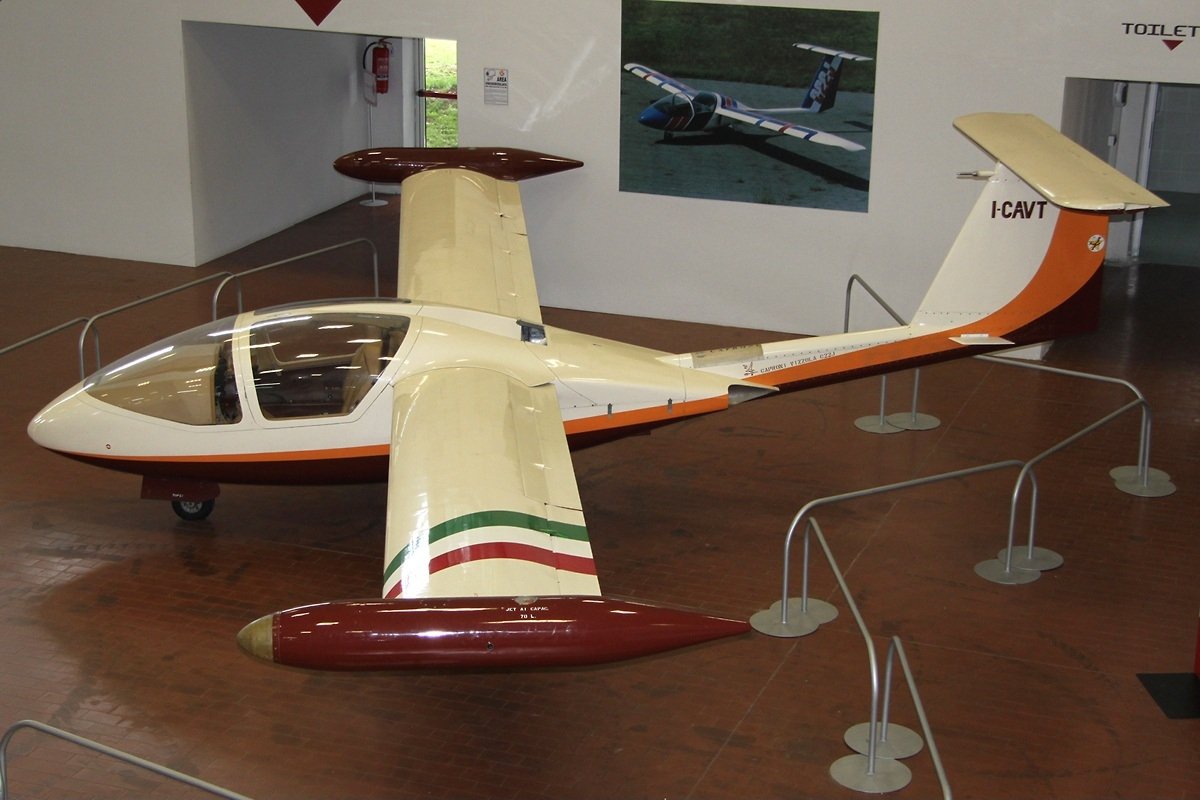
Designers Carlo Ferrarin and Livio Sonzio created an unconventional configuration featuring a high-wing monoplane with T-tail arrangement and twin turbojets embedded in the fuselage sides. The wing incorporated a Wortmann FX-67K-170 airfoil with an impressive 11.42:1 aspect ratio, providing exceptional fuel efficiency. Construction utilized a mix of metal, fiberglass, and composite materials including carbon and glass fibers, representing advanced manufacturing techniques for the early 1980s.
First Flight and Testing
Prototype I-CAVJ made its maiden flight on July 21, 1980, with no major incidents reported during the test program. Two additional prototypes followed: I-GIAC (002) and I-CAVT (003), completing the entire production run by 1981. The aircraft demonstrated respectable performance figures, achieving a maximum speed of 299 mph and a service ceiling of 25,000 feet while maintaining economical operation costs.
The Ventura's unique powerplant consisted of two Microturbo TRS 18-046 turbojets, each producing between 220-242.5 pounds of thrust. These French-manufactured engines, fed through dorsal NACA intakes, enabled the aircraft to achieve a climb rate of 1,810 feet per minute and a range of 460 miles. However, the engines' noise characteristics would later prove problematic for certification efforts.
The Manufacturer's Trajectory
Caproni Vizzola traced its heritage to one of Italy's oldest aviation companies, founded in 1910. The post-1969 iteration focused on glider production, building expertise that directly influenced the C-22J's efficient wing design. This glider background proved both an asset and a limitation, providing aerodynamic sophistication while lacking experience in jet aircraft certification and marketing.
In 1981, helicopter manufacturer Agusta acquired a 50% stake in the C22 program, bringing financial resources and international marketing capabilities. Agusta had entered Caproni's capital structure around 1981 and completed full acquisition of the company in 1983. The partnership seemed promising, with Augusta Aviation Corp launching a U.S. marketing campaign in 1985, pricing the Ventura at $380,000 per unit.
Market Challenges and Certification Issues
Despite appearances at major air shows including Farnborough (1980, 1982, 1984) and Paris Le Bourget (1981), the Ventura failed to attract orders. The aircraft faced significant certification hurdles, particularly noise issues that blocked FAA FAR23 approval for the U.S. market. This regulatory obstacle proved insurmountable, effectively eliminating the largest potential customer base.
The military variant promised versatility with 200 kg external load capacity distributed across two pylons. Proposed configurations included reconnaissance pods with three cameras, rocket pods, or 50 kg bombs. A dedicated reconnaissance variant, designated C22R, was proposed in 1981 for Forward Air Control and electronic intelligence missions but never progressed beyond planning stages.
Performance and Operational Characteristics
The completed aircraft weighed 1,587 pounds empty and 2,502 pounds at maximum takeoff weight, with 77 gallons of fuel capacity. Normal operating speed reached 201 mph, with landing approach at a modest 75 mph. The side-by-side seating arrangement provided good visibility and communication for training missions, while the tricycle retractable landing gear ensured conventional ground handling.
Operational costs remained attractively low, meeting the original design objective. However, the twin-engine configuration, while providing redundancy, increased maintenance complexity compared to single-engine competitors. The T-tail design, though aerodynamically efficient, raised concerns about deep stall characteristics during certification reviews.
Program Termination and Legacy
Agusta terminated the C-22J program in 1988, choosing instead to focus on the Siai Marchetti S211, which offered superior market prospects and certification compliance. The remaining Microturbo engines were sold to U.S. interests, effectively ending any possibility of program revival. Total investment in the three prototypes represented Caproni's final aircraft design effort.
Today, two of the three prototypes survive in Italian museums. I-CAVJ resides at the Museo dell'Aeronautica Gianni Caproni in Trento following restoration between 2007-2009, while I-CAVT is displayed at Volandia Museum near Milan. The fate of I-GIAC remains unclear. None remain airworthy, marking the end of an ambitious but ultimately unsuccessful attempt to democratize jet training aircraft.
The Ventura's failure reflected broader challenges facing smaller manufacturers entering the competitive military trainer market. Despite innovative design elements and reasonable performance, certification obstacles and market dynamics favored established players with deeper resources and regulatory experience.