
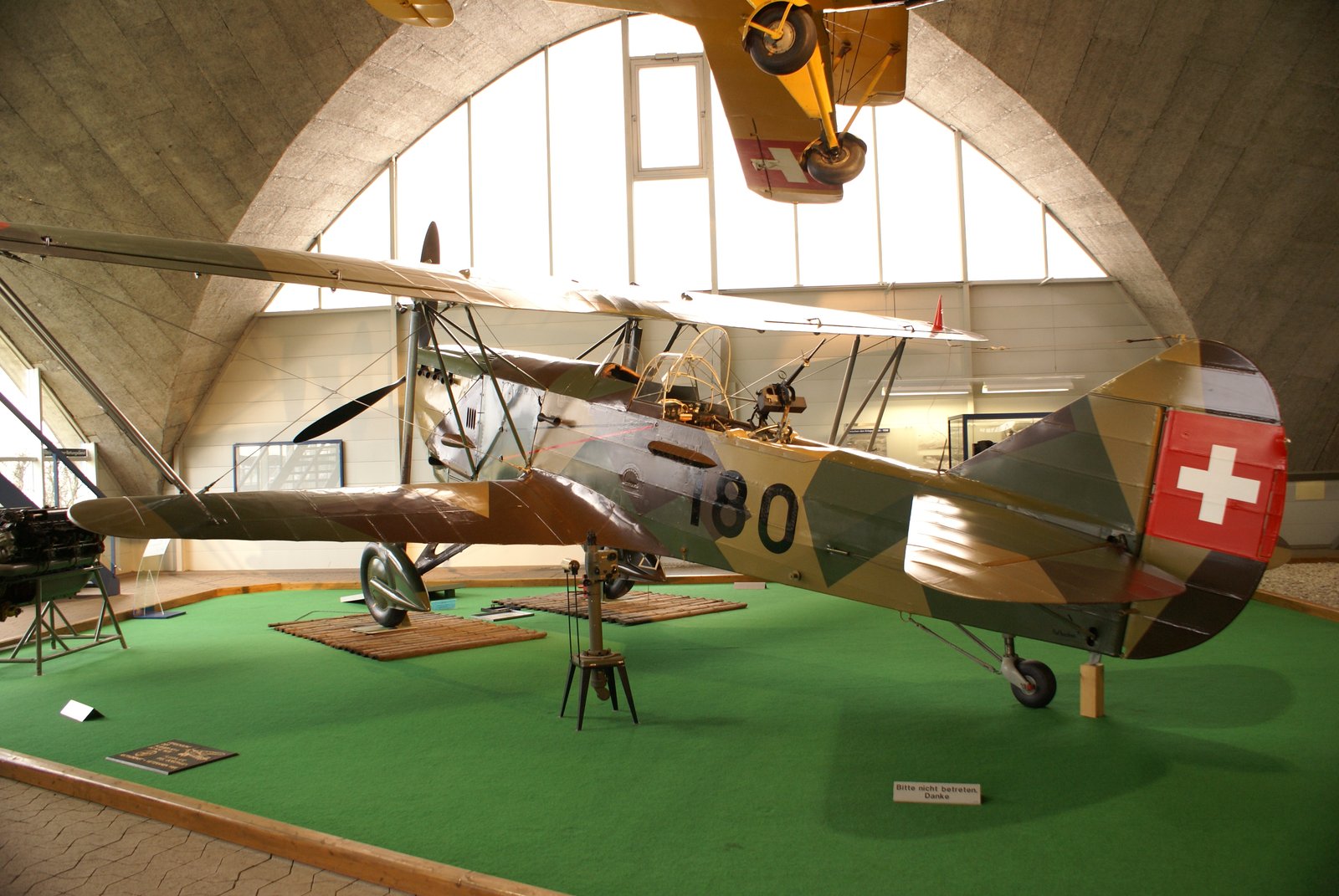
The Eidgenössische Konstruktionswerkstätte (EKW), also known as K+W, developed the C-35 in Thun, Switzerland, starting in 1936. Designed as a replacement for the license-built Fokker C.V-E and C.X reconnaissance aircraft, the C-35 represented a significant effort by Switzerland to establish indigenous military aviation capabilities during the inter-war period. The aircraft was a two-seat multipurpose biplane, a configuration that remained in use for Swiss front-line roles even as other nations transitioned to monoplanes.
Production began in the mid-1930s, with the first aircraft delivered to the Swiss Air Force in May 1937. The primary production run concluded by the end of 1938, though a small additional batch of eight aircraft was assembled from spare parts between 1941 and 1942, bringing the total number of airframes in service to 88. The C-35 was powered by a single liquid-cooled 12-cylinder V-type Hispano-Suiza HS-77 piston engine, which produced approximately 860 PS (633 kW).
Technically, the C-35 was designed for versatility, capable of performing tactical reconnaissance and light bombing via both horizontal and dive-attack methods. Its armament was substantial for a reconnaissance aircraft, featuring a 20 mm engine-mounted cannon firing through the propeller hub, two fixed forward-firing 7.5 mm machine guns in the wings, and one flexible 7.5 mm machine gun in the rear cockpit. For offensive strikes, it could carry 22 kg of bombs on underwing racks.
During the Second World War, the C-35 encountered combat during the German Western campaign of 1940. Swiss C-35s engaged Luftwaffe Heinkel He 111 bombers and Messerschmitt Bf 110 fighters near the border; during these engagements, at least one C-35 was shot down, resulting in the deaths of both crew members. Although considered outdated by 1939, the type remained in front-line service until 1943, when it was replaced by the F+W C-3603. Surviving aircraft were then relegated to night-flying and training units until their final withdrawal from service in 1954. Today, a preserved example (airframe number 180) is displayed at the Swiss Air Force Museum in Dübendorf.