
Service History
The C-3605 dominated Swiss Air Force target-towing operations from 1971 to 1987, providing aerial targets for military training exercises throughout the Cold War era. All 24 aircraft wore distinctive yellow-and-black striped liveries that earned them the nickname "Flying Zebra Crossing," making them among the most visually recognizable military aircraft in Swiss service. The type exceeded its planned 10-year structural life, operating reliably until airframe fatigue necessitated retirement in 1987, when surviving aircraft were replaced by converted Pilatus PC-9s.
Development and Conversion Program
The C-3605 program emerged from a 1965 Swiss Air Force evaluation that determined turboprop conversion of existing C-3603 airframes would be the most economical modernization solution. Jean-Pierre Weibel directed the conversion project, which began with the 102nd C-3603 airframe serving as the prototype. The conversion required significant engineering challenges, including a 1.82-meter nose extension to maintain proper center of gravity after replacing the heavy Hispano-Suiza piston engine with the much lighter Lycoming T53 turboprop.
Early flight testing revealed additional modifications were necessary, including the installation of a third vertical stabilizer to maintain directional stability. These engineering solutions proved successful, with the prototype completing satisfactory trials in August 1968 before the first official flight on August 19, 1968.
The Manufacturer
Farner Werke (F+W) undertook all C-3605 conversions at their Emmen facility between 1971 and January 1973. The company was the renamed successor to Eidgenoessische Konstruktionswerkstaette (EKW), Switzerland's Federal Construction Works, which had originally developed the C-3603 base aircraft beginning in 1942. EKW became Farner Werke in 1972, midway through the C-3605 conversion program.
The original C-3603 production had involved multiple Swiss manufacturers including F&W Emmen, DoFlug Altenrhein, and Pilatus AG in Stans, with approximately 160 units completed by 1948. EKW's Thun works had transitioned from aircraft production to artillery and armored vehicle manufacturing during the post-war period, leaving aircraft work concentrated at Emmen.
Engine and Technical Innovation
The Lycoming T53 turboprop engine transformation fundamentally altered the aircraft's characteristics and capabilities. This powerplant, significantly lighter than the original 860-horsepower Hispano-Suiza 12Y-51 twelve-cylinder inline piston engine, necessitated the dramatic nose extension that became the C-3605's most distinctive visual feature.
The conversion retained the original 45-foot wingspan while adding the third vertical stabilizer for enhanced directional control. Performance increased substantially, with the turboprop-powered aircraft achieving speeds near 300 mph compared to the piston-powered predecessor's more modest capabilities.
Operational Performance
Swiss Air Force crews found the C-3605 reliable and effective in the target-towing role, with the aircraft consistently performing training support missions throughout the 1970s and early 1980s. The type's high-visibility paint scheme served dual purposes, ensuring easy identification during training exercises while creating one of military aviation's most distinctive liveries.
By the mid-1980s, structural fatigue began appearing in the converted airframes, reflecting their origins as 1940s-era aircraft that had exceeded their designed service life. Despite this limitation, the C-3605 program successfully extended the operational utility of Swiss-built airframes for nearly two decades beyond their original retirement date.
Legacy and Preservation
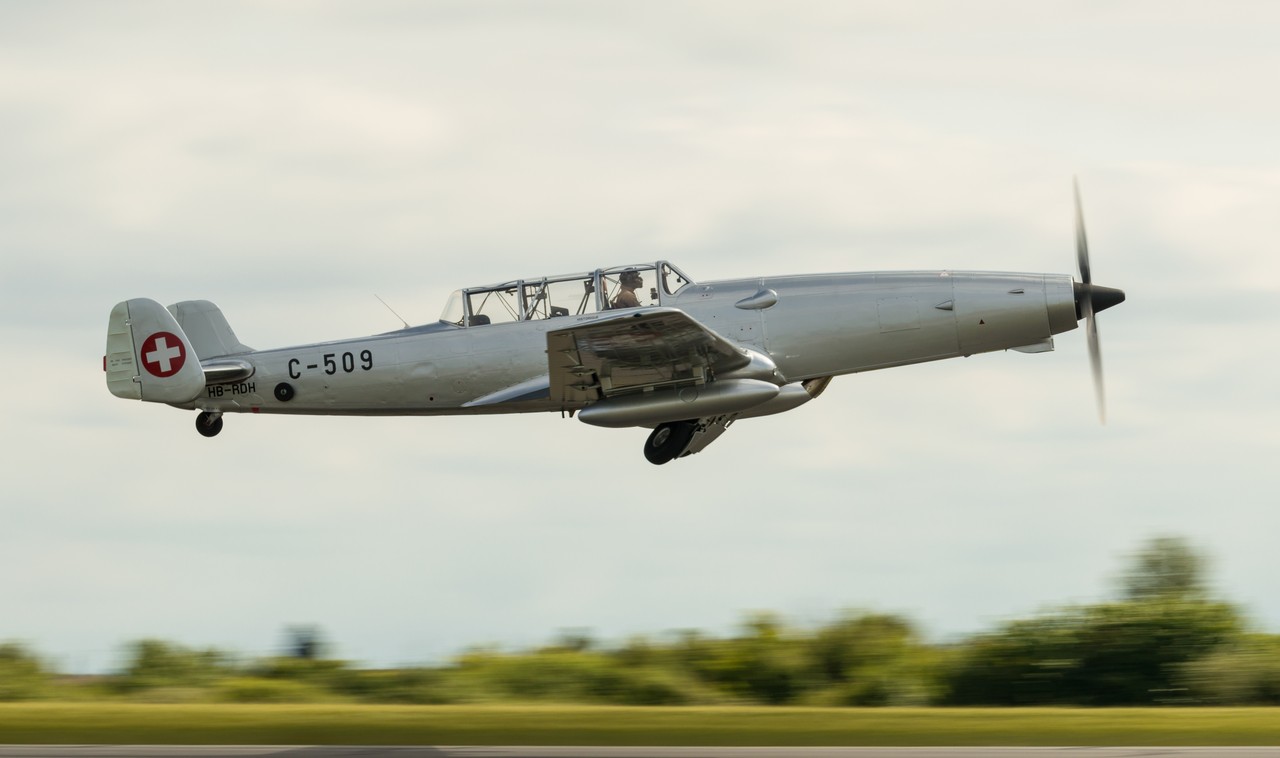
Two C-3605 aircraft remained airworthy in private hands following military retirement, representing rare examples of successful turboprop conversions of World War II-era designs. The most notable preservation effort involved aircraft C-547 (serial 327), which Max Daetwyler commissioned for reconversion to original C-3603-1 configuration with a restored Hispano-Suiza engine.
Ju-Air undertook this complex restoration beginning in 1990, requiring more than 3,400 hours of work to return the aircraft to its piston-engine configuration. The restored aircraft, registered HB-RBI, completed its maiden flight on September 2, 1991, at Zurich/Kloten, demonstrating the enduring appeal of these Swiss-designed aircraft.
The C-3605 program exemplified practical aircraft modernization, successfully extending airframe utility through powerplant conversion while maintaining operational effectiveness in specialized roles. Its distinctive appearance and successful service record established it as a memorable chapter in Swiss military aviation history.