
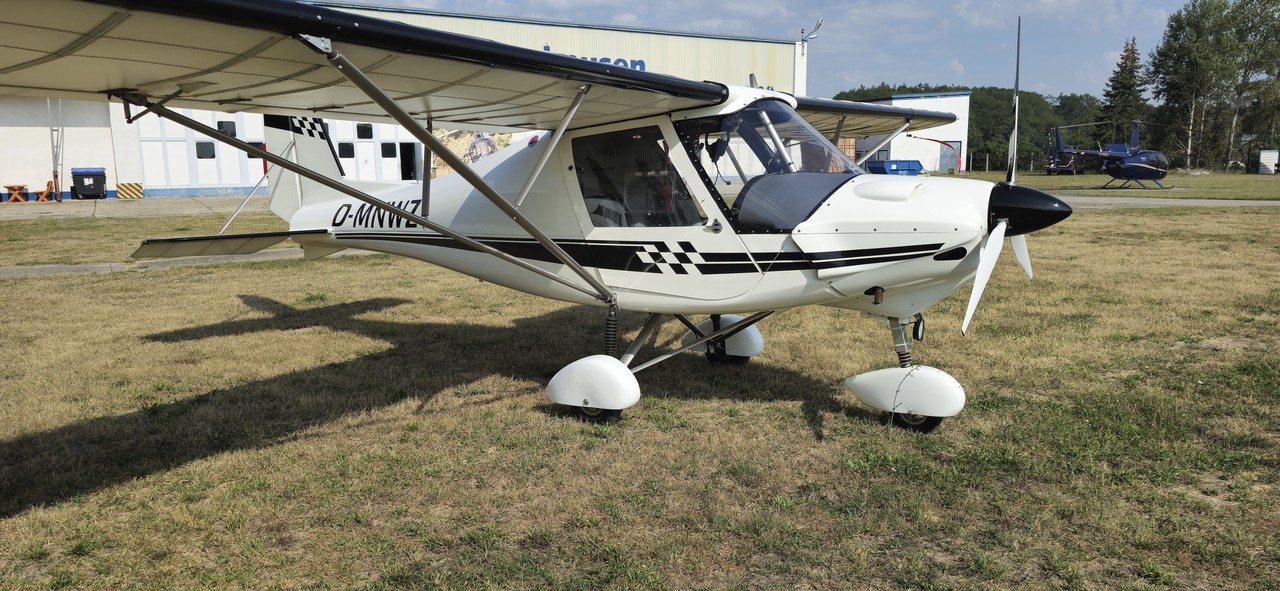
Development and Design Philosophy
Hans Gygax approached the C-42's design with clear objectives: create an ultralight that prioritized safety without sacrificing the agility and efficiency pilots demanded. Building upon lessons learned from the company's earlier C-22 Fox microlight, Gygax incorporated modern composite construction techniques with a steel tube framework to achieve both durability and weight savings. The resulting aircraft featured innovations uncommon in the ultralight category, including hydraulic disc brakes, gull-wing doors for easy access, and optional folding wings for hangar storage.
The C-42 made its public debut simultaneously at two major aviation events in the second quarter of 1997: the Friedrichshafen Air Show in Europe and Sun 'n' Fun in North America. This dual-continent launch strategy reflected Comco Ikarus's ambitious global marketing approach, with European deliveries commencing immediately following the aircraft's introduction.
Performance and Records
The C-42 quickly demonstrated its performance capabilities through a series of speed records. On May 10, 1998, the aircraft achieved 90.4 knots over a 100-kilometer course, followed three days later by a 71.78-knot average over 500 kilometers on May 13, 1998. These achievements validated the design's efficiency and established the C-42 as a serious contender in the touring ultralight market.
Operational characteristics include a maximum takeoff weight of 450 kilograms and fuel capacity of 50 liters, with optional ferry tanks available for extended range missions. The aircraft's tricycle landing gear features a steerable nosewheel and heavy-duty suspension system, enabling operations from both paved and grass airfields.
Manufacturing Excellence
Comco Ikarus GmbH traces its ultralight aviation heritage to before 1982, when the company had already delivered 2,000 aircraft across four different models worldwide. The German manufacturer established itself as an industry pioneer by developing the first dynamic test facility for ultralight aircraft, a facility that remained in continuous operation through the C-42's production era. Prior successful designs included the Sherpa, which became Germany's most-flown three-axis microlight, and the Fox series that served as the direct predecessor to the C-22.
Production of the C-42 commenced at the company's 640-square-meter facility in Hohentengen, Germany, following a facility relocation completed in spring 1992. Manufacturing peaked at approximately 80 aircraft annually, with both factory-built and kit-built options available to customers. The initial C-42 variant remained in production until 2003, when the improved C-42B superseded it.
Global Market Penetration
By late 2005, Comco Ikarus had delivered over 600 C-42 aircraft worldwide, with distribution spanning Europe, the Middle East, North and South America, Africa, and Asia. The United Kingdom emerged as a significant market, with 58 aircraft registered by the end of 2004 following Popular Flying Association clearance in 2002. The Netherlands received its first example, registered PH-2Y5, in mid-1997, while Australia's inaugural delivery occurred in mid-2005 with construction number 31192 registered as 19-8409.
Technical Innovation
The Rotax 912 series engine, manufactured by BRP-Rotax GmbH & Co KG in Austria, powers the C-42 through a 2.273:1 reduction gearbox driving either two or three-blade propellers. The 1,352-cubic-centimeter, four-cylinder, horizontally-opposed engine employs both air and liquid cooling systems, contributing to its reputation for reliability and fuel efficiency. Digital engine monitoring systems provide real-time data on RPM, temperatures, and oil pressure, while stainless steel exhaust systems and carburetor heat enhance operational reliability.
Evolution and Variants
The C-42B variant, introduced in 2003, incorporated Light Sport Aircraft compliance modifications for the expanding American market. Further development continued with the C-42C in 2012, featuring winglets and enhanced composite construction, followed by the C-42CS in 2015 with updated landing gear and interior appointments.
Current Status and Legacy
Comco Ikarus GmbH continues operations under its original name, leveraging five decades of ultralight aviation experience. The C-42 established new benchmarks for ultralight touring aircraft, demonstrating that small aircraft could achieve airline-like reliability while maintaining the freedom and accessibility that defines ultralight aviation. Notable examples include N577JP, which appeared at EAA AirVenture Oshkosh in 2007, showcasing the type's successful penetration into the North American Light Sport Aircraft market.
The aircraft's legacy extends beyond mere production numbers, having influenced ultralight design philosophy toward greater emphasis on safety systems, comfort, and cross-country capability. Optional equipment such as ballistic recovery parachutes and float landing gear expanded the C-42's operational envelope, while its spacious cockpit and modern avionics made it equally suitable for flight training and personal transportation.