
Service History
The C-46 Commando earned its reputation as the workhorse of the China-Burma-India theater, where it transported over one million tons of cargo across the Himalayas starting in April 1943. While the smaller C-47 Skytrain received more fame, the C-46's superior high-altitude performance and larger cargo capacity made it indispensable for supplying Allied forces in China. The aircraft could haul nearly double the payload of a C-47 at altitudes where thin air crippled other transports.
Wartime Operations
The U.S. Army Air Forces operated the C-46 primarily as a cargo hauler and troop transport throughout World War II. The aircraft proved its worth in multiple configurations: it could accommodate up to 50 fully equipped soldiers, serve as a medical evacuation platform with 33 stretchers, or handle paratroop operations through specialized side doors. The Royal Air Force and Royal Canadian Air Force also operated the type, extending its service across multiple Allied nations.
Production focused on three main variants. The initial C-46 saw limited production with just 25 aircraft built. The C-46A became the primary cargo variant with 1,456 examples featuring an enlarged cargo door. The C-46D, with 1,430 aircraft produced between 1944 and 1945, incorporated paratroop doors for airborne operations. The final C-46F variant accounted for 234 aircraft, with the last example (serial 44-78774) delivered in September 1945.
The Manufacturer
Curtiss-Wright Corporation emerged from the 1929 merger of the Curtiss Aeroplane and Motor Company, founded in 1916, and Wright Aeronautical. This aviation giant produced legendary aircraft including the P-40 Warhawk fighter before tackling the C-46 project. The company operated major manufacturing facilities in Buffalo, New York; Louisville, Kentucky; and St. Louis, Missouri during C-46 production.
The original corporation underwent significant restructuring after World War II, with its aviation divisions absorbed or sold by the 1950s. While elements of the company survived in other industries, the Curtiss-Wright that created the Commando effectively ceased aircraft production in the immediate postwar period.
Design Origins
The C-46's development traced back to the CW-20 airliner project initiated in 1936, designed to compete with Boeing's 307 Stratoliner in the pressurized passenger market. Curtiss-Wright's engineering team conducted extensive wind tunnel testing at the California Institute of Technology to refine the design. Test pilot Edmund T. "Eddie" Allen flew the prototype's maiden flight on March 26, 1940, launching what would become one of aviation's most significant transport aircraft.
The design incorporated several innovations for its era, including a distinctive "dome" cockpit for improved visibility and unique nacelle tunnel cowls that reduced drag. Unlike four-engine competitors such as the Douglas DC-4, the C-46 achieved superior performance through twin high-power engines, offering better fuel efficiency and simplified maintenance.
Engine and Technical Excellence
Pratt & Whitney R-2800 Double Wasp engines powered production C-46s, each delivering 2,000 horsepower from an 18-cylinder, double-row radial configuration. These engines replaced the original Wright R-2600 Twin Cyclone powerplants used in prototypes, providing superior single-engine performance and the high-altitude capability essential for Himalayan operations.
Founded in 1925, Pratt & Whitney produced over 125,000 R-2800 engines between 1937 and 1946, with the design proving exceptionally reliable in the demanding conditions of the Hump airlift. The engine's outstanding power-to-weight ratio enabled the C-46 to maintain performance with heavy loads at altitudes where other aircraft struggled.
Performance Characteristics
The C-46 measured 74 feet 4 inches in length with a height of 23 feet, dimensions that provided substantial internal volume for cargo operations. Its maximum speed reached 270 miles per hour, with a service ceiling of 27,000 feet and range extending up to 3,000 miles depending on payload configuration. The aircraft typically operated with a crew of three to four, including pilot, co-pilot, radio operator, and sometimes a flight engineer.
Postwar Legacy
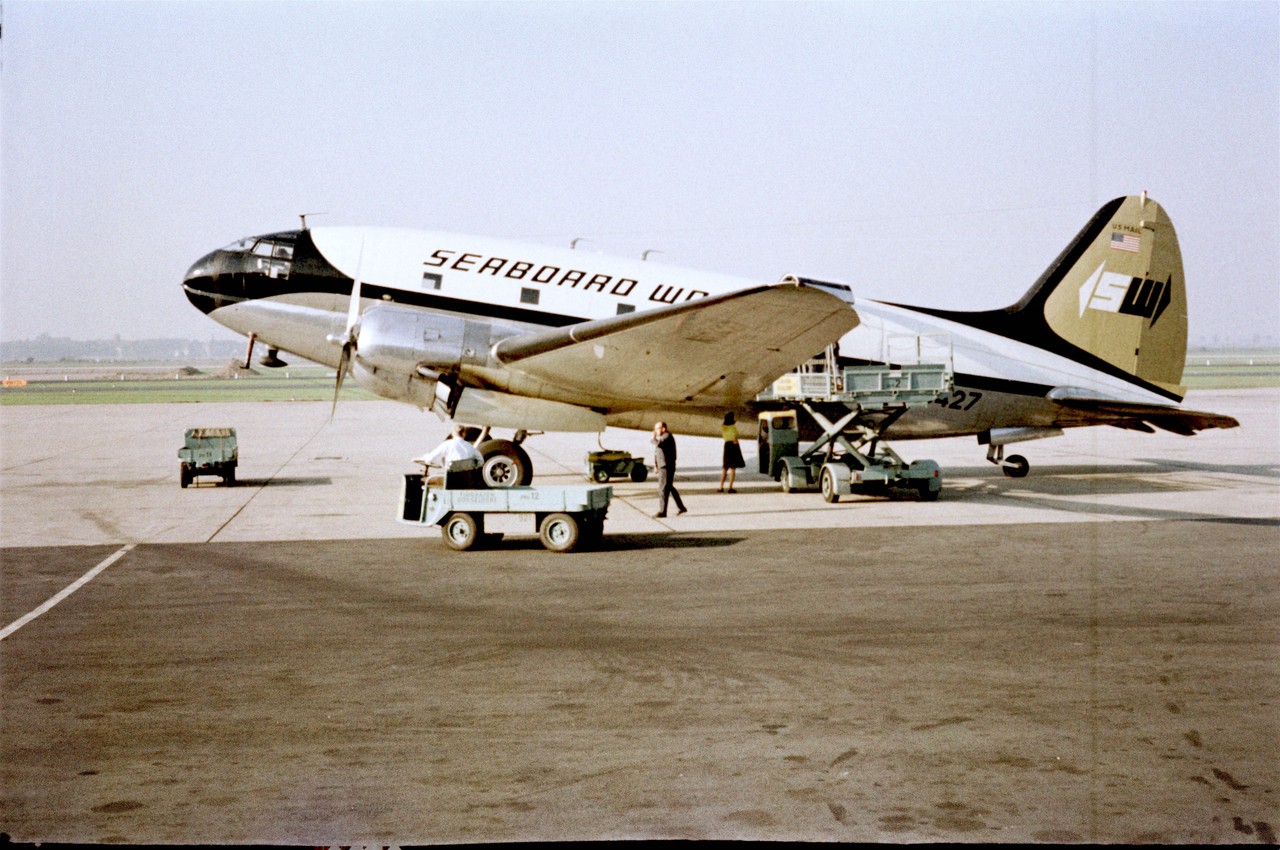
Surplus C-46s found extensive civilian use after 1945, with nearly 400 aircraft serving airlines worldwide by 1960. Carriers including Northwest Orient and Flying Tigers operated the type on domestic and international routes, particularly in South America and Asia where its payload capacity and high-altitude performance remained valuable assets.
Today, fewer than ten C-46s remain airworthy globally. Notable museum examples include C-46F serial 44-78774 displayed at the Military Aviation Museum in Virginia Beach, Virginia. The aircraft's legacy endures as the unsung hero of World War II logistics, proving that behind every famous fighter or bomber stood reliable transports like the Commando that made victory possible.