
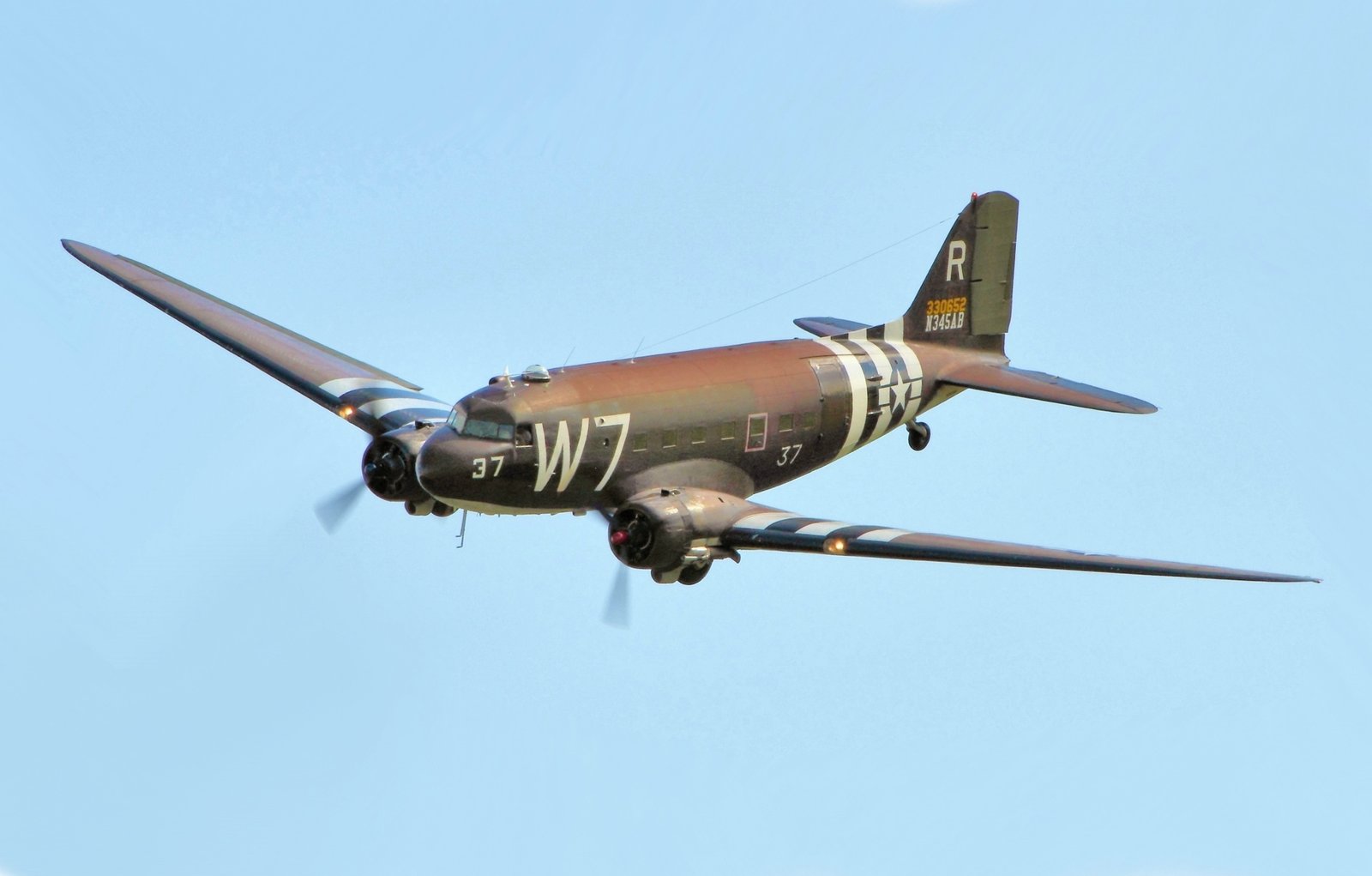
The Douglas C-47 Skytrain was a primary military transport for Allied forces, developed from the civilian Douglas DC-3. The C-47 specifically made its first flight on December 23, 1941, at Daugherty Field in Long Beach, California. Designed as a rugged, all-metal, low-wing monoplane with retractable landing gear, the aircraft featured military-specific modifications including a reinforced cargo floor and large cargo doors. These enhancements allowed the C-47 to transport 28 fully equipped soldiers, 14 stretchers and three nurses for medical evacuation, or up to 6,000 lb of cargo, including a 37 mm cannon or a fully assembled jeep.
Production took place between 1941 and 1945 at several Douglas Aircraft Company plants, including facilities in Long Beach and Santa Monica, California, as well as a plant in Tulsa, Oklahoma, which alone produced 5,231 C-47/C-47A aircraft. While exact production totals vary, the U.S. Air Force records 9,125 units, while other museum sources estimate over 10,000 were produced. The aircraft was powered by two Pratt & Whitney R-1830 Twin Wasp 14-cylinder radial piston engines.
During World War II, the C-47 operated in every theater of the war. It played a critical role in major airborne operations, including Operation Husky (dropping 4,381 paratroops in Sicily), Operation Avalanche, and Operation Overlord, where more than 50,000 paratroopers were delivered during the initial days of the Normandy invasion. Other key operations included Operation Dragoon, Operation Market Garden, and Operation Varsity, the latter of which utilized 836 aircraft. In the China-Burma-India theater, C-47s flew essential supplies over the Himalayas, known as "the Hump."
Post-war, the C-47 remained vital, serving in the Berlin Airlift (1948–1949), the Korean War, and the Vietnam War. In Vietnam, it was adapted into the AC-47D "Spooky" gunship, equipped with three 7.62 mm General Electric miniguns, and the EC-47N/P/Q electronic warfare variants. Its longevity is remarkable; the USAF's 6th Special Operations Squadron flew the type until 2008. General Dwight D. Eisenhower famously listed the DC-3/C-47 as one of the four key innovations that won the war for the Allies.