
Service History
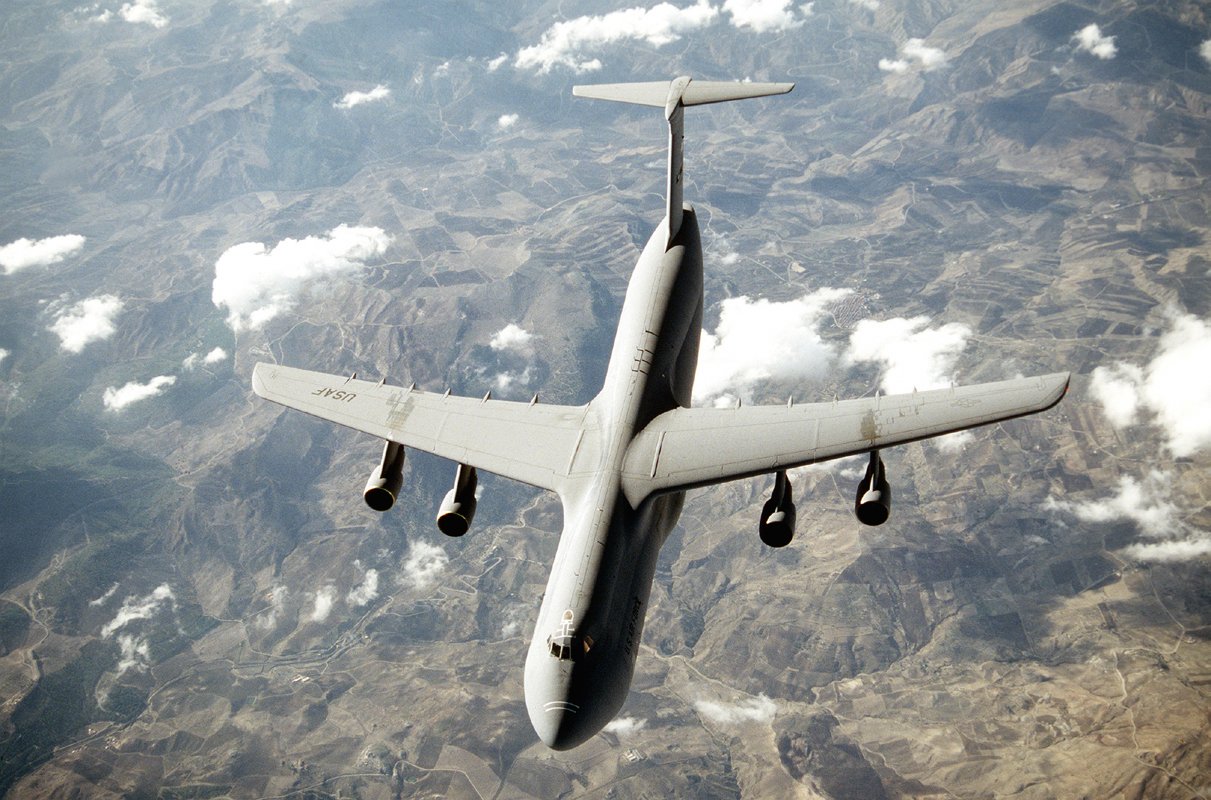
The C-5A Galaxy transformed American military logistics by providing unprecedented strategic airlift capability. Beginning operations in July 1970 during the Vietnam War, the Galaxy could transport entire tank units, helicopters, and massive quantities of supplies across the Pacific in a single flight. The aircraft's 6,240 nautical mile range with a 120,000-pound payload eliminated the need for multiple fuel stops that hampered previous transport aircraft. By the mid-1970s, the C-5A fleet had become the backbone of Air Mobility Command's intercontinental operations, capable of moving 25 percent of its cargo load in the aircraft's cavernous 121-foot cargo bay.
Wartime and Operational History
The Galaxy's combat debut came on July 9, 1970, during Southeast Asian operations. The aircraft's unique kneeling landing gear system and front and rear cargo doors allowed rapid loading of oversized equipment directly from trucks and rail cars. C-5As served with operational wings at Charleston Air Force Base in South Carolina, Dover AFB in Delaware, Travis AFB in California, and reserve units at Lackland AFB in Texas and Westover ARB in Massachusetts. Training operations began at Altus AFB, Oklahoma in December 1969. The type's strategic importance grew during subsequent conflicts, though early wing fatigue problems required extensive redesign work between 1981 and 1987.
The Manufacturer
Lockheed Aircraft Corporation, founded in 1912 by brothers Allan and Malcolm Lockheed, won the competitive CX-Heavy Logistics System contract in October 1965, defeating proposals from Boeing and Douglas. The company's Marietta, Georgia facility began C-5A construction in 1966, though development costs nearly bankrupted Lockheed by 1970, requiring federal government intervention. Lockheed's engineering team created the L-500 design to meet Air Force requirements for transporting the Army's largest equipment. The company later became Lockheed-Georgia, then merged with Martin Marietta in 1995 to form Lockheed Martin, which continued Galaxy upgrades until 2022.
Engine and Technical Innovation
Four General Electric TF39-GE-1 turbofan engines powered the C-5A, each producing 40,000 pounds of thrust. GE had won the engine contract in August 1963, and the TF39 became the first high-bypass turbofan engine designed for military transport use. This revolutionary powerplant technology, scaled up from civilian CF6 designs, provided significantly better fuel efficiency than turbojet engines while reducing noise levels for improved airport operations. The engines' performance enabled the Galaxy's impressive short-field capabilities despite the aircraft's massive 769,000-pound maximum takeoff weight.
Design and Performance
Chief engineering test pilot Leo J. Sullivan led the first flight crew on June 30, 1968, alongside pilots Walter E. Hensleigh and USAF Lieutenant Colonel Joseph S. Schiele. The Galaxy's high-wing configuration and T-tail design optimized ground clearance for cargo loading while maintaining stability with heavy loads. At maximum speed, the C-5A could reach 509 knots and climb to a service ceiling of 41,000 feet. The aircraft required a crew of seven: two pilots, two flight engineers, and three loadmasters to manage the complex cargo systems. Presidential ceremonies marked the rollout on March 2, 1968, with President Lyndon B. Johnson attending the unveiling of the first aircraft, serial number 66-8303.
Production and Legacy
Lockheed delivered all 81 C-5As between June 1970 and May 1973, though one early aircraft was destroyed in a ground fire at Dobbins AFB on October 17, 1970, killing one worker. The Galaxy spawned several variants: 50 improved C-5Bs built from 1986-1989, two C-5Cs modified for oversized space cargo, and ultimately 52 C-5Ms upgraded with modern avionics and engines. The last C-5A retired from service on September 7, 2017, after 47 years of operation. Wing redesign programs extended the fleet's service life using new aluminum alloys rated for 10,000 flight hours. Today, the upgraded C-5M Super Galaxy continues the legacy established by the original C-5A, maintaining America's strategic airlift supremacy into the 21st century.