
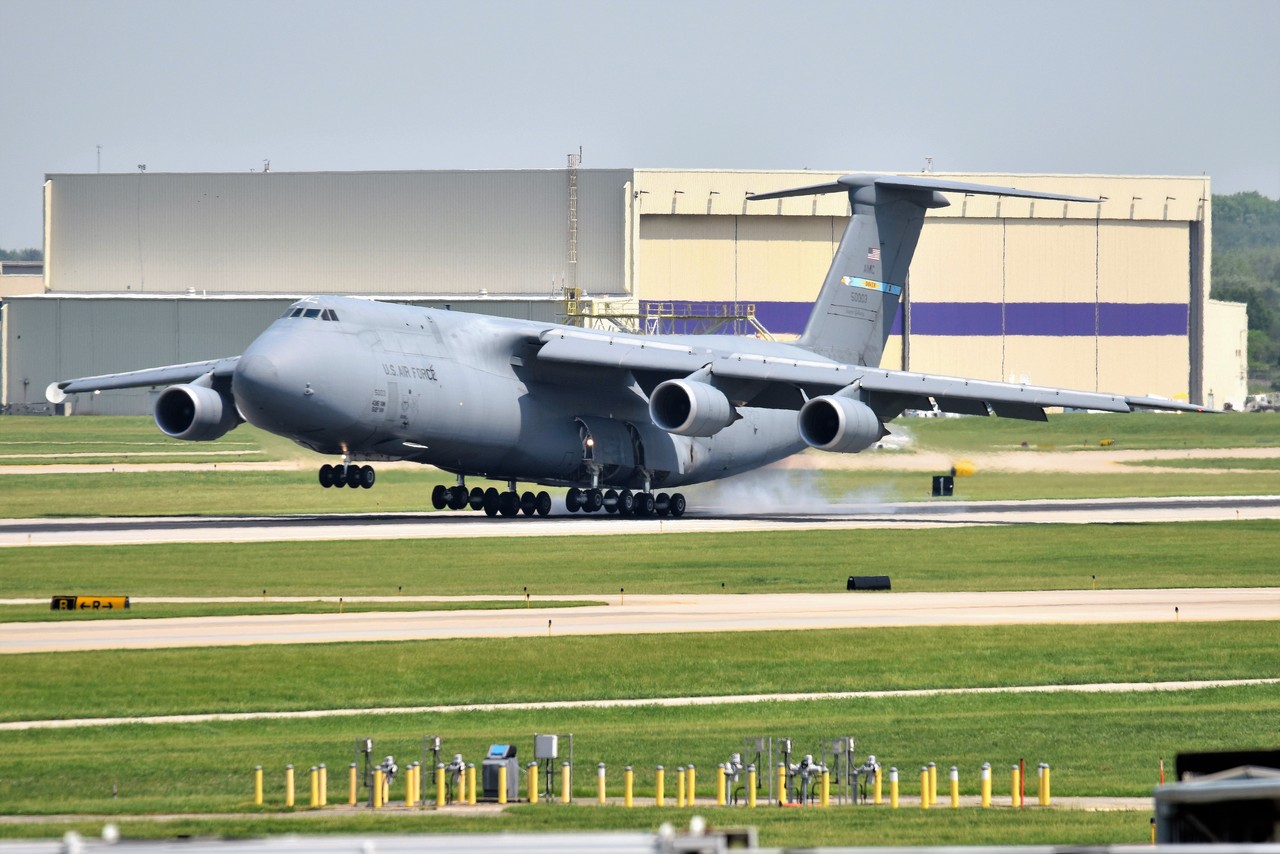
Service History
The C-5 Galaxy transformed American strategic airlift capability when it entered service in 1970, providing the Air Force with unprecedented cargo capacity. The aircraft's first operational mission occurred on July 9, 1970, during the Vietnam War in Southeast Asia. By the early 1970s, Galaxy operations were established at four major bases: Altus Air Force Base in Oklahoma, Charleston Air Force Base in South Carolina, Dover Air Force Base in Delaware, and Travis Air Force Base in California.
The C-5M Super Galaxy achieved initial operating capability on February 24, 2014, with 16 aircraft delivered. As of February 2019, the Air Force operated 52 C-5M aircraft, representing the culmination of the Reliability Enhancement and Re-engining Program that modernized the entire remaining Galaxy fleet.
Evolution Through Variants
The Galaxy program produced 134 aircraft across three distinct variants. The original C-5A saw 81 aircraft manufactured between 1968 and 1973, establishing the basic design that would dominate heavy airlift for decades. Production resumed with the improved C-5B model, delivering 50 aircraft between 1986 and 1989 with upgraded engines and systems.
The C-5M transformation began with low-rate initial production in August 2009, reaching full production by May 2011. Lockheed Martin completed the final C-5M conversion on July 25, 2018, with the Air Force receiving the last modernized aircraft on August 1, 2018. This comprehensive upgrade replaced engines, modernized avionics, and enhanced structural components throughout the fleet.
The Manufacturer
Lockheed Aircraft Corporation secured the Galaxy contract in October 1965, with all production taking place at the company's Georgia facility in Marietta. The selection marked Lockheed's entry into the strategic transport market, competing against Boeing and Douglas for the massive military contract.
Lockheed-Georgia conducted the aircraft's rollout ceremony on March 2, 1968, with President Lyndon B. Johnson presiding over the event. The division's expertise in large aircraft manufacturing proved crucial to the program's success. Following Lockheed's 1995 merger with Martin Marietta to form Lockheed Martin Corporation, the company continues as one of the world's largest defense contractors, maintaining the Galaxy fleet and developing next-generation military aircraft.
Engine and Technical Innovation
The original C-5A utilized four General Electric TF39 turbofan engines, each producing 41,000 pounds of static thrust in the TF39-GE-1A configuration. The C-5B incorporated upgraded TF39-GE-1C engines, providing improved reliability and performance. The C-5M received entirely new powerplants as part of its modernization, significantly enhancing fuel efficiency and operational capability.
Structural innovations included a complete wing redesign program conducted between 1981 and 1987, utilizing new aluminum alloys unavailable during original production. This modification addressed fatigue issues and extended the aircraft's operational life well into the 21st century.
Operational Capabilities
The Galaxy's revolutionary design held the distinction of being the world's largest and heaviest aircraft from its 1968 maiden flight until the early 1980s, when the Soviet Antonov An-124 surpassed its dimensions. With aerial refueling capability, the C-5M's range is limited only by crew endurance, enabling truly global reach for American military forces.
The aircraft proved instrumental in major military operations and humanitarian missions worldwide. Its unique front and rear cargo door configuration allows drive-through loading of vehicles and equipment impossible to transport in other aircraft. The upper deck provides space for 73 passengers in addition to the main cargo compartment.
Production Costs and Legacy
In 1998 dollars, each C-5A cost approximately $152.8 million, while the improved C-5B carried a price tag of roughly $179 million per aircraft. These substantial investments reflected the Galaxy's unique capabilities and the complexity of manufacturing such a massive aircraft.
The program experienced early challenges, including a significant incident on October 17, 1970, when the first C-5A (serial number 66-8303) was destroyed in a ground fire at the Marietta facility during maintenance. The fuel cell fire killed one Lockheed employee and injured another, highlighting the risks inherent in developing such revolutionary technology.
The last operational C-5A retired on September 7, 2017, after nearly five decades of service. The final C-5A units served with Air Force Reserve Command's 433rd Airlift Wing at Lackland Air Force Base, Texas, and the 439th Airlift Wing at Westover Air Reserve Base, Massachusetts. The complete transition to the modernized C-5M fleet ensures the Galaxy's continued service well into the 2040s, maintaining America's strategic airlift supremacy for future generations.