
Revolutionary Design Concept
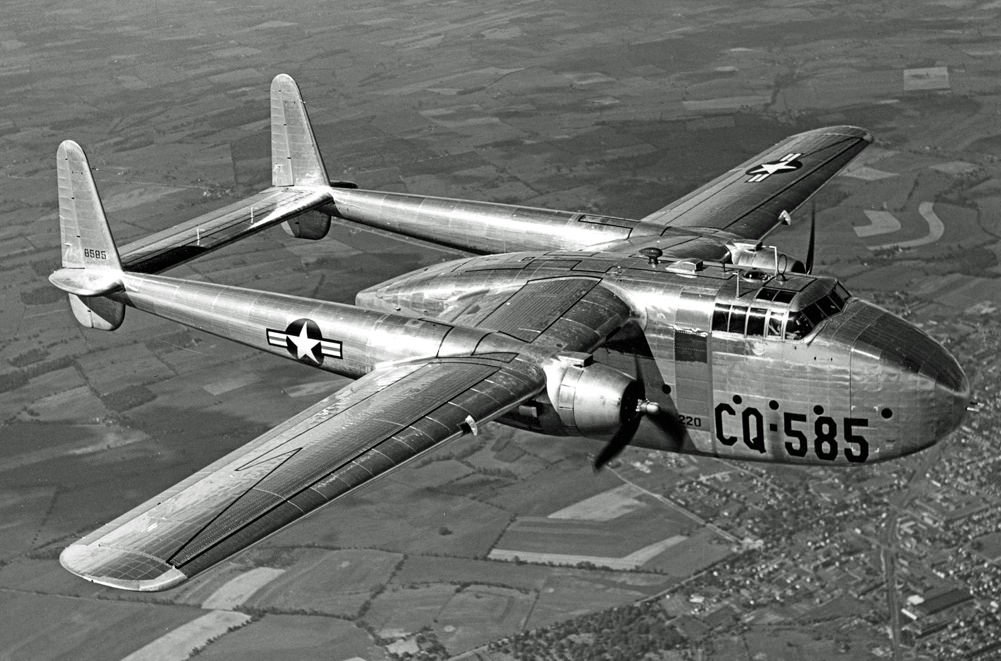
The C-82 Packet emerged from a 1941 U.S. Army Air Forces requirement for a heavy-lift cargo aircraft capable of transporting vehicles, artillery, and paratroopers using non-critical materials to avoid interfering with combat aircraft production. Fairchild's engineering team created a groundbreaking twin-boom configuration that positioned the cargo compartment between two fuselage booms, each housing an engine and landing gear. This design provided an unobstructed cargo bay with ground-level loading through removable rear clamshell doors—innovations that became standard features in subsequent military transports.
Limited Production and Service
Production began in 1945 with deliveries starting in June, but the war's end in most theaters limited the aircraft's wartime impact. Fairchild manufactured exactly 223 aircraft: one XC-82 prototype and 220 C-82A production models, plus three C-82N variants completed by North American Aviation before their 1,000-unit contract cancellation. The United States Army Air Forces, and later the USAF, operated the Packet primarily for cargo transport, paratroop drops, glider towing, and medical evacuation missions carrying up to 18 stretcher patients.
Operational Challenges
Despite its innovative design, the C-82 suffered from significant performance limitations. The twin Pratt & Whitney R-2800-85 engines, producing 2,100 horsepower each, proved inadequate for the aircraft's maximum takeoff weight of 54,000 pounds. Single-engine performance was particularly poor, leading to several fatal crashes when one engine failed. The aircraft's maximum speed of 216 knots and service ceiling of 27,000 feet were respectable, but the underpowered configuration restricted operational flexibility.
Notable Operations
The C-82 participated in several significant postwar operations despite its limitations. During Project Yukon in January 1948, the 62nd Troop Carrier Group deployed C-82s from McChord Air Force Base to the Arctic for cold-weather testing. Five Packets supported the Berlin Blockade in fall 1948, delivering crucial earthmoving equipment for constructing Berlin Tegel Airport. These missions demonstrated the aircraft's utility for specialized cargo operations requiring rear-loading capability.
Fairchild Aircraft Legacy
Fairchild Aircraft, founded in 1925 by Sherman Fairchild, initially focused on training aircraft before expanding into transport designs. The company operated from the 1920s through the mid-20th century, undergoing various mergers and reorganizations. Fairchild evolved into Fairchild Hiller in 1964 and later became part of larger aerospace conglomerates, with elements eventually acquired by companies including Northrop Grumman. The original Fairchild name no longer exists as an independent aircraft manufacturer.
Engine Technology
The Pratt & Whitney R-2800 engine family, in production from 1939 to 1955, powered numerous World War II aircraft including the P-47 Thunderbolt. Over 125,000 R-2800 engines were manufactured across all variants, making it one of the most successful radial engine designs. The 18-cylinder, two-row radial featured advanced supercharging for high-altitude performance, though in the C-82 application it struggled with the aircraft's weight and single-engine requirements. Each engine drove a 15-foot, 2-inch diameter Hamilton Standard Hydromatic three-bladed propeller.
Variants and Modifications
Beyond the standard C-82A, Fairchild developed several variants including the EC-82A with experimental tracked landing gear (only one of 13 planned was completed) and the XC-82B with more powerful R-4360 engines, which became the precursor to the successful C-119 Flying Boxcar. In civilian service, the Steward-Davis company created jet-assisted versions: the Jet-Packet 1600 with one Westinghouse J30-W turbojet producing 1,600 pounds of thrust, and the Jet-Packet 3200 with twin J30-W engines.
Brief Service Life
The USAF retired the C-82 by 1954, replacing it with the improved C-119 Flying Boxcar that addressed many of the Packet's shortcomings. Some aircraft found limited civilian use, including operations by Brazilian airline Cruzeiro do Sul, which operated a C-82A freighter at Santos Dumont Airport in Rio de Janeiro as late as May 1972. Trans World Airlines also experimented with jet-boosted variants in 1959.
Museum Preservation
No C-82 Packets remain airworthy today, but several examples survive in museums. The Pima Air & Space Museum in Tucson, Arizona, displays C-82A serial number 44-23006, marked in the colors of the 7th Geodetic Squadron, 55th Strategic Reconnaissance Group from Forbes Air Force Base. McChord Air Museum also preserves a C-82, maintaining the type's historical significance for aviation enthusiasts and researchers.
Lasting Impact
Though only 223 C-82s were built and the type served briefly, its design innovations profoundly influenced military transport aircraft development. The twin-boom configuration, rear-loading doors, and ground-level cargo access became standard features in the successful C-119 Flying Boxcar (1,112 built) and C-123 Provider. The Packet's pioneering design established principles still evident in modern military transports, making it a crucial stepping stone in cargo aircraft evolution despite its operational limitations.