
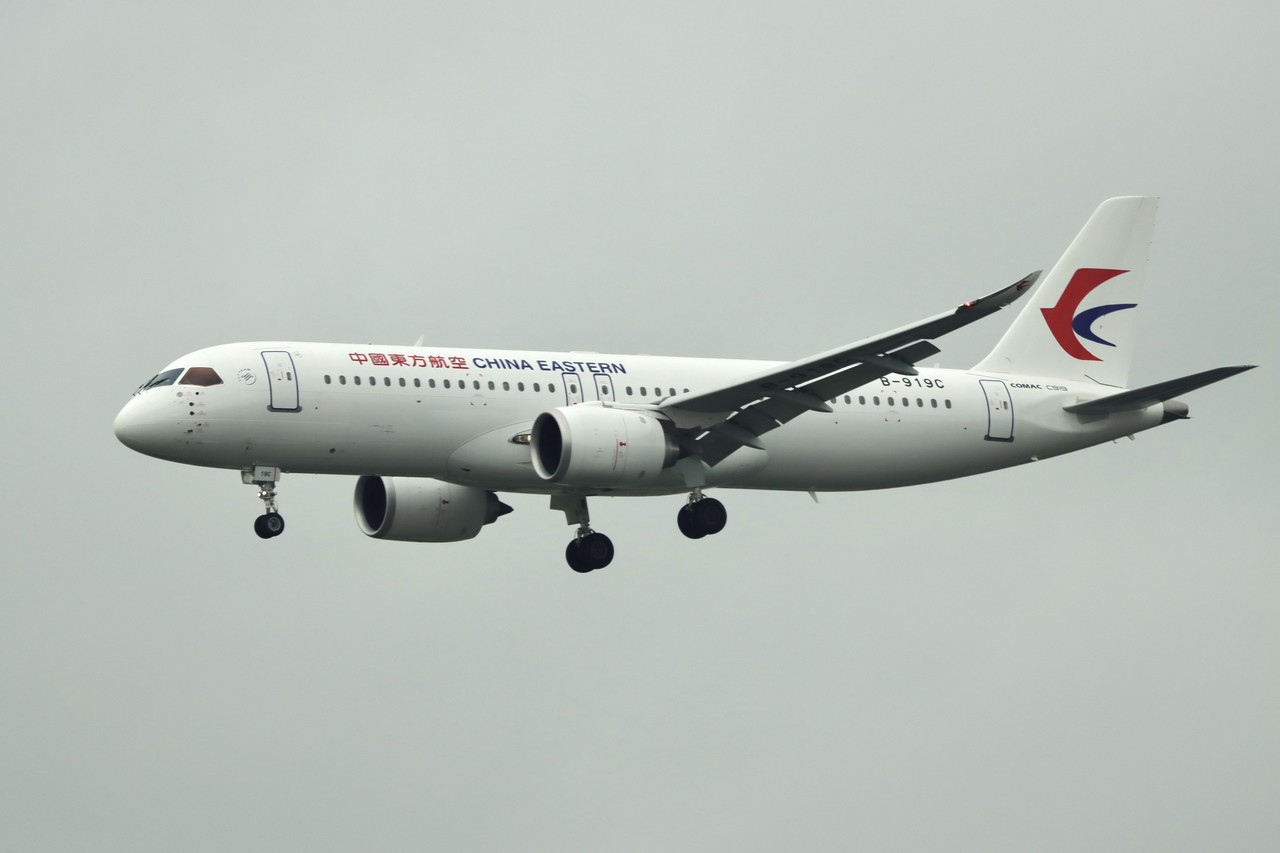
Market Entry and Commercial Significance
The C-919 entered commercial service on May 28, 2023, when China Eastern Airlines operated the inaugural flight MU9191 from Shanghai to Beijing, completing the two-hour journey and marking a historic milestone for Chinese aviation. As of early 2025, exactly 12 aircraft have been delivered to operators, all within China's domestic market. The aircraft has secured more than 1,000 orders from Chinese carriers including China Eastern Airlines, Air China, and China Southern Airlines, demonstrating strong domestic confidence in the program.
China Eastern Airlines serves as the launch customer, having placed its first firm order in November 2016, followed by additional commitments totaling multiple aircraft. The airline's fleet utilization has shown impressive growth, with C-919 operations experiencing a 40 percent surge during the 2025 Lunar New Year travel period. Current passenger configuration typically accommodates 168 economy and 8 business class seats, though high-density arrangements can accommodate up to 220 passengers.
The Manufacturer's Vision
The Commercial Aircraft Corporation of China (COMAC) was established on May 28, 2008, in Shanghai as a state-owned enterprise specifically created to develop large commercial aircraft. The company emerged during the global financial crisis as part of China's strategic push for aviation self-reliance and technological independence. COMAC announced the C-919 program in January 2009 with the explicit goal of creating a 150-190 seat airliner capable of competing directly with the Boeing 737 and Airbus A320 families.
The manufacturer has maintained ambitious production targets, currently aiming for 75-100 aircraft deliveries annually through 2025, with plans to scale up to 200 units per year by 2029. All manufacturing takes place at COMAC's primary facility in Shanghai, where the first prototype assembly began on December 9, 2011. The company has faced various challenges including U.S. blacklist episodes from January to November 2021, but has continued development and production efforts.
Engine and Technical Innovation
The C-919 is powered by two CFM International LEAP-1C high-bypass turbofan engines, products of the joint venture between GE Aviation and Safran Aircraft Engines. The first LEAP-1C engine was delivered on July 2, 2015, featuring an 18:1 bypass ratio that provides 15 percent better fuel efficiency compared to the previous-generation CFM56 series. These engines incorporate advanced materials and design elements that have made the LEAP series highly successful, powering over 50 percent of new narrow-body aircraft orders globally.
The aircraft features several technological innovations including extensive use of composite materials for weight reduction and advanced fly-by-wire flight controls. The design integrates Western-sourced engines and avionics systems to meet international certification standards while simultaneously fostering development of Chinese supply chain capabilities. The flight deck accommodates two pilots with four cabin crew members for typical operations.
Performance and Operational Capabilities
The C-919 achieves a maximum speed of Mach 0.785, equivalent to approximately 907 kilometers per hour, with a service ceiling of 12,100 meters and a climb rate of roughly 20 meters per second. The standard variant offers a range of 4,075 kilometers, while the extended-range C-919ER can fly up to 5,555 kilometers. Cargo capacity totals approximately 5.28 tons in the aircraft's belly holds.
With overall dimensions of 38.9 meters in length, 35.8 meters wingspan, and 11.95 meters height, the C-919 fits squarely into the narrow-body market segment. The aircraft's performance specifications closely match its intended competitors, positioning it as a viable alternative for short-to-medium haul routes throughout Asia and potentially beyond.
Certification and Global Prospects
The C-919 received Chinese Civil Aviation Administration (CAAC) type certification on September 29, 2022, exactly eleven years after the program's launch. This milestone enabled the first delivery to China Eastern Airlines on December 9, 2022. European Aviation Safety Agency (EASA) validation remains pending, with industry observers estimating the process may require 3-6 years from 2025.
The program represents China's most serious challenge to the Boeing-Airbus duopoly since the 1970s, when these manufacturers consolidated their dominance in commercial aviation. Despite facing geopolitical tensions and supply chain complexities, the C-919 has achieved more than 300 firm orders by November 2022, demonstrating market confidence in Chinese commercial aviation capabilities.
Current Status and Future Outlook
As of early 2025, all 12 delivered C-919 aircraft remain in active service with Chinese operators, bearing registrations including B-919A through B-919F among others. Production continues to ramp up with COMAC targeting 50-75 deliveries during 2025. The aircraft's cultural significance extends beyond commercial aviation, symbolizing China's technological advancement and reduced dependence on Western aerospace manufacturers.
No C-919 aircraft have yet entered museum collections due to the program's recent commercial entry, though the type's historical importance as China's first successful large commercial airliner ensures future preservation efforts. The aircraft represents a fundamental shift in global aerospace manufacturing, potentially reshaping competitive dynamics in the world's fastest-growing aviation market.