
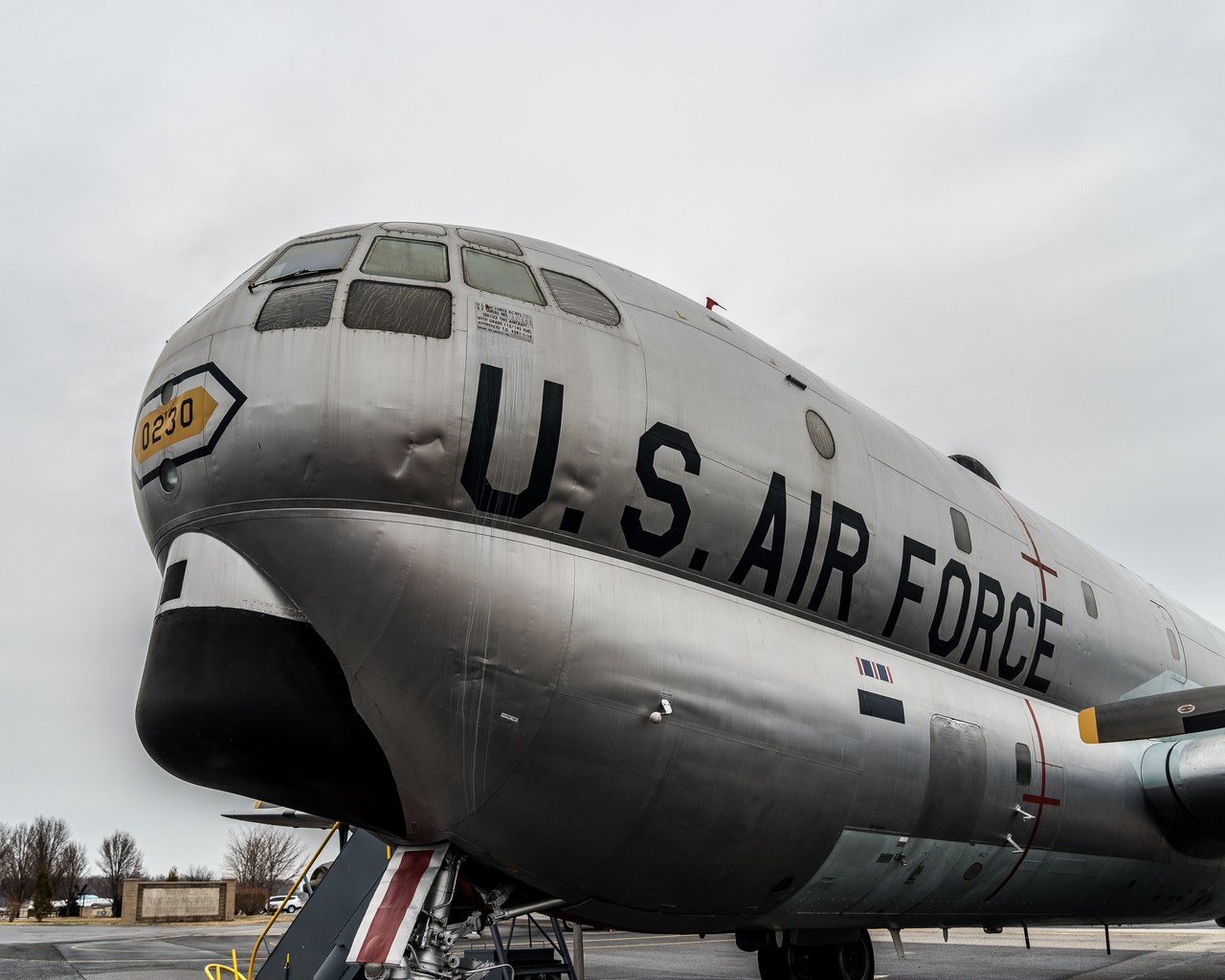
Strategic Air Command Workhorse
The C-97 Stratofreighter dominated American military airlift and aerial refueling operations throughout the 1950s and into the 1960s. Of the 888 aircraft produced, 811 served as KC-97 aerial refueling tankers with Strategic Air Command, providing the crucial midair refueling capability that enabled America's nuclear deterrent force to maintain global reach. The remaining 77 served as cargo transports, participating in critical operations including the Berlin Airlift of 1949 and casualty evacuation missions during the Korean War.
Cold War Operations
The Stratofreighter proved its worth during some of the most tense moments of the Cold War. During the Korean conflict from 1950 to 1953, C-97s shuttled wounded personnel from combat zones, sometimes flying at treetop level to avoid enemy detection. The aircraft's pressurized cabin allowed it to operate at altitudes up to 35,000 feet, providing safety margins unavailable to unpressurized transports. Strategic Air Command also employed specialized variants as airborne command posts, ensuring continuity of nuclear command authority during potential Soviet attacks.
Boeing's Engineering Innovation
The Boeing Aircraft Company developed the C-97 beginning in 1942 in response to U.S. Army Air Forces requirements for a long-range transport based on the proven B-29 Superfortress. Boeing engineers created the distinctive "double bubble" fuselage by essentially stacking two B-29 fuselage sections and integrating them with a straight wing that intersected the lower section. This innovative approach maximized cargo volume while maintaining structural integrity and pressurization capability. The design proved so successful that Boeing adapted it for their first postwar commercial airliner, the Model 377 Stratocruiser.
Powerplant and Performance
Four massive Pratt & Whitney R-4360 Wasp Major engines powered the Stratofreighter, each 28-cylinder radial producing 3,500 horsepower. This powerplant configuration gave the aircraft a maximum speed of 375 miles per hour and an impressive range of 4,949 miles when fully loaded. The aircraft required a crew of five to six personnel, including pilot, copilot, navigator, flight engineer, and one or two loadmasters depending on mission requirements.
The Jet Age Challenge
By the late 1950s, the introduction of Boeing's all-jet KC-135 Stratotanker exposed the C-97's primary weakness: insufficient speed to effectively refuel modern jet fighters. F-4 Phantom II pilots found themselves flying dangerously close to stall speeds when attempting to maintain formation with the slower KC-97s during refueling operations. Boeing addressed this limitation by developing the KC-97L variant, which added two surplus General Electric J47 turbojet engines to supplement the radial engines. This modification, applied to 82 aircraft between 1965 and 1966, substantially increased performance and extended the type's service life.
Production Variants
Boeing manufactured numerous specialized variants throughout the production run. The initial C-97A cargo model saw 50 examples delivered, while the KC-97G tanker variant represented the largest single production block with 592 aircraft built. Other notable variants included the YC-97 cargo evaluation aircraft, the 80-seat YV-97B passenger transport prototype, and the C-97K troop transport conversion. Each variant incorporated specific modifications for its intended mission while maintaining the basic airframe and powerplant configuration.
Operational Legacy
The final KC-97L aircraft retired from Texas Air National Guard service in 1976, marking the end of nearly three decades of military service. During its operational career, the Stratofreighter family logged millions of flight hours supporting American military operations across three major conflicts and countless peacetime missions. The aircraft's reliability and versatility made it indispensable during the crucial early years of the jet age, when few alternatives existed for long-range transport and aerial refueling missions.
Surviving Examples
Of the 888 Stratofreighters produced, only a handful survive today in museums and private collections. The "Angel of Deliverance," a former KC-97L operated by the Berlin Airlift Historical Foundation in Farmingdale, New Jersey, represents the sole remaining airworthy example. This aircraft underwent a 17-year restoration and returned to flight status in 2017. The Pima Air & Space Museum in Arizona displays a C-97G bearing International Red Cross markings from its service in Biafra during 1970, while the Minnesota Air National Guard Museum houses another preserved example. These surviving aircraft serve as tangible reminders of an era when piston-powered transports ruled military logistics operations and helped maintain America's global military presence during the early Cold War period.