
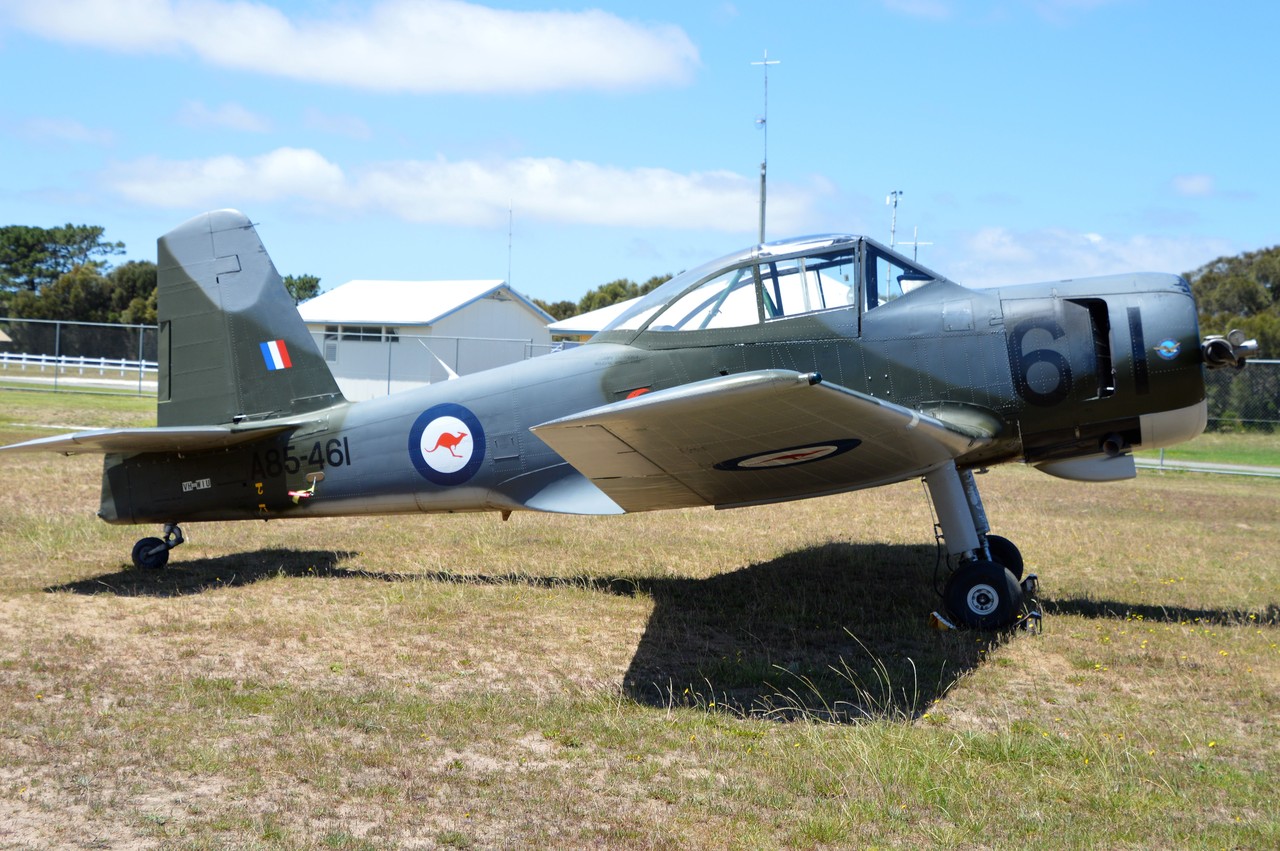
Service History
The Winjeel dominated RAAF pilot training for two decades, serving as the primary basic-to-advanced trainer from 1955 to 1975. All 62 production aircraft operated initially at No. 1 Basic Flying Training School at Uranquinty, New South Wales until 1958, then relocated to Point Cook, Victoria until 1968. The aircraft trained not only RAAF pilots but also Navy and Army aviators, making it the cornerstone of Australian military aviation training during the transition from World War II-era biplanes to modern jet aircraft.
When the RAAF's ambitious "all-through jet training" program failed in 1968, the Winjeel found new purpose. From 1975 to 1994, fourteen aircraft were converted for Forward Air Control duties with No. 4 Flight and No. 76 Squadron at Williamtown. These FAC variants featured smoke bomb racks, upgraded radio equipment, improved sighting systems, and olive drab camouflage schemes. Only four aircraft remained active at any given time during the FAC program, which lost four Winjeels over its 19-year operational period.
The Manufacturer
The Commonwealth Aircraft Corporation was established by the Australian government in 1936 to achieve aviation self-sufficiency during the looming war years. Operating from its Fisherman's Bend facility in Victoria, CAC had already proven its capabilities by producing the Wirraway trainer and Boomerang fighter during World War II. The company remained Australia's premier military aircraft manufacturer until 1985, when Hawker de Havilland Australia acquired its operations, which later became part of Boeing Australia.
CAC's 49-year history represented Australia's determination to maintain an independent aerospace industry. The Winjeel project emerged from this philosophy, designed entirely in-house to meet RAAF Specification No. AC.77 issued in 1948. This specification called for a replacement of the aging de Havilland Tiger Moth primary trainer and CAC's own Wirraway advanced trainer with a single, fully aerobatic aircraft capable of handling both roles.
Engine & Technical Innovation
The Winjeel's Pratt & Whitney R-985 Wasp Junior represented proven reliability in training applications. This nine-cylinder radial engine, producing 450 brake horsepower, had powered over 39,000 aircraft since entering production in 1930. The air-cooled, supercharged powerplant was specifically chosen for its ruggedness and maintenance simplicity in demanding training environments.
CAC's design team faced significant challenges during development of the two CA-22 prototypes. Initial flight testing revealed excessive stability that prevented intentional spinning - a critical requirement for military pilot training. Engineers resolved this by enlarging the tail fin, relocating it 38 inches forward, and moving the entire engine assembly forward seven inches. These modifications achieved the desired flight characteristics while maintaining the aircraft's inherently safe handling qualities.
Performance and Pilot Perspective
The production CA-25 achieved a maximum speed of 181 miles per hour with a range of 550 miles, making it suitable for both local training flights and cross-country navigation exercises. Its gross weight of approximately 3,400 pounds and robust fixed landing gear construction allowed for the inevitable hard landings associated with student pilot training.
Pilots appreciated the Winjeel's forgiving handling characteristics and excellent visibility from its side-by-side cockpit configuration. The third rear seat proved valuable for instructor pilots monitoring student progress or for advanced training scenarios requiring additional crew members. During its FAC conversion, pilots found the aircraft's low-speed handling and stability ideal for target marking missions, where precision flying at reduced speeds was essential.
Production and Legacy
CAC manufactured exactly 62 production Winjeels between 1955 and 1957, serialed A85-401 through A85-462. The first production aircraft, A85-401, completed its maiden flight on February 23, 1955, with deliveries beginning that September. This relatively small production run reflected the RAAF's specific training requirements rather than any shortcomings in the design.
The Winjeel's 39-year service life demonstrated exceptional longevity for a training aircraft. Its successful adaptation from primary trainer to forward air control platform proved the design's versatility and structural integrity. When the CT-4 Airtrainer replaced the Winjeel in the training role in 1975, the aircraft had already exceeded its expected service life.
Today, several Winjeels remain airworthy in private hands, including restored examples A85-404, A85-411, and A85-426. Museums preserve the type's legacy, with the first production aircraft A85-401 displayed at the RAAF Museum at Point Cook and A85-418 exhibited at Moorabbin Air Museum in Victoria. These survivors represent Australia's successful transition from wartime expedient designs to sophisticated post-war indigenous aircraft development, marking the Winjeel as a significant milestone in Australian aviation history.