
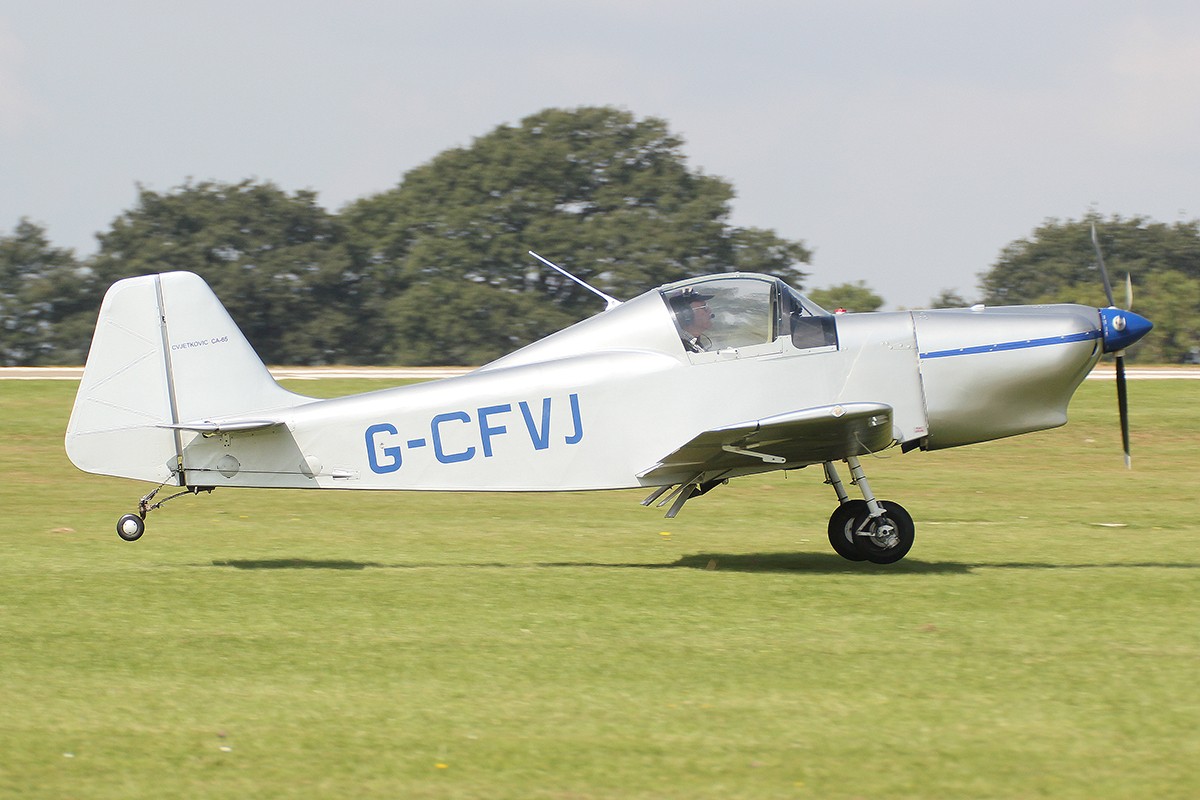
Design Philosophy and Innovation
Anton Cvjetkovic created the CA-65 Skyfly with ambitious goals for the homebuilt aircraft community. The design emphasized efficiency and practicality, incorporating features rarely seen in amateur-built aircraft of the era. The most striking innovation was the optional folding wing system, which reduced the aircraft's width from 25 feet to just 9 feet when folded, enabling storage in standard garage spaces. This feature, combined with retractable tailwheel landing gear, gave the CA-65 performance and convenience advantages over most contemporary homebuilts.
Construction and Variants
The original CA-65 featured all-wooden construction with a NACA 4415 modified airfoil optimized for efficient cruise flight. Cvjetkovic later developed the CA-65A variant, which eliminated the folding wings in favor of a swept tail design and metal construction. The CA-65W variant accommodated more powerful engines ranging from 108 to 150 horsepower, while later builders experimented with alternative powerplants including the Rotax 912S and NSI Propulsion Systems EA81.
Manufacturing and Distribution
Unlike mass-produced aircraft, the CA-65 existed only as construction plans distributed by Cvjetkovic Aircraft. Individual builders constructed each example in home workshops, with completion times varying significantly based on builder experience and available time. Charles Wilcoxon completed one notable example that first flew on June 1, 1975, and later found its way to the Tillamook Air Museum in Oregon. International interest led to completed aircraft in New Zealand and the United Kingdom, including G-CFVJ, built in 2013 with modern avionics and an alternative engine installation.
Performance Characteristics
The baseline CA-65 delivered impressive performance for its 125-horsepower engine rating. With an empty weight of 900 pounds and maximum takeoff weight of 1,500 pounds, the aircraft achieved a maximum speed of 160 mph and cruised efficiently at 135 mph. The design's 500-mile range came from 28 gallons of fuel carried in two fuselage tanks, while the service ceiling reached 15,000 feet. Takeoff performance was particularly noteworthy, requiring only 450 feet of runway, though landing distance stretched to 600 feet.
Engine Specifications
The standard powerplant was the Lycoming O-290-G, a four-cylinder horizontally-opposed air-cooled engine producing 125 horsepower. This engine drove a two-bladed fixed-pitch Sensenich wooden propeller with a diameter of 5 feet 8 inches. The O-290 series, produced from the late 1940s through the 1960s, was known for reliability and simplicity, having powered thousands of general aviation aircraft including the Piper Tri-Pacer. The engine's light weight and proven track record made it an excellent match for the CA-65's performance objectives.
Operational History and Safety Record
The CA-65 remained strictly within private aviation, with no commercial or military applications. Individual owners operated their aircraft for personal sport flying, taking advantage of the type's efficient cross-country capabilities and reasonable operating costs. However, the safety record included notable accidents, with confirmed incidents involving N165CA in May 1972, N3280 in April 1985, and N5656 in December 1998. These accidents, while tragic, were not necessarily indicative of design flaws but rather reflected the challenges inherent in amateur-built aircraft operations.
Legacy and Museum Preservation
While exact production numbers remain undocumented due to the plans-built nature of the aircraft, the CA-65 represents an important chapter in homebuilt aviation history. The Tillamook Air Museum preserves Charles Wilcoxon's example, providing visitors with an opportunity to examine Cvjetkovic's innovative design firsthand. The aircraft's combination of folding wings, retractable gear, and wooden construction demonstrated that amateur builders could achieve sophisticated engineering solutions typically reserved for factory-built aircraft.
Today, the CA-65 Skyfly stands as a testament to 1960s homebuilt innovation, though it never achieved the widespread popularity of simpler designs. Its complexity, while impressive from an engineering standpoint, likely limited the number of builders willing to tackle such an ambitious project. Nevertheless, the surviving examples continue to showcase Anton Cvjetkovic's vision of efficient, high-performance amateur aviation.