
Development and Design Origins
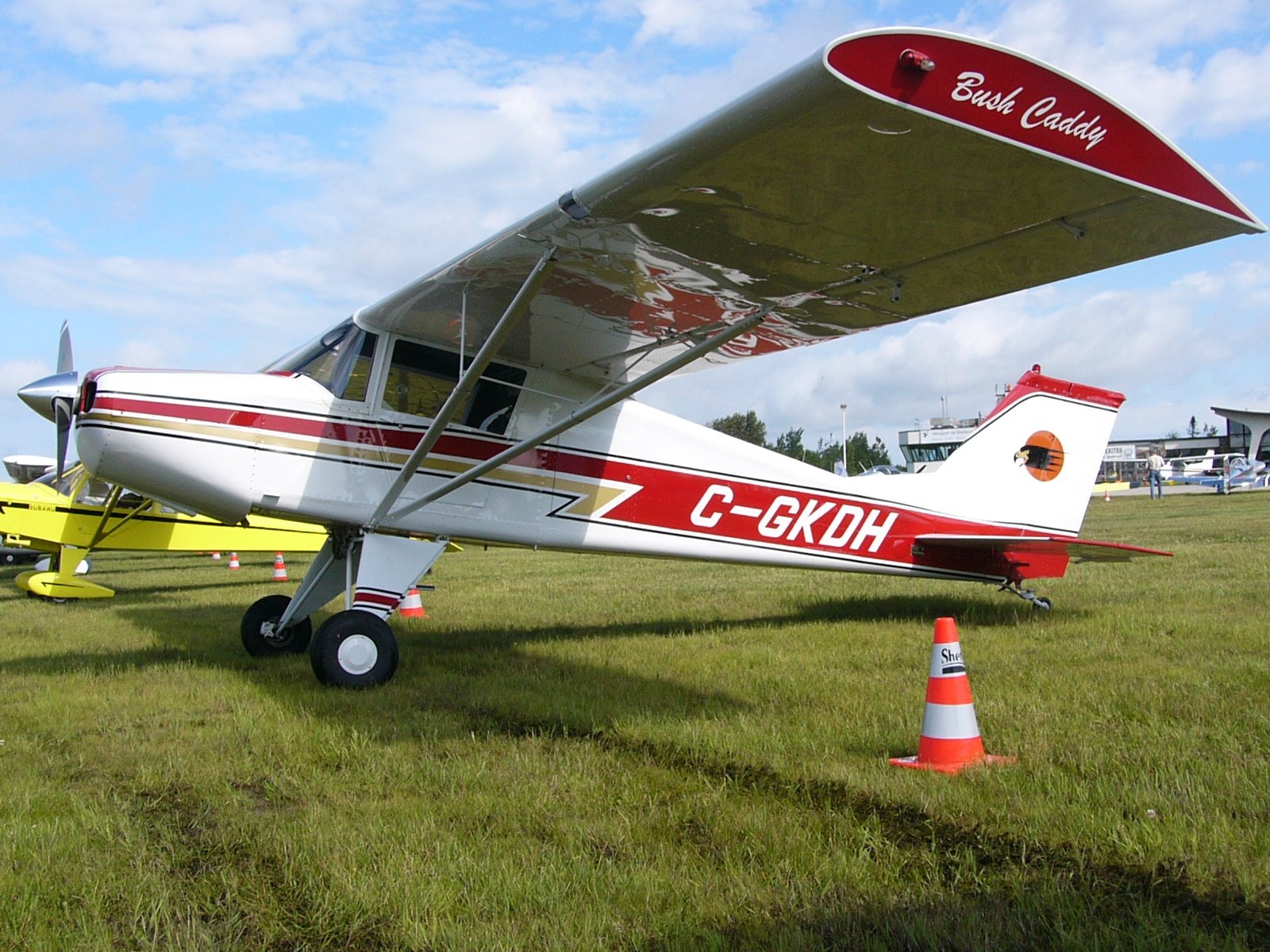
The Bush Caddy L-160 traces its origins to the innovative work of Jean Eudes Potvin, who founded Club Aeronautique Delisle Incorporated (CADI) as a flight training operation in Lac Saint-Jean, Quebec. Potvin's original Bush Caddy design first took flight in the first half of 1993, leading to refined kit production beginning in 1994 with the R-80 model. The L-160 variant emerged around 2000 as an evolution of the R-120, specifically engineered to provide additional cargo space or accommodation for a child seat behind the front seats.
Manufacturing Evolution
The Bush Caddy series underwent significant manufacturing transitions throughout its production life. CADI initiated kit production in 1994, establishing Quebec as the center for Bush Caddy manufacturing. In 1998, production responsibility shifted to Canadian Light Aircraft Sales and Service (CLASS), which operated from Les Cedres, Quebec until 2011. By 2005, the operation had expanded to employ five workers at the Les Cedres facility. Following another transition in 2011, production moved to a company operating under the Bushcaddy name, which continues manufacturing operations today.
Production Statistics and Market Performance
By the end of 2002, nearly 100 aircraft of all Bush Caddy variants had been sold, with 66 aircraft actively flying at that time. The L-160 specifically achieved more modest production numbers, with exactly 12 completed and operational aircraft recorded as of December 2011. This relatively small production run reflects the specialized nature of the kit aircraft market and the L-160's position as a niche variant within the broader Bush Caddy family.
Technical Innovation and Construction
The L-160 incorporates several advanced design features that distinguish it from traditional kit aircraft. Potvin's team developed an all-metal construction using 6061-T6 aluminum throughout, featuring a welded tube fuselage covered with aluminum sheeting. The aircraft employs a modified Piper Super Cub airfoil optimized for short-field operations, supported by a distinctive V-strut configuration with jury struts for additional structural integrity. Composite materials appear in the wingtips and cowling, reducing weight while maintaining durability.
Kit builders can expect approximately 1,000 to 1,200 hours to complete construction, aided by preformed and pre-welded components that simplify the assembly process. The high constant-chord wing design provides predictable handling characteristics, while the sweptback tail configuration enhances directional stability during bush operations.
Powerplant and Performance
The Lycoming O-320 engine powering the L-160 represents a proven powerplant choice for general aviation applications. This air-cooled, four-cylinder, horizontally-opposed engine delivers 160 horsepower through direct drive, providing reliable operation in demanding bush flying environments. Textron's Lycoming division has manufactured thousands of O-320 variants since the 1950s, establishing an extensive support network and parts availability.
Fuel capacity ranges from 173 to 180 liters, providing operational flexibility for extended bush operations. The L-160 achieves a maximum speed between 91 and 115 mph, with cruise speeds reaching 115 mph at 75 percent power settings. Stall characteristics remain docile at 37 mph with flaps retracted, supporting the aircraft's intended short-field mission profile.
Operational Capabilities
The L-160's design prioritizes versatility in challenging operating environments. Standard equipment includes manual flight controls and flaps, while the landing gear configuration can accommodate tricycle or conventional arrangements depending on operator preferences. Optional equipment extends to float and ski installations, expanding operational capability to water and snow-covered surfaces.
With a service ceiling of 13,000 feet and range extending from 625 to 720 miles, the L-160 provides substantial operational flexibility for bush pilots. The aircraft's structural design supports load factors of +5.3/-3.2 g, exceeding typical general aviation requirements and reflecting its intended role in demanding operational environments.
Current Status and Legacy
The Bush Caddy L-160 continues in production under the current Bushcaddy organization, though production numbers remain limited compared to mainstream kit aircraft. The design's emphasis on rugged construction and bush operation capability has established a dedicated following among pilots requiring reliable short-field performance.
While the L-160 has not achieved widespread market penetration, its contribution to Canadian aviation design represents a successful transition from flight training operations to aircraft manufacturing. The evolution from CADI's original concept through CLASS production to current Bushcaddy operations demonstrates the resilience of specialized aircraft design in serving niche market requirements.
The aircraft's safety record includes isolated incidents, such as a wing spar failure involving the related L-164 variant near Durand, Michigan on September 11, 2006, highlighting the importance of proper maintenance and inspection protocols for kit-built aircraft.