
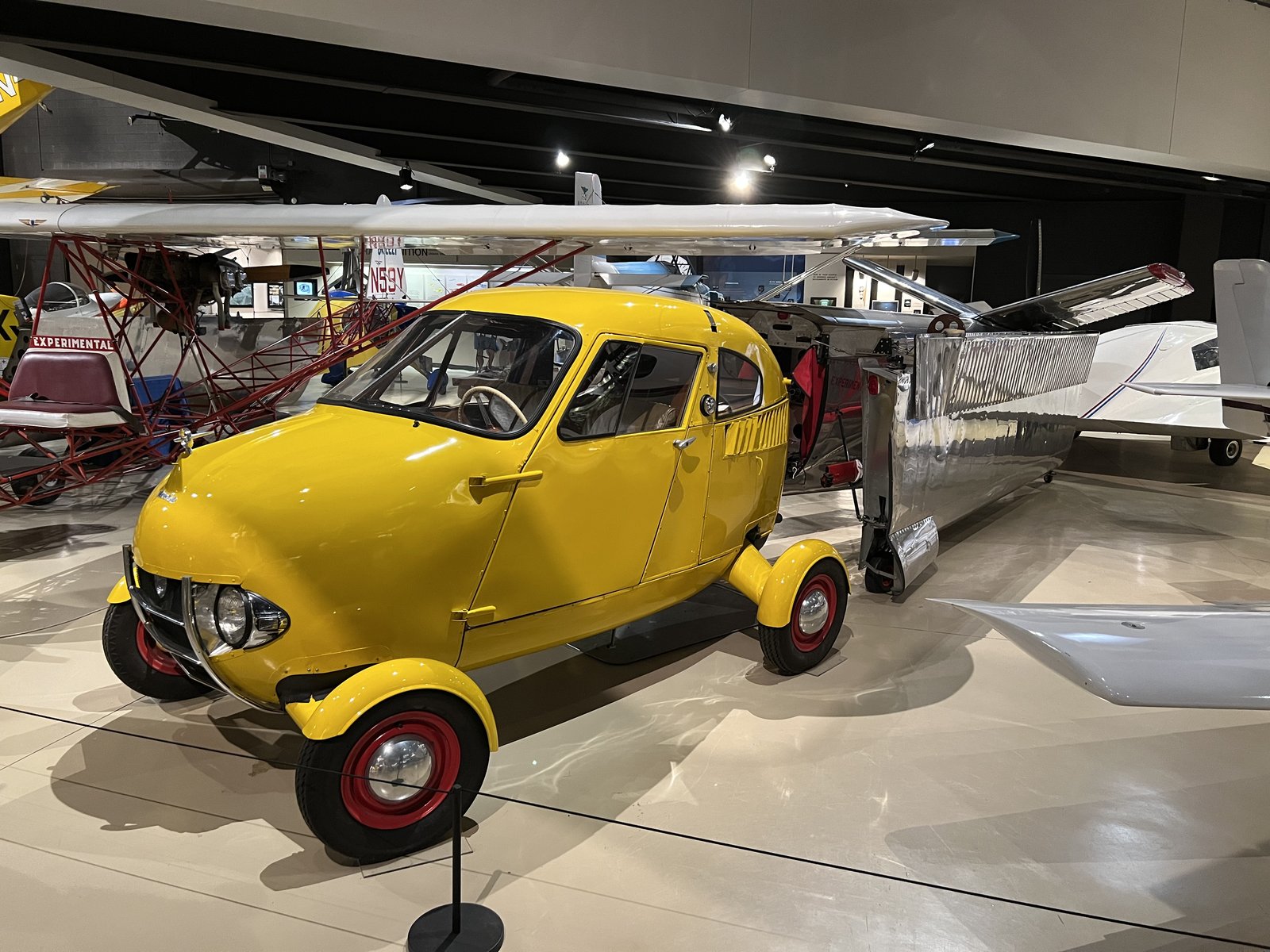
The Flying Car Reality
While countless inventors dreamed of flying cars throughout the 20th century, Moulton Taylor actually built one that worked. The Aerocar achieved what seemed impossible: Federal Aviation Administration certification as both an aircraft and an automobile in December 1956. Unlike previous attempts that compromised both road and air performance, Taylor's design delivered genuine dual-purpose capability.
Limited Production Success
Aerocar International produced only six examples between 1949 and 1968, including four Aerocar Is, one Aerocar II, and one Aerocar III. The limited production stemmed from insufficient market demand rather than technical failures. In 1956, Ling-Temco-Vought offered to manufacture the Aerocar if Taylor could secure 500 orders, but only 250 materialized, killing the mass production opportunity.
Innovative Engineering
Taylor's aeronautical engineering background produced several groundbreaking innovations. The Aerocar featured detachable conventional wings that could be removed for road travel, a rear-mounted Lycoming O-320 engine producing 143 horsepower, and a unique drivetrain that powered the front wheels through a three-speed manual transmission on roads while driving a pusher propeller in flight. The fiberglass body construction reduced weight significantly compared to contemporary designs.
The distinctive Y-tail configuration provided adequate control authority while maintaining ground clearance. External wheel spats on early models gave way to retractable landing gear on the final Aerocar III variant, which first flew in June 1968 with improved aerodynamics and handling characteristics.
Performance Capabilities
On roads, the Aerocar achieved a top speed of 67 miles per hour while delivering 15 miles per gallon fuel economy. In flight, maximum speeds reached 100 to 160 miles per hour depending on the variant, with cruise speeds typically 55 to 60 miles per hour and fuel consumption of 8 gallons per hour. The 34-foot wingspan and 190 square feet of wing area provided stable flight characteristics for the two-seat configuration.
Corporate Interest and Near Success
The Aerocar attracted serious corporate attention beyond the aerospace industry. In 1970, Ford Motor Company executive Lee Iacocca pitched internal production of 25,000 Aerocars annually. However, Ford ultimately canceled the project after estimating $400 million in development costs to meet automotive safety and emissions regulations, combined with Department of Transportation concerns about flying car integration into existing transportation systems.
Aerocar International Legacy
Moulton Taylor founded Aerocar International specifically to develop and manufacture his roadable aircraft concept. Operating primarily from 1949 onward in Longview, Washington, the company never achieved large-scale success despite the technical achievement. Taylor personally continued development, rebuilding one aircraft into the improved Aerocar III specification before the company ceased operations.
Museum Preservation
Several Aerocar examples survive in museums today. The 1949 Aerocar I prototype, registration N4994P (originally N31214), resides at the EAA AirVenture Museum in Oshkosh, Wisconsin, displayed in yellow and silver livery. Although maintained in flying condition, museum policy prevents regular flight operations. The Museum of Flight in Seattle, Washington, exhibits the 1968 Aerocar III, registration N100D for the wing and tail components.
Continuing Legacy
At least one Aerocar remained airworthy as of 2008, with a flyable example selling for $275,000 at the Barrett-Jackson Scottsdale auction in 2020. The Aerocar's significance extends beyond its modest production numbers as proof that roadable aircraft could achieve practical dual-purpose operation. While the flying car concept continues attracting modern entrepreneurs, none have matched Taylor's achievement of simultaneous FAA aircraft certification and highway legal operation in a single vehicle.
The Aerocar represents a unique chapter in aviation history where visionary engineering met practical execution, creating the world's first and only certified roadable aircraft despite commercial market limitations.