
Wartime Dominance
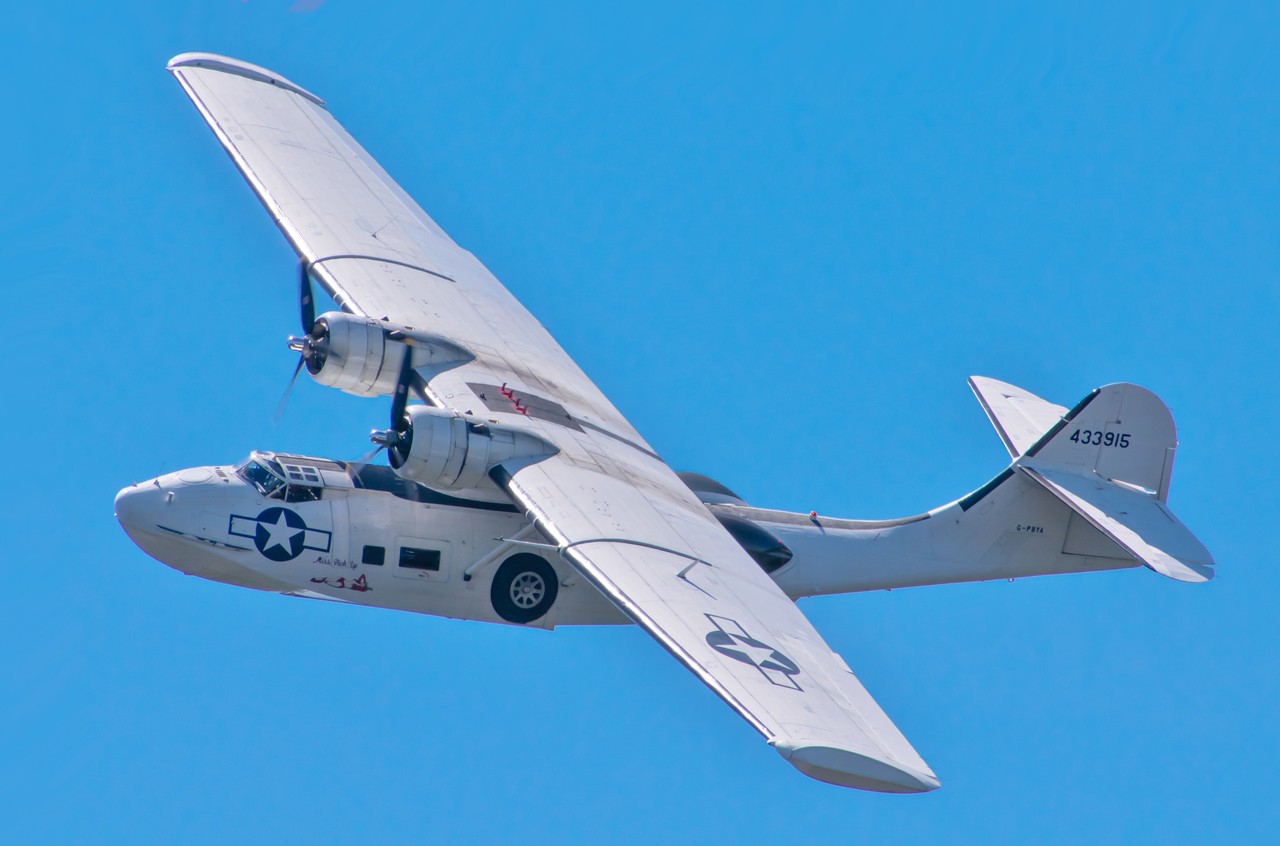
The PBY Catalina established itself as the backbone of Allied maritime patrol operations throughout World War II. U.S. Navy patrol squadrons like VP-11F began operating the type in 1936, followed by VP-73 in 1941. The aircraft's impact on anti-submarine warfare proved decisive, with PBY crews destroying 38 German submarines during the war. One particular aircraft, Bureau Number 2459, achieved legendary status by sinking 3.5 U-boats while operating from Iceland, becoming the first PBY to score a submarine kill after its acceptance on December 22, 1941.
Production encompassed multiple variants serving diverse roles across Allied forces. The U.S. Coast Guard operated 114 PBY-5A amphibians from 1942 to 1945, losing eight aircraft while conducting critical patrol missions. Royal Air Force, Royal Australian Air Force, Royal New Zealand Air Force, and Royal Canadian Air Force collectively flew approximately 700 Catalinas, designated as Catalina I through IV variants. These aircraft conducted missions ranging from night reconnaissance to combat operations across French Morocco, the Canary Islands, Gibraltar, and the Azores.
Manufacturing Legacy
Consolidated Aircraft Corporation, founded by Reuben H. Fleet in Buffalo, New York in 1923, designed the PBY to meet a 1933 U.S. Navy requirement for long-range Pacific patrol operations. Chief engineer Isaac Laddon led the design team, creating an aircraft optimized for maritime endurance and bomb-carrying capacity. The prototype XP3Y-1 first flew on March 15, 1935, followed by the modified XPBY-1 delivered in October 1936.
The company rapidly expanded during wartime, ultimately producing nearly 13 percent of all U.S. military aircraft across thirteen manufacturing divisions. Production facilities operated in Buffalo, New York; San Diego, California at Lindbergh Field; and New Orleans, Louisiana. International production supplemented domestic output through Boeing of Canada (362 aircraft), Vickers of Canada (240 Catalinas and Cansos), with New Orleans facilities completing 75 aircraft for the U.S. Army Air Forces and 48 for the Soviet Union.
In 1943, Consolidated merged with Vultee Aircraft to form Convair, which later became part of General Dynamics in 1954. Through subsequent corporate mergers and acquisitions, the company lineage now exists under Boeing.
Technical Innovation
The PBY's design emphasized long-range capability and operational versatility. Early variants utilized Pratt & Whitney R-1830-64 engines, while later models employed R-1830-72 powerplants producing 1,050 horsepower in the PBY-4, and R-1830-82/92 engines generating 1,200 horsepower in the PBY-5 and PBY-5A variants. These 14-cylinder radial engines, produced by Pratt & Whitney from the early 1930s through the 1950s, provided exceptional reliability for extended maritime operations.
The aircraft achieved remarkable range performance, demonstrated by a record-setting flight in October 1935 covering 3,443 miles non-stop from Cristóbal Harbor, Panama to Alameda, California in 34 hours and 45 minutes. This endurance capability proved invaluable for Pacific theater operations where landing fields remained scarce.
A significant innovation came with the amphibious PBY-5A variant, featuring retractable tricycle landing gear. The first XPBY-5A flew on November 22, 1939, expanding operational flexibility by enabling land-based operations alongside traditional water operations.
Operational Characteristics
The PBY-5A measured 63 feet 10 inches in length with a 104-foot wingspan, weighing between 17,526 and 20,910 pounds empty and 35,420 pounds when fully loaded. Maximum speed reached 189 miles per hour at 7,000 feet, though crews typically cruised at 125 miles per hour to maximize range and endurance.
Military armament consisted of two .30-caliber and two .50-caliber machine guns mounted in flexible positions at bow, waist, and ventral locations. Bomb-carrying capacity accommodated four 1,000-pound bombs, making the aircraft equally effective in patrol and attack roles.
Production Achievement
Total production reached 3,305 aircraft across all variants, with 1,486 comprising PBY-5 and PBY-5A models. The PBY-5 variant saw 684 aircraft completed between September 1940 and July 1943, while 802 PBY-5A amphibians rolled off production lines between October 1941 and January 1945. The final PBY-6A variant included 112 aircraft for the U.S. Navy plus 75 for the U.S. Army Air Forces, featuring increased fuel capacity and radar equipment.
Enduring Legacy
The U.S. Navy retired its last PBY Catalinas around 1956, concluding two decades of military service. Today, four to five examples remain airworthy worldwide, including the historically significant Bureau Number 2459 displayed at the American Heritage Museum. Additional flying examples operate at the Military Aviation Museum and Pacific Northwest Naval Air Museum.
The Catalina's cultural impact extends beyond its technical achievements, earning the nickname "Pig Boat" among crews for its handling characteristics. The aircraft appeared in wartime films including Thirty Seconds Over Tokyo (1944), cementing its place in popular memory as a symbol of Allied maritime patrol innovation during history's largest conflict.