
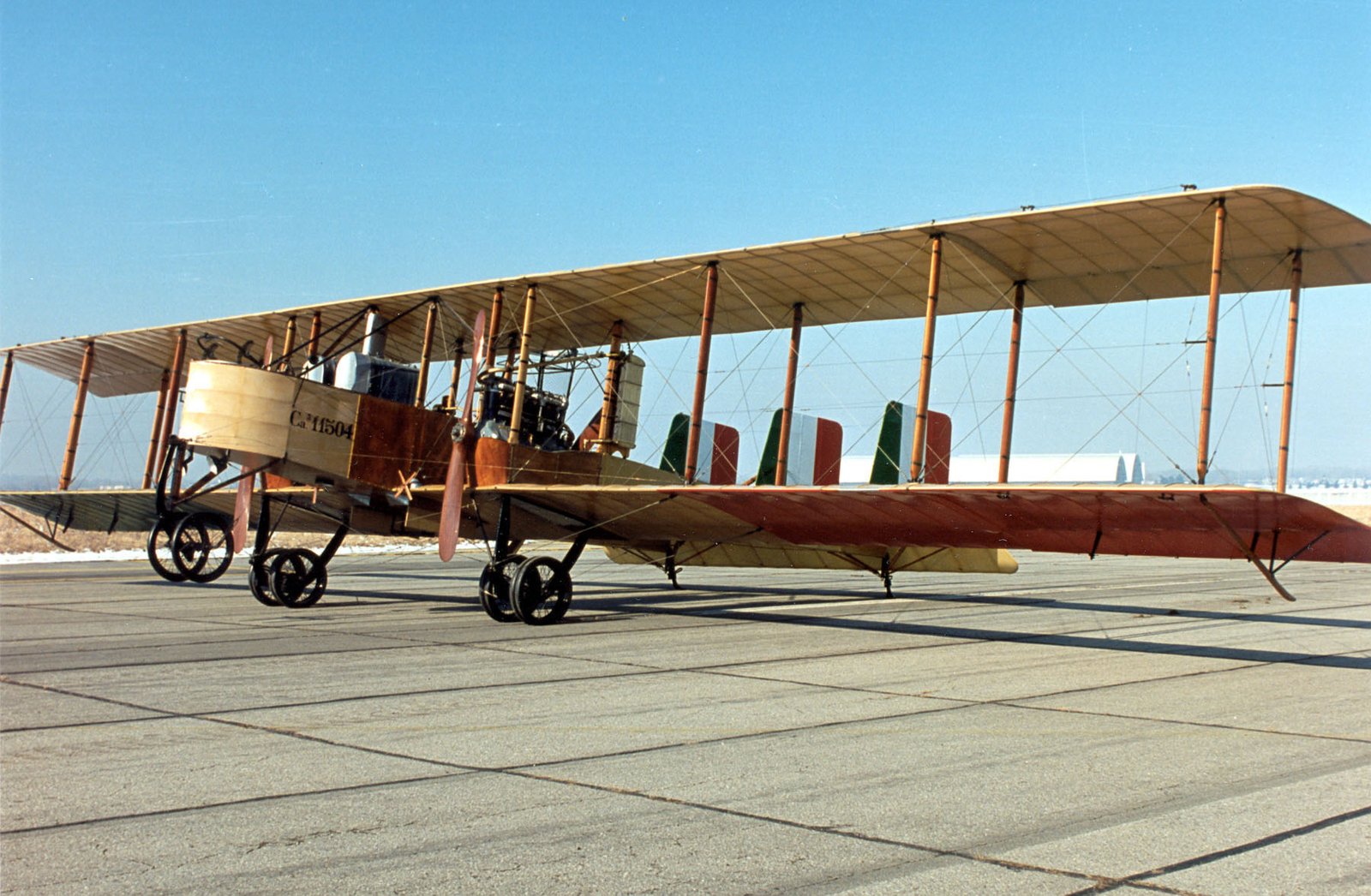
The Caproni Ca.3 (post-war designation Ca.33) was conceived in 1913 by engineer Gianni Caproni. The design was heavily influenced by the operational concepts of Giulio Douhet, who advocated for long-range aerial bombardment. This strategic focus made the Ca.3 one of the first aircraft ever designed specifically for strategic bombing rather than tactical support. The development of the three-engined bomber family began with a prototype flown on November 20, 1914, by pilot Emilio Pensuti. The definitive Ca.3 variant, featuring a 450 hp configuration, flew its prototype in late 1916 and quickly entered production.
Structurally, the Ca.3 was a large tail-boom biplane of wooden construction with fabric covering. It featured a central nacelle that housed a crew of four, consisting of two pilots seated side-by-side, a front gunner, and a rear gunner-mechanic. A distinctive design element was the rear gunner's platform, or "cage," located above the central engine, allowing the gunner to fire over the top of the aircraft. For stability and safety on rough airfields, the aircraft utilized a fixed undercarriage with double main wheels under each engine and a substantial double nosewheel.
Power was provided by three liquid-cooled inline piston engines. The Ca.3 improved upon the earlier Ca.2 by utilizing the same Isotta-Fraschini engine for all three positions—one central pusher and two tractors on the booms—resulting in a total power output of approximately 450 hp. This configuration allowed the aircraft to carry a significant bomb load of 800 kg over several hundred miles.
Production occurred primarily at Caproni's works in Taliedo, Milan, with additional licensed production in France. Estimates of total production vary; some sources suggest between 250 and 300 units, while others, citing Italian Air Force records, estimate approximately 750 units, including 89 built in France. The aircraft saw extensive service during World War I with the Italian Army and Navy, the latter utilizing the type as a torpedo bomber. The U.S. Air Service also employed the Ca.3, with American pilots training in Italy under the leadership of senior officer Fiorello LaGuardia. Notable crews, including poet Gabriele D’Annunzio and pilots Maurizio Pagliano and Luigi Gori, became famous for their long-range strikes.
Following the war, the Ca.3 remained in service into the late 1920s, with some aircraft participating in the invasion of the Horn of Africa. In Italy, the type continued in a training role until roughly 1934. Today, only two original airframes survive: one at the National Museum of the United States Air Force in Dayton, Ohio, and another at the Italian Air Force Museum in Vigna di Valle. A full-scale airworthy replica, registered as I-ZANA and built by Giancarlo Zanardo, continues to fly in Italy.