
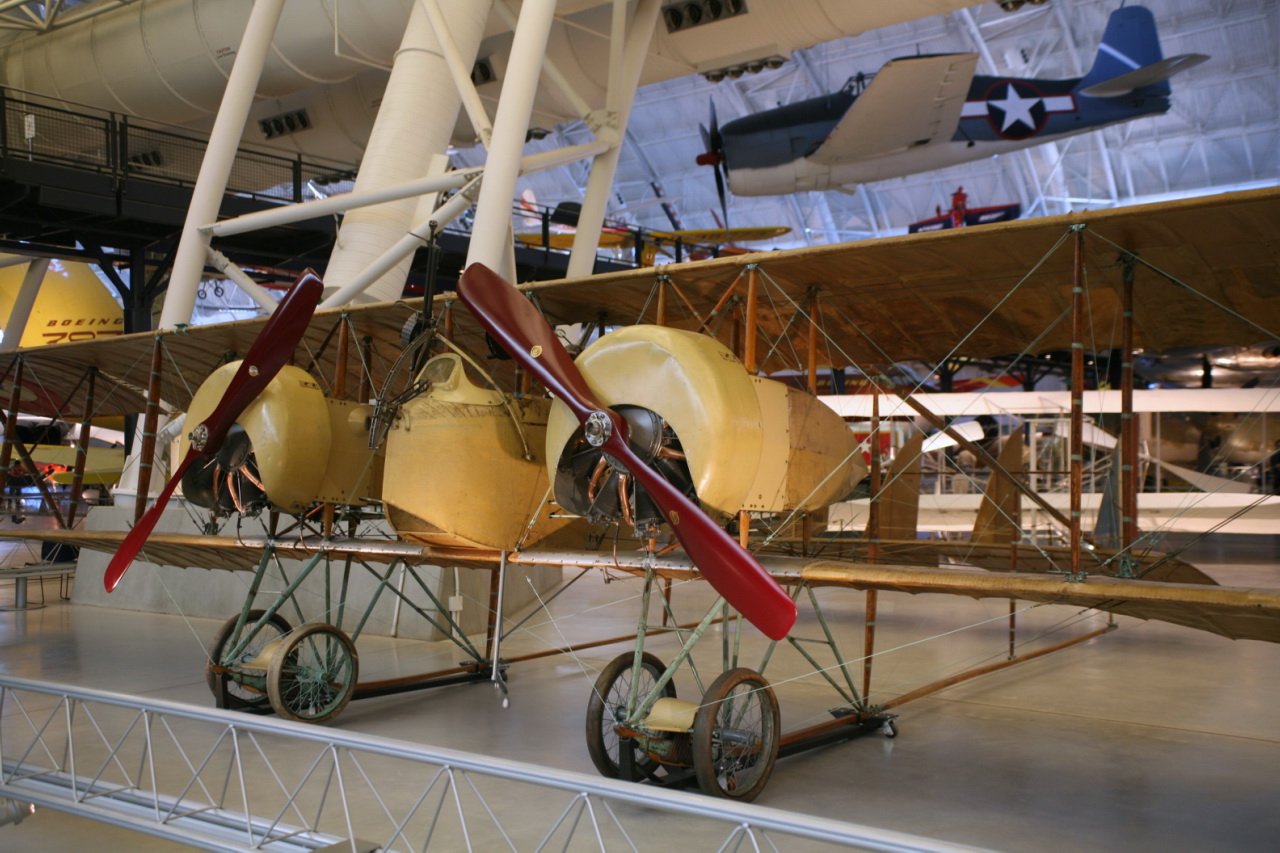
The Caudron Type G was a French two-seat biplane developed as a trainer and general-purpose aircraft. First flown in 1913, the aircraft was designed by brothers René and Gaston Caudron. Its primary historical significance lies in its role as the foundation for the extensive Caudron G-series, which included the G.2, G.3, G.4, and G.6. While the original Type G provided the conceptual blueprint, it was rapidly evolved into the refined G.3, which entered French service by early 1914.
Designed for use at the Caudron flight school located in Le Crotoy on the coast of the Somme, the Type G featured a unique configuration consisting of a short central nacelle for the crew and an open tailboom truss that supported the tail surfaces. To achieve low weight and efficient climb performance, the designers employed a sesquiplane wing layout. Early versions of the aircraft utilized wing-warping for lateral roll control, a feature that was later replaced by ailerons on the upper wings in subsequent G.3 production models. Due to the aircraft's stability and controllability, it became an ideal platform for pilot training.
Production was handled by Société des Avions Caudron in France. While exact production totals for the original Type G are unknown, its direct descendant, the G.3, became one of the first mass-produced French aircraft with nearly 2,500 units built across France, Britain, and Italy. The original manufacturer, founded in 1909, operated until 1944, eventually becoming Caudron-Renault during the 1930s and 1940s before ceasing to exist as an independent entity.
Although the Type G was intended as a civil trainer, its lineage proved vital during World War I. While the original Type G did not see significant front-line combat, its descendants were used extensively by the French Aéronautique Militaire and the British Royal Flying Corps for reconnaissance and artillery spotting. The design's legacy is further cemented by the G.4, one of the earliest successful twin-engine bombers, and the G.3, which was used by Adrienne Bolland in 1919 to become the first person to cross the Andes.