
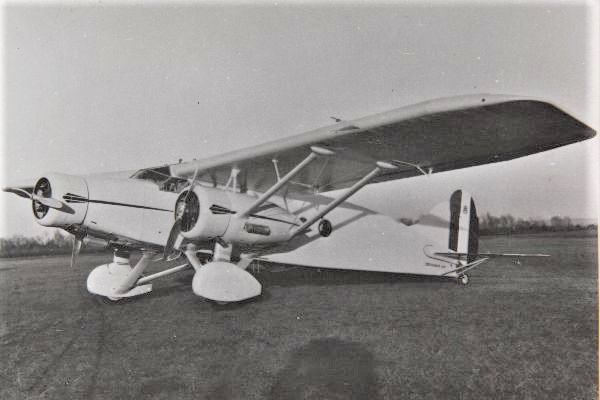
The Caproni Ca.133 was a three-engined, high-wing monoplane developed by the Società Italiana Caproni in the mid-1930s. It was personally designed under the leadership of the company's founder, Giovanni Battista "Gianni" Caproni, and is historically significant as the last aircraft he personally designed. The aircraft evolved from earlier colonial designs, specifically developing from the 1930 Ca.101 and combining the fuselage of the Ca.111 with three Piaggio P.VII engines. The first prototype, registered as MM.283, flew in 1934 at Caproni's Taliedo works in Milan.
Series production began in December 1935 and continued until April 1937. Total production is estimated at approximately 416 to 417 aircraft, including the prototype and various sub-types. These included the baseline bomber/transport, the Ca.133S ambulance variant, and the Ca.133T troop transport, the latter of which was capable of carrying 18 fully equipped soldiers. The aircraft was powered by three 7-cylinder, single-row, air-cooled Piaggio P.VII radial engines (variants C.15 or C.16), producing between 435 hp and 475 hp each, driving two-blade variable-pitch propellers.
Designed specifically for colonial operations, the Ca.133 became the primary bomber for the Regia Aeronautica during the Second Italo-Ethiopian War (1935–1936). While more advanced bombers like the Fiat BR.20 were reserved, the Ca.133 was deployed in large numbers to East Africa, with the 14° Stormo receiving deliveries on December 31, 1935. During this campaign, it operated from bases such as Gura and Kufra Airfield, the latter expanded under Captain Aldo Ramondino. The bomber configuration could carry up to 1,200 kg of bombs in internal bays and external racks, defended by four 7.7 mm machine guns (either Lewis or Breda-SAFAT).
By the start of the Second World War on June 10, 1940, over 250 Ca.133s remained in service. Although obsolete as front-line bombers, they served extensively in the Balkans, Greece, and on the Eastern Front as cargo transports, medical evacuation aircraft, and paratroop trainers. Due to its robust construction and low operating costs, the Ca.133 remained in non-frontline service until approximately 1948. Technically, the aircraft featured a wingspan of 21.44 m, a maximum take-off weight of 6,500 kg, and a maximum speed of 260 km/h with a service ceiling of 6,500 m.