
Development and Design Philosophy
Claudius Dornier Jr. conceived the CD-2 Seastar in the early 1980s as a modernized interpretation of his grandfather's legendary flying boat designs from the 1920s and 1930s. The project aimed to combine the proven parasol-wing, push-pull configuration of aircraft like the Dornier Do J Wal with contemporary composite materials and turboprop propulsion. Development began with clear objectives: create a low-drag amphibious aircraft suitable for private owners, regional airlines, and search-and-rescue operations while incorporating corrosion-resistant composite construction throughout.
The first proof-of-concept prototype took to the air on 17 August 1984 from Hamburg, utilizing recycled metal wings from a Dornier Do 28 to accelerate testing. This initial aircraft validated the basic design concept, leading to construction of a second prototype featuring purpose-built composite wings that flew on 24 April 1987 from Oberpfaffenhofen. By 1991, three prototypes had been completed, with the Seastar achieving European certification in 1990 and United States certification in 1991, making it the first all-composite commercial aircraft to reach this milestone.
Technical Innovation and Performance
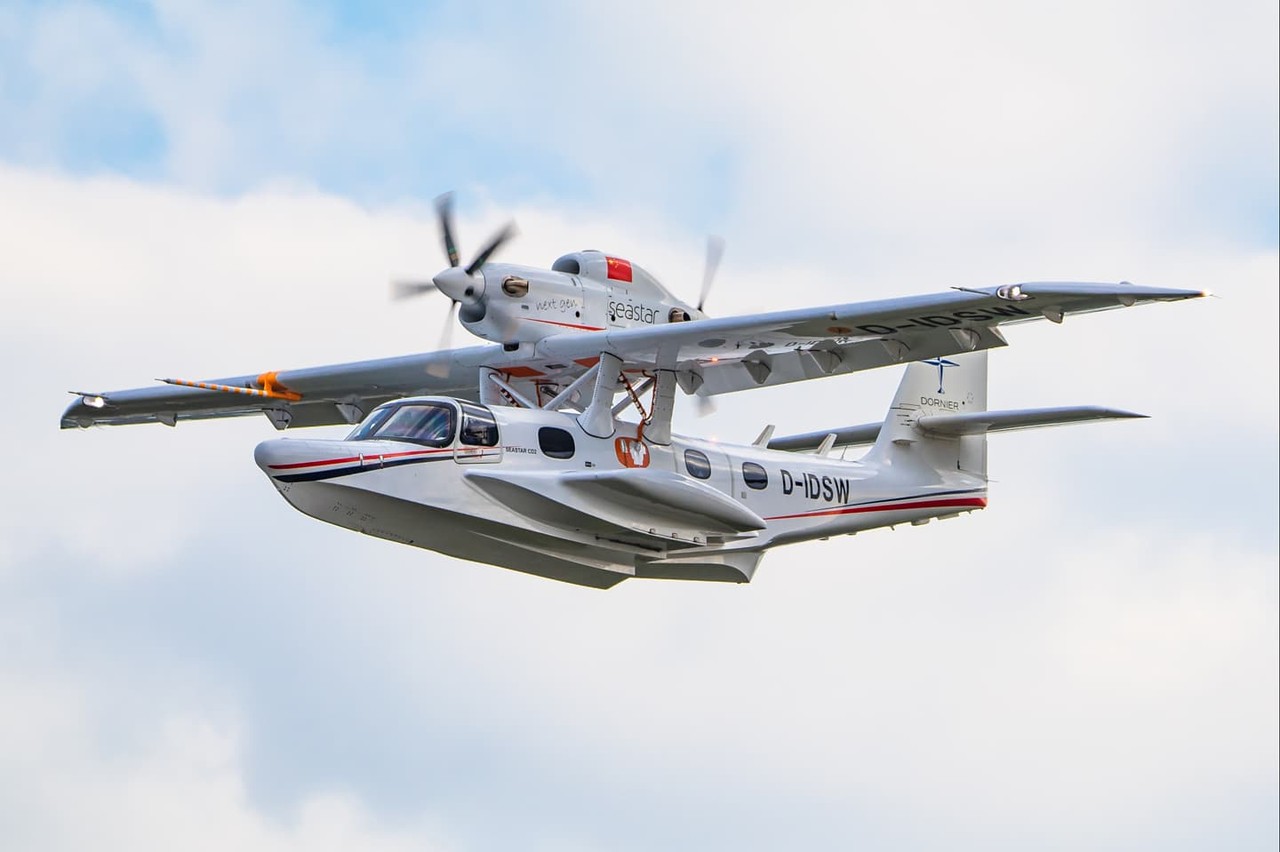
The Seastar's design incorporated several notable innovations beyond its composite construction. Twin Pratt & Whitney Canada PT6A-112 turboprops mounted in a single nacelle above the parasol wing provided 180-knot cruise performance while maintaining the clean aerodynamic lines essential for efficient amphibious operations. The integrated hull design minimized drag compared to conventional floatplane configurations, enabling takeoff runs of 2,500 feet from water and 1,850 feet from prepared runways.
The new-generation prototype that emerged in 2017 featured significant updates including more powerful PT6A-135A engines, five-blade composite propellers, Honeywell Primus glass cockpit avionics, and accommodation for 9-12 passengers. Additional modern amenities included air conditioning, a stern thruster for water maneuvering, and Sumitomo landing gear systems. The updated SN1003 prototype completed its maiden flight on 28 March 2020, demonstrating the continued viability of the design after more than three decades of intermittent development.
The Dornier Legacy
The Seastar project represented the third generation of Dornier involvement in aviation, tracing its lineage to Claudius Dornier Sr., who founded Dornier Metallbauten in 1914 after working with Count Zeppelin. The original Dornier company produced more than 100 aircraft designs and over 10,000 airplanes, including more than 1,000 seaplanes, while pioneering all-metal aircraft construction. This rich heritage provided both inspiration and technical foundation for the modern Seastar development.
However, the ambitious project faced continuous financial challenges. The original Claudius Dornier Aircraft company went bankrupt, followed by successor Dornier Composite Aircraft. Conrado Dornier, son of Claudius Dornier Jr., subsequently established Dornier Seawings AG to continue development. In recent years, the company became a joint venture with Chinese state-owned firms Wuxi Industry Development Group Co., Ltd., and Wuxi Communications Industry Group Co., Ltd., securing €150 million in funding for renewed production attempts.
Production Struggles and Market Reality
Despite multiple production announcements spanning four decades, the Seastar never achieved commercial manufacturing success. Planned production facilities were proposed for various locations including the United States in 2008, St.-Jean-sur-Richelieu or North Bay in Canada during 2009-2010, Oberpfaffenhofen in Germany, and Wuxi in China. The most serious attempt occurred in October 2009 with plans for first aircraft rollout by end of 2011 and eventual production rates reaching 50 aircraft annually.
Market studies projected demand for 300-500 Seastars over a 10-12 year period, and by 2009 the company claimed more than 25 letters of intent from potential customers. However, these expressions of interest never converted to firm orders, reflecting the challenging economics of specialized amphibious aircraft and the limited market for such expensive, niche vehicles. The absence of established airline operators or commercial service routes further complicated efforts to demonstrate market viability.
Current Status and Future Prospects
Today, no Seastar aircraft operate in commercial service, with only the various prototypes representing the program's four-decade development effort. The successful 2020 first flight of the new-generation prototype demonstrated that Dornier Seawings maintains technical capability to produce the aircraft, supported by Chinese investment and modern manufacturing techniques. However, the company faces the same fundamental market challenges that prevented earlier production attempts.
The Seastar's legacy lies primarily in its technical achievements rather than operational success. As the first certified all-composite commercial aircraft, it pioneered construction techniques that became standard throughout the industry. The design also proved that traditional flying boat configurations could incorporate modern systems and materials while maintaining the versatility that made amphibious aircraft valuable for specialized missions. Whether this innovation will ever translate into series production remains an open question after nearly 40 years of development.