
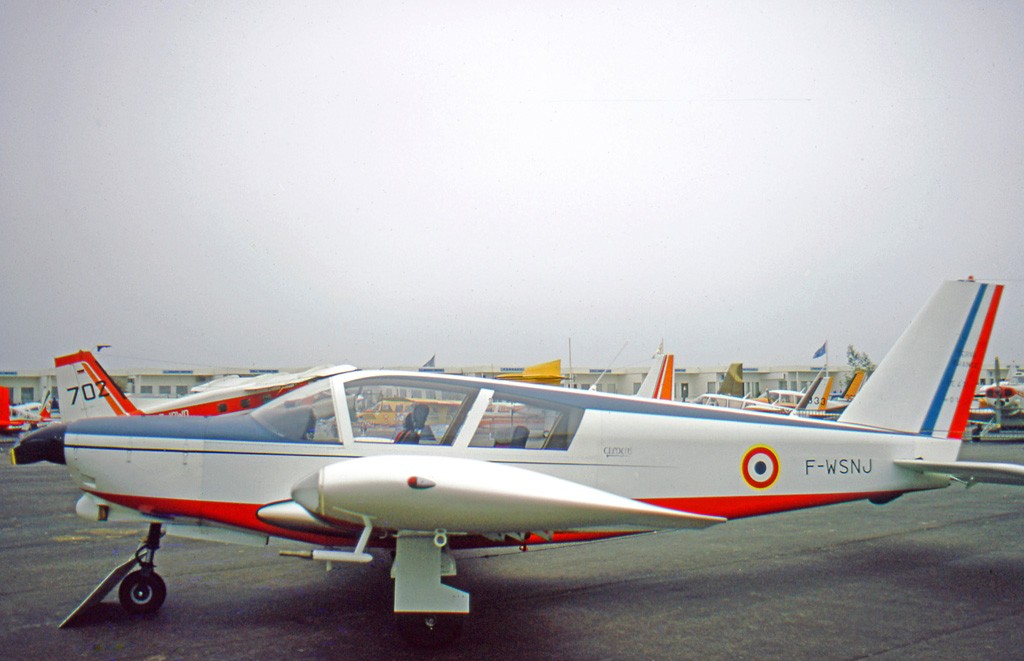
Military Service Dominance
The French Air Force recognized the Guépard's potential early, purchasing 18 of the 43 aircraft produced for training and liaison duties. The Armée de l'Air operated these aircraft through the AIA (Atelier Industriel de l'Aéronautique), where they served as reliable training platforms for military pilots transitioning to more complex aircraft. This military adoption represented the majority of the aircraft's operational success, as the French military appreciated the Guépard's predictable handling characteristics and robust American-standard construction.
The Manufacturer's Rise and Fall
Wassmer, the original designer, had established itself as France's most renowned glider manufacturer since opening its design department in 1955. The company, founded in 1905 as an aircraft repair organization, possessed extensive experience in creating aircraft with excellent handling qualities. For the CE-43 project, Wassmer partnered with Siren SA, an engineering company, to form CERVA (Consortium Européen de Réalisation et de Vente d'Avions) specifically to manufacture the all-metal version of their earlier fabric-and-plywood WA.4/21 design.
The ambitious project represented a significant departure from Wassmer's traditional glider expertise, as the company attempted to create what industry observers called "France's Bonanza killer." However, financial instability plagued the venture from the beginning, and Wassmer's bankruptcy in September 1977 ended all production permanently, making the company defunct after more than 70 years in aviation.
Engine and Technical Innovation
The Guépard's heart was the proven Lycoming IO-540-C4B5, a fuel-injected, horizontally-opposed six-cylinder engine producing 250 horsepower. This American powerplant choice reflected the designers' commitment to international standards and reliability. The engine drove the aircraft to a maximum speed of 320 kilometers per hour at a service ceiling of 17,060 feet, with an impressive range of 1,802 miles.
Two variants attempted to expand the line's appeal: the CE-44 Couguar featured a 285-horsepower Continental Tiara six-cylinder engine, while the CE-45 Léopard was designed around a turbocharged 310-horsepower Lycoming TIO-540. The Continental Tiara proved problematic despite its theoretical efficiency, running at up to 4,500 RPM but consuming excessive fuel and requiring expensive maintenance. Only a handful of CE-44s were completed in 1976, and the CE-45 apparently never flew.
Pilot Experience
Pilots appreciated the Guépard's handling characteristics, which benefited from Wassmer's extensive glider-building experience. The aircraft offered predictable flight behavior and what contemporary reports described as "pleasant" control responses. With an empty weight of 1,863 pounds and a maximum takeoff weight of 3,527 pounds, the single-pilot aircraft provided substantial payload capacity for its class.
The seven-hour endurance capability set the Guépard apart from many competitors, allowing extended cross-country flights without fuel stops. This performance made it particularly valuable for the military liaison role, where range and reliability were paramount considerations.
Production Challenges and Commercial Reality
Despite producing only 43 aircraft between 1973 and 1976, the Guépard faced insurmountable market challenges. American manufacturers Beechcraft, Cessna, and Piper dominated the international touring aircraft market with established dealer networks, parts availability, and proven track records. The French aircraft, while technically competent, couldn't overcome these commercial disadvantages.
The limited production run of exactly 43 aircraft makes the Guépard one of the rarer aircraft types in aviation history. Each aircraft represented a significant investment in French aviation independence, but the market realities of competing against established American manufacturers proved overwhelming.
Legacy and Current Status
The CE-43 Guépard stands as a testament to French ambition in general aviation during the 1970s, representing the country's most serious attempt to break American dominance in the touring aircraft market. While the project ultimately failed commercially, it demonstrated that European manufacturers could produce aircraft meeting international design standards and performance expectations.
Today, the surviving Guépards remain rare sights at airports worldwide. The aircraft's brief production run and the manufacturer's subsequent bankruptcy have made parts availability challenging, though some examples continue to fly in private hands. The type serves as a reminder of the ambitious but ultimately unsuccessful European attempts to challenge American supremacy in the light aircraft market during aviation's golden age of general aviation expansion.