
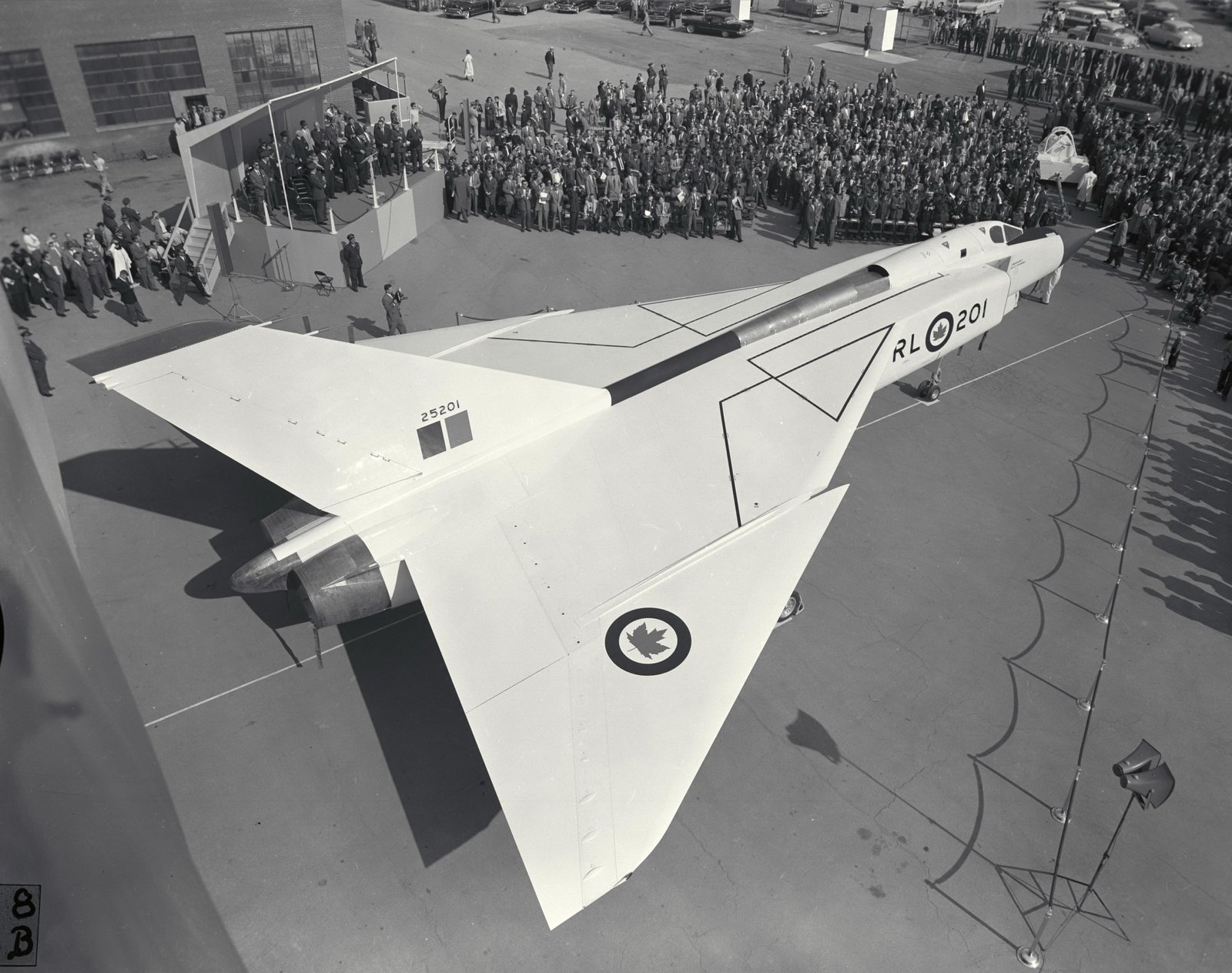
The Avro Canada CF-105 Arrow was a twin-engine, all-weather supersonic interceptor developed during the 1950s for the Royal Canadian Air Force (RCAF). Conceived as a replacement for the CF-100 Canuck, the Arrow was intended to serve as Canada's primary long-range interceptor to counter jet-powered Soviet bombers approaching via the Arctic. Design studies for the aircraft began in 1953, with serious development of the final configuration starting around March 1955. The project was led by U.K.-born chief engineer James Charles Floyd and featured the contributions of Polish-born test pilot Janusz Zurakowski.
Technologically, the CF-105 was a masterpiece of its era. It featured a large, thin delta wing optimized for stability and high-speed flight, and it is recognized as the first production aircraft to utilize a fly-by-wire flight control system and computerized controls. The aircraft was designed to reach speeds of approximately Mach 2 at altitudes exceeding 50,000 feet. The first prototype, RL-201, made its maiden flight on 25 March 1958, operating out of Avro Canada's plant at Malton Airport in Malton, Ontario.
The program produced two distinct versions. The Arrow Mk 1 (RL-201 through RL-204) utilized Pratt & Whitney J75 twin-spool axial-flow turbojets. The Arrow Mk 2 was designed for production and featured the Orenda PS-13 Iroquois axial-flow turbojets, developed by Orenda Engines. Each Iroquois engine provided 26,000 lb of static thrust with afterburner. While the Mk 2 prototype RL-206 was prepared for taxi testing and RCAF acceptance trials, no Iroquois-powered Arrow ever flew.
Despite its technical promise, the program was abruptly cancelled on 20 February 1959, a date known as "Black Friday." Only five aircraft were completed before the cancellation. Following the government's order, all completed aircraft, equipment, and documentation were destroyed. No complete airframes survive today, though the Canada Aviation and Space Museum in Ottawa holds a nose cone section. Additionally, the Raise the Arrow project has recovered a Delta Test Vehicle and four of the nine 1/8-scale rocket-boosted models previously lost in Lake Ontario. The cancellation led to the winding down of Avro Canada's aircraft operations and remains a controversial event in Canadian history.