
Early Development and Innovation
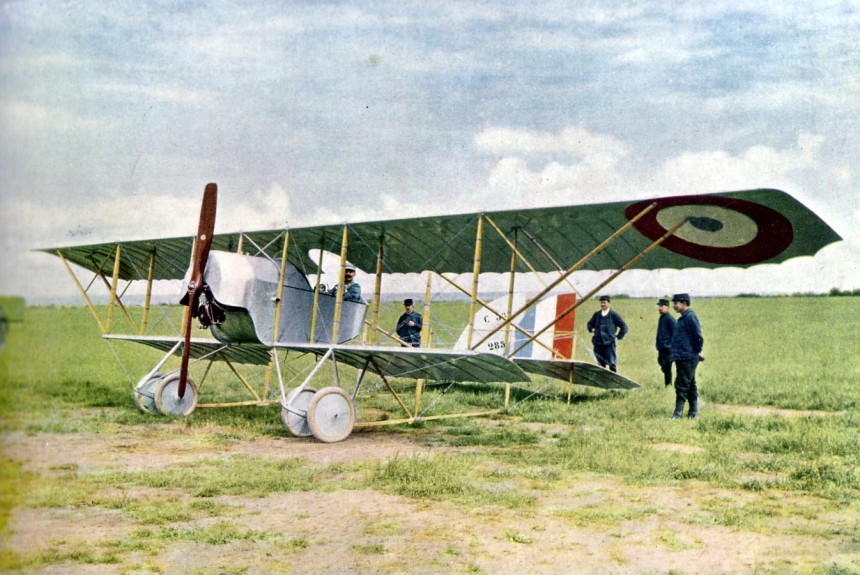
René and Gaston Caudron developed the G.3 in 1913 as an evolution of their earlier G.2 model, specifically designed for military reconnaissance missions. The brothers tested their creation at their Le Crotoy aerodrome, where the aircraft demonstrated exceptional stability and climbing performance that would make it highly sought after by military forces. The G.3's pusher configuration placed the engine behind the crew nacelle, providing unobstructed forward visibility crucial for reconnaissance work.
The aircraft incorporated several innovative features that set it apart from contemporary designs. Its unstaggered biplane wings and unique pusher layout made it remarkably stable and forgiving to fly, earning it recognition as one of the most controllable wing-warping aeroplanes of its era. Later production variants replaced wing warping with conventional ailerons, allowing for stronger wing construction and improved control authority.
Wartime Service and Global Adoption
When World War I erupted, the G.3 quickly entered service with the French Aéronautique Militaire, equipping Escadrille C.11 at the conflict's outbreak. The aircraft's excellent handling characteristics and reliability led to rapid international adoption, with the British Royal Flying Corps, Royal Naval Air Service, and Italian air forces all operating the type. The Caudron brothers' patriotic decision to waive licensing fees accelerated this widespread adoption.
Despite its popularity, the G.3's limitations became apparent as the war progressed. Its lack of armament and relatively modest performance led to its withdrawal from front-line reconnaissance duties by mid-1916. However, the aircraft found new life in training roles, where its forgiving flight characteristics proved invaluable for instructing new pilots. The type continued serving as a trainer well into the 1920s and beyond.
Record-Breaking Achievements
The G.3 became associated with numerous aviation milestones and daring pilots. Adrienne Bolland, a French test pilot for Caudron, achieved the first crossing of the Andes by a woman on April 1, 1921, flying a G.3 between Argentina and Chile. She also earned distinction as the first pilot to perform a loop in a biplane. Jules Védrines accomplished perhaps the most audacious G.3 feat, landing on the 28-by-12-meter roof of Paris's Galeries Lafayette department store on January 19, 1919.
The aircraft also pioneered commercial aviation applications. François Durafour, a Swiss aviation pioneer, operated the first commercial airmail flight between Paris and Geneva in 1919, completing the journey in four and a half hours. The G.3 achieved another first when it became the initial aircraft to fly from a French warship on May 7, 1914.
The Caudron Legacy
Caudron Frères, established in 1909, built their reputation on the G.3's success. The company operated its own flying school as early as 1910 and became internationally recognized for sports and training aircraft. During World War II, the company was renamed Caudron-Renault and produced both German designs and original aircraft until Allied bombing destroyed their factory in September 1943. The French government nationalized Caudron in 1944, merging it into SNCAC (Société Nationale de Construction Aéronautique du Centre).
Extended Service Life
The G.3's service life extended far beyond World War I. Portugal's Army Military Aeronautical Service adopted it as their primary trainer, with the Portuguese Parque de Material Aeronáutico building 50 new examples between 1922 and 1924. Even more remarkably, Chinese Fengtian clique warlords operated G.3s until the Mukden Incident of 1931, when Japanese forces captured many remaining aircraft.
Modern Preservation and Replicas
Today, the G.3's legacy lives on through museum displays and flying replicas. The RAF Museum in London houses a 1913-built example on static display, while the Airspace Museum in Rio de Janeiro maintains another original aircraft. Cole Palen constructed a notable reproduction at Old Rhinebeck Aerodrome, building it around an original 80-horsepower Le Rhône rotary engine using plans acquired from the Musée de L'Air in Paris. This replica, painted in Italian colors and markings, was featured in the "First Flights" television documentary hosted by Neil Armstrong.
Technical Specifications and Performance
The G.3's 80-horsepower Le Rhône rotary engine provided adequate power for its reconnaissance and training missions. The aircraft's wooden frame construction with fabric covering represented standard practice for the era, while its pusher configuration eliminated propeller-related visibility restrictions. The type's exceptional climb rate and stability made it particularly suitable for operations in mountainous terrain, giving it advantages over many contemporary designs.
With total production exceeding 2,800 aircraft across multiple nations, the Caudron G.3 stands as one of the most successful early military aircraft designs, bridging the gap between pioneering aviation and the more sophisticated fighters and reconnaissance planes that would dominate later stages of World War I.